How to Choose the Best Prop Firm For Beginners
Find the best prop firm for beginners with Goat Funded Futures' expert guide. Compare top firms, funding options, and trading requirements to start your career.
Breaking into futures trading feels impossible when faced with dozens of prop firms, each promising the perfect path to funded trading. New traders navigate a maze of evaluation rules, profit splits, drawdown limits, and fee structures that can drain savings before they even start. Choosing the best prop firm for beginners requires focusing on what actually matters: fair evaluation challenges, reasonable costs, and genuine support for developing trading skills.
The right firm removes unnecessary barriers while still teaching proper risk management principles. Quality prop firms provide genuine guidance rather than just collecting fees, giving beginners the breathing room they need to learn without destructive pressure. Traders seeking this supportive approach should consider partnering with an established futures prop firm that prioritizes trader development.
Table of Contents
Summary
Most beginners fail prop firm evaluations because they choose based on account size and challenge cost rather than on the rule's compatibility with their skill level. Two firms might both advertise $50,000 accounts with 80% profit splits, but one uses trailing drawdowns while the other enforces static limits, and those structural differences determine whether your trading style can survive their evaluation. The firms with the most impressive marketing often have the most restrictive rules buried in documentation that most traders skim rather than study.
Evaluation fees compound faster than new traders expect, with three failed attempts across different providers costing $400 to $600 without ever reaching funded status. The psychological damage runs deeper than the financial loss, making traders question their strategy and discipline when the actual problem was the choice of an evaluation structure that never matched their experience level. According to research in the Journal of Finance, individual investors underperform market benchmarks primarily because of behavioral mistakes such as excessive trading and poor position sizing, not flawed market forecasts, and the same pattern appears in prop trading evaluations.
Low-priced challenges frequently attach aggressive drawdown limits, strict consistency requirements, or trading restrictions that eliminate strategies that beginners rely on, making the total cost of repeated failures exceed any initial savings. A $99 challenge that you fail three times costs more than a $199 challenge with transparent rules you can actually pass. The evaluation fee matters far less than whether the rules allow your trading style to survive long enough to demonstrate profitability.
Account size creates the appearance of opportunity, but the drawdown limit determines how much flexibility you actually have during an evaluation. Large accounts paired with restrictive drawdown rules create a mismatch between what the marketing suggests and what traders can realistically execute, causing beginners to take positions sized for a $100,000 account while operating under risk constraints that demand the caution of a $25,000 account. Credit Karma reports that nearly half of Americans say their finances worsened in 2025, often due to decisions made without fully understanding the constraints they were operating under.
The EOD drawdown structure evaluates risk at the end of each trading day rather than tracking it continuously throughout the session, eliminating the confusion of watching moving thresholds adjust with every price fluctuation. For traders still learning position sizing and risk calculation, this approach removes friction points that cause violations unrelated to actual trading ability. Firms that eliminate activation fees, remove consistency rules from evaluations, and allow holding trades during news events signal a different philosophy focused on transparent rules rather than complexity that increases failure rates.
Goat Funded Futures addresses common beginner challenges by offering multiple funding pathways (EOD, Sprint, Instant Funded, and Pro programs) with transparent one-time fees, no activation charges on EOD plans, and 100% profit share on the first $10,000 earned, giving new traders flexibility to match evaluation structures with their actual skill development stage.
Why Beginners Often Struggle to Choose a Prop Firm
The challenge isn't finding a futures prop firm—it's understanding which structure won't punish you for being new. Most beginners compare the wrong things, focusing on advertised metrics like account sizes and profit splits while overlooking drawdown rules, consistency requirements, and hidden restrictions that cause most failures.

🎯 Key Point: The real evaluation criteria for prop firms aren't the flashy numbers in their marketing—they're the risk management rules and evaluation structure that determine whether you'll actually pass their challenges.
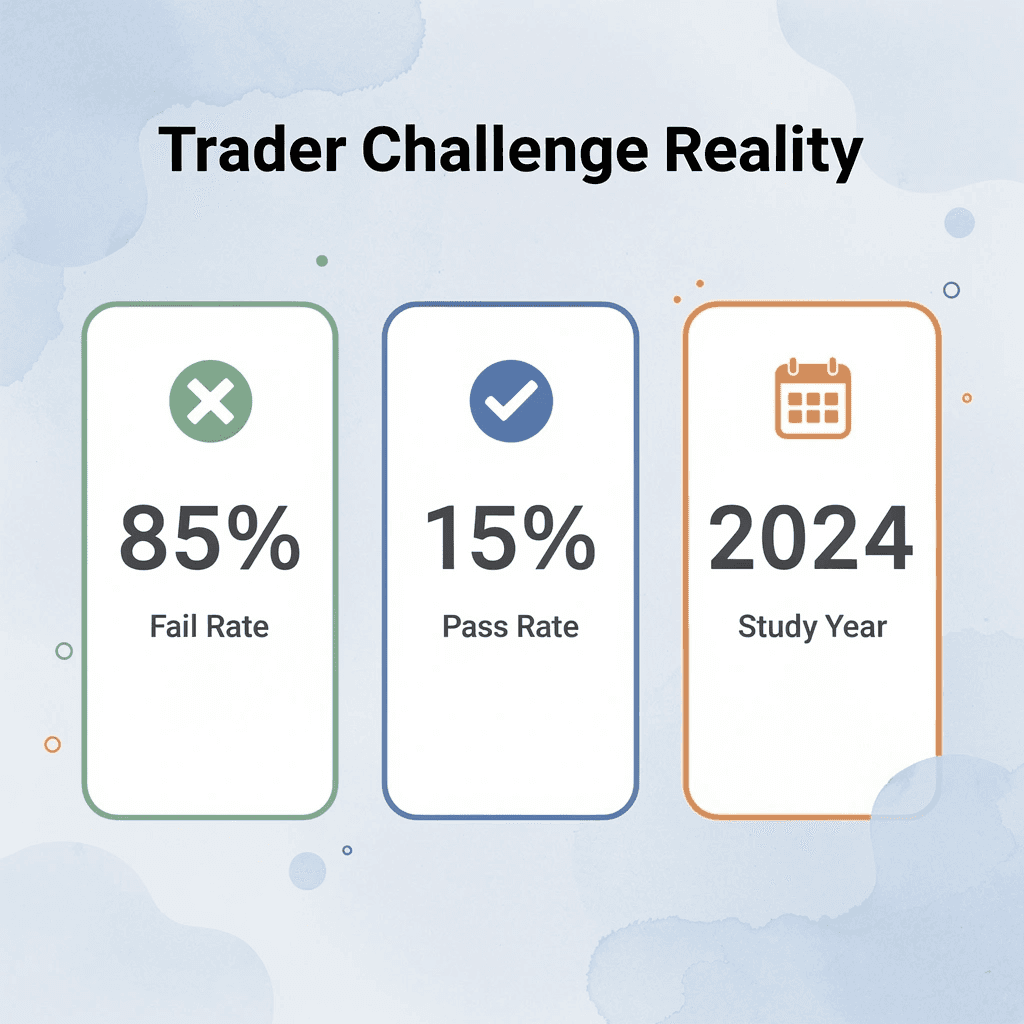
"85% of traders fail prop firm challenges not due to lack of skill, but because they choose firms with evaluation criteria that don't match their current trading experience level." — Prop Trading Research, 2024

⚠️ Warning: Advertised profit splits and large account sizes mean nothing if the drawdown limits and daily loss rules are designed for experienced traders who can maintain consistent profitability from day one.
What Beginners Focus On | What Actually Matters |
|---|---|
Account size ($100K vs $50K) | Drawdown tolerance (5% vs 8%) |
Profit split (80% vs 70%) | Consistency requirements (daily vs monthly) |
Challenge cost ($150 vs $200) | Reset policies and second chances |
Why does the prop trading market create confusion for beginners?
According to For Traders, prop trading reached a $12 billion market in 2025. Growth brought competition that created confusion: every firm now markets similar promises—large accounts, high profit splits, trader-friendly policies—yet uses nearly identical language to describe fundamentally different evaluation structures. A beginner researching options encounters dozens of providers with no clear way to distinguish between them.
How do surface similarities hide critical trading differences?
Surface-level similarities hide critical differences. Two firms might both offer $50,000 accounts with 80% profit splits, but one uses trailing drawdowns while the other uses static limits. One allows holding trades through news events; the other forbids it. One requires a minimum number of trading days; the other doesn't. These differences determine whether your trading style can survive their evaluation, yet they're buried in rule documents most people skim rather than study.
Why does too much information hurt beginners?
Search for prop firm reviews, and you'll find thousands of opinions, comparison charts, YouTube breakdowns, and Discord debates. Some sources emphasize low challenge fees, others prioritize fast funding timelines, and a few focus on payout reliability. Most content compares features without helping beginners match rules to their actual skill level.
What mistakes do overwhelmed traders make?
This overload triggers two common mistakes. Some traders fall into analysis paralysis, endlessly comparing firms without feeling confident enough to choose one. Others rush into a challenge because a promotional discount creates urgency, only to discover the evaluation structure conflicts with their trading style. Both paths waste money and erode confidence before real learning begins.
The Real Cost of Choosing Wrong
Evaluation fees add up fast. Three attempts across different providers cost $400–$600 without reaching funded status. Beyond the money lost, repeated failures damage confidence in your strategy and discipline, even when the real problem was choosing an evaluation structure that was mismatched to your experience level. Platforms like Goat Funded Futures remove the complexity that causes failures among beginners. Our evaluations eliminate consistency rules, allow holding trades during news events, and start at $69, letting new traders focus on learning risk management instead of navigating restrictions designed for advanced traders.
Why do beginners focus on the wrong metrics when choosing prop firms?
Most beginners compare account size and profit split percentage as if those numbers determine success. What matters is whether the drawdown structure, minimum trading requirements, and risk rules allow your current skill level to survive long enough to demonstrate profitability. A smaller account with forgiving rules beats a larger account with restrictions that guarantee failure for inexperienced traders.
What happens when beginners choose based on appealing numbers?
Few beginners understand this until after they have failed multiple evaluations. Firms that advertise the largest accounts and highest splits attract the most attention, regardless of whether their evaluation structures help or hurt new traders. Beginners choose based on appealing numbers, discover the rules don't match their abilities, and either quit or spend months cycling through expensive challenges before understanding what they should have prioritized. The real question isn't which firm to choose, but why beginners keep making the same expensive mistake about what makes a challenge worth attempting.
The Costly Belief That Cheap Challenges and Big Accounts Matter Most
A beginner opens five browser tabs, compares challenge fees and account sizes, then picks the firm offering the largest account for the lowest price. This approach assumes the most visible features are also the most important ones—an assumption that costs traders more than the evaluation fee ever could.

⚠️ Warning: Focusing solely on account size and low fees is like buying a car based on horsepower and price while ignoring the engine reliability. The cheapest option often becomes the most expensive mistake.
"Price-focused decisions in trading evaluations lead to higher failure rates and repeated attempts, making the 'cheapest' option the most costly in the long run." — Trading Psychology Research, 2023
🎯 Key Point: The real cost isn't the upfront fee—it's the time wasted, confidence lost, and opportunities missed when you choose a firm that doesn't support your trading success.
Why cheap evaluations often become expensive lessons
A $99 challenge looks better than a $199 challenge until you fail it three times. The total cost of repeated failures quickly exceeds any initial savings. According to Bank of America's 2025 Better Money Habits® financial education study, 72% of young adults take action to improve their financial health, but taking action without understanding the underlying structure often leads to predictable setbacks.
Low-priced challenges frequently come with restrictive rules that make passing harder: aggressive drawdown limits, strict consistency requirements, or trading restrictions that eliminate strategies beginners rely on. Traders choose based on price, discover the evaluation structure doesn't match their abilities, fail, then move to another cheap option, hoping for different results.
Each attempt reinforces the same lesson: the evaluation fee matters far less than whether the rules allow your trading style to survive long enough to succeed. A more expensive challenge with transparent rules and realistic risk parameters often costs less over time than multiple attempts at discounted evaluations designed to be difficult to pass.
What creates the illusion of buying power in prop firm accounts?
A $100,000 account sounds impressive until you realize your actual risk budget is $2,000. Account size creates the illusion of more opportunities, but the drawdown limit determines your flexibility. If a firm advertises a large account with a small maximum loss threshold, the practical difference between that account and a smaller one becomes negligible. Both end your challenge the moment you breach the limit.
Why do beginners struggle with position sizing in large accounts?
Beginners often lack experience with position sizing to manage tight risk parameters effectively. They see six figures and imagine substantial buying power, then discover they're operating within the same narrow margin for error as a much smaller account. Large accounts paired with restrictive drawdown rules create a mismatch between marketing claims and what traders can realistically execute. Traders size positions for a $100,000 account while operating under risk constraints that demand the caution of a $25,000 account.
What matters more than account size for trading success?
Most traders fail not because they lack capital, but because they break risk rules before their strategy has a chance to work. Credit Karma reports that nearly half of Americans say their finances worsened in 2025, often due to choices made without understanding their constraints. Understanding how the system works matters more than accessing the largest advertised capital.
What should beginners prioritize instead?
The companies that help beginners succeed most consistently aren't the cheapest or largest: they're the ones that remove unnecessary complexity. No hidden consistency rules. No restrictions on holding trades during news events. Clear drawdown structures that don't require a risk management degree to understand.
These features don't appear in comparison charts, but they determine whether a trader can focus on executing their strategy or constantly second-guess unclear rules. Our evaluation program at Goat Funded Futures eliminates consistency requirements during evaluations and allows traders to hold positions during news, reducing friction points that cause beginners to fail for reasons unrelated to their trading ability.
Which questions should beginners ask when choosing a prop firm?
Instead of asking which firm offers the biggest account or the lowest fee, successful beginners ask which firm's structure matches their current skill level. Can they realistically manage the drawdown limits? Are the rules simple enough to follow while learning? Does the evaluation structure reward disciplined trading or punish normal learning curves? These questions lead to better decisions than comparing advertised features. But knowing what matters and evaluating it are two different challenges.
Related Reading
What to Look for in the Best Prop Firm for Beginners
Evaluation should center on how a firm's structure supports your ability to survive the challenge, not on final account size. The most beginner-friendly prop firms offer transparent risk rules, realistic profit targets, accessible funding paths, and support systems that help you learn rather than punish inexperience.

🎯 Key Point: Focus on survival factors rather than maximum account sizes when choosing your first prop firm. The best firms for beginners prioritize education and gradual skill development over aggressive profit requirements.
"The most successful beginner traders choose prop firms based on learning support and realistic expectations, not maximum profit potential." — Trading Psychology Research, 2024
💡 Tip: Look for firms that offer extended evaluation periods, educational resources, and mentorship programs. These features are far more valuable than large account sizes when you're starting your prop trading journey.
Risk Rules You Can Actually Follow
The critical difference between firms is not how strict the rules are, but how clearly they're explained and how consistently they're applied. Some prop firms use multiple drawdown types (end-of-day, trailing, static) with different calculation methods for each, or add consistency requirements that disqualify winning trades if they exceed a certain percentage of total profits. These structures create confusion that leads to violations.
How can you identify firms with clear risk documentation?
Look for companies that use simple drawdown structures with clear documentation. If you need to read the rules three times to understand when your account gets violated, that's a warning sign. The best beginner-focused companies explain their risk parameters in plain language, provide visual examples of how drawdowns are calculated, and offer tools that show your current risk status in real time.
When a company eliminates activation fees, removes consistency rules from evaluations, and allows trades during news events, it signals a different philosophy: transparent rules and reduced friction help more traders succeed rather than relying on complexity to increase failure rates. Platforms like Goat Funded Futures have built their entire structure around this approach, starting evaluations at $69 with no hidden requirements that disqualify otherwise profitable trading.
Funding Paths That Match Your Experience Level
Not every trader should start with the same type of challenge. Some beginners benefit from instant funding options that skip evaluation entirely, while others need the structure of an evaluation to build discipline. Many firms offer only one path, forcing traders into a model misaligned with their learning style or risk tolerance.
What funding options should beginners consider?
Flexible prop firms offer multiple account sizes, different evaluation lengths, and alternative funding structures. A trader who struggles with time pressure might perform better in a longer evaluation period, while someone with strong risk management but limited capital might prefer instant funding with a smaller account. According to Best Proprietary Trading Firms for Beginners in 2025, 90% of traders fail within their first year, often because they choose evaluation structures misaligned with their actual trading behavior.
How can you ensure long-term growth potential?
Look for programs that offer clear pathways to larger accounts based on performance, not tenure or extra fees. A firm that caps account size after you reach funded status limits your earning potential.
Educational Support That Goes Beyond Marketing Content
Most prop firms publish blog posts and YouTube videos on trading psychology and risk management, but these differ from structured educational support tailored to their specific environment. The distinction appears in how firms explain their rules, answer traders' questions, and provide resources for common challenges.
What should quality educational support include?
Good educational support includes detailed documentation of rule violations with real trade examples, responsive customer service that answers questions before you place a trade, and transparent communication about policy changes. Some firms offer 24/7 support and reward systems that help traders stay engaged during the learning curve, while others provide only generic FAQs and slow email responses, leaving beginners uncertain about critical details.
How does educational quality affect trader success?
The quality of a company's educational resources is linked to how many traders it retains. Companies that invest in trader development tend to have lower evaluation failure rates, not because their rules are easier, but because traders understand what's expected before they risk capital.
What should you know about profit splits and payout timing?
Finishing a challenge is the start. Payment structures vary significantly: some companies offer 80% profit splits but delay payouts for weeks or require minimum withdrawals, while others pay faster with slightly lower splits for more regular income. World Business Outlook reports that top firms now offer 80% profit splits, but payout speed and ease of withdrawal matter more than the split percentage. A firm that pays within two business days and enforces penalties for missed deadlines demonstrates operational excellence, directly affecting your monthly earnings.
How do payout terms change as you scale up?
Look at how payout terms change as your business grows. Some firms lower your profit split when you move to bigger accounts, while others keep it the same or raise it based on consistency. Understanding these terms before you start trading helps you avoid frustration when you discover that the advertised split applies only to your first payout or to your smallest account size.
7 Prop Firms Beginners Should Consider
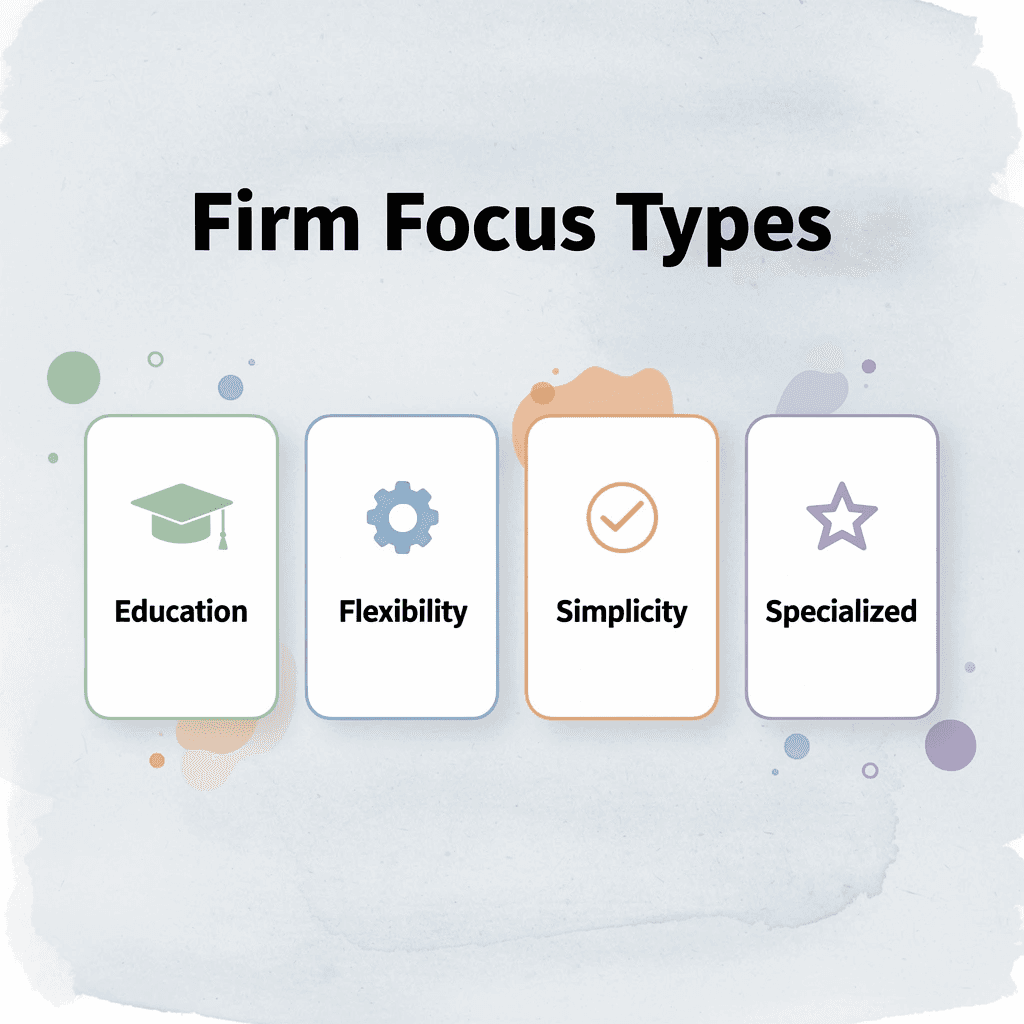
The firms below represent different approaches to trader funding: some emphasize flexibility in evaluation structures, others focus on education, simplicity, or market specialization. Choose based on your trading style, risk tolerance, and priorities.

🎯 Key Point: Each prop firm has a unique approach to trader evaluation and funding structures. Understanding these differences is essential for selecting the right fit for your trading goals.
"The most successful traders choose prop firms that align with their trading style and risk management approach, rather than simply chasing the highest profit splits." — Trading Industry Research, 2024

⚠️ Warning: Don't choose a prop firm based solely on profit percentages. Consider evaluation criteria, drawdown limits, trading rules, and support systems to find the best match for your skill level and trading approach.
Firm Focus | Best For | Key Advantage |
|---|---|---|
Education-Focused | New traders | Comprehensive training |
Flexibility-Focused | Experienced traders | Customizable rules |
Simplicity-Focused | All levels | Straightforward evaluation |
Market-Specialized | Niche traders | Specific market expertise |
1. Goat Funded Futures
Best fit: Beginners seeking multiple funding options and clear structures
New traders often discover after purchasing an evaluation that the drawdown model doesn't align with their risk management approach, or unexpected fees appear upon payout. Our Goat Funded Futures platform solves this by offering multiple pathways rather than requiring every trader to complete a single evaluation structure.
What funding programs does Goat Funded offer beginners?
The platform offers four programs: EOD Program, Sprint Program, Instant Funded Program, and Pro Program. The EOD Program uses an end-of-day drawdown structure, eliminating the need to recalculate moving risk thresholds throughout the trading day. According to DNA Funded, the standard profit split starts at 80% and can reach 90%. The platform eliminates activation fees on EOD plans, removes consistency rules during evaluations, and permits traders to hold positions during news events.
How does Goat Funded ensure transparency for new traders?
Extra benefits include 100% profit share on the first $10,000, transparent one-time fees, 24/7 support, and access to over 800 trading instruments. Goat Funded Futures provides clear documentation with visual examples showing how drawdown calculations work, what constitutes rule violations, and when payouts occur. This transparency helps new traders avoid costly misunderstandings about evaluation requirements. Ideal trader profile: New traders seeking flexibility, straightforward funding options, and manageable drawdown structures.
2. Topstep
Best fit: Structured trader development
Topstep is one of the longest-established futures prop firms, known for combining funding opportunities with trader education and risk management. The platform provides a clear path from evaluation to funded trading, along with educational content, performance tools, and a large trading community. Its focus on process and discipline appeals to beginners seeking a guided experience rather than complete freedom. Ideal trader profile: Beginners who value education, structure, and a well-defined progression system.
3. TradeDay
Best fit: Simple evaluation process
TradeDay appeals to traders who prefer straightforward evaluation models without excessive complexity. The platform emphasizes simplicity and transparency, offering clear evaluation objectives and funding requirements without complicated rule matrices. This benefits beginners learning prop firm environments who want to avoid unnecessary confusion. Ideal trader profile: new traders seeking a straightforward evaluation process and clear funding criteria.
4. Apex Trader Funding
Best fit: Account variety
Apex Trader Funding offers a wide selection of account sizes and evaluation options. The platform provides multiple configurations, allowing traders to choose structures that match their goals and risk tolerance, whether smaller accounts with lower fees or larger accounts with higher profit potential. Ideal trader profile: beginners seeking multiple account options and flexible funding paths.
5. Take Profit Trader
Best fit: Straightforward funding pathways
Take Profit Trader appeals to traders who value simplicity and transparency. The firm's funding model provides a direct path to funded trading without unnecessary complexity. The platform features clear evaluation requirements and funding progression, helping beginners focus on trading rather than interpreting complex rules or navigating hidden requirements. Ideal trader profile: Traders seeking a simplified evaluation process with straightforward requirements.
6. My Funded Futures
Best fit: Futures-focused traders
My Funded Futures focuses specifically on futures trading, appealing to traders seeking an environment built around futures markets. Its futures-only focus allows the platform to tailor programs, infrastructure, tools, support, and educational resources toward futures market dynamics rather than serving multiple asset classes. Ideal trader profile: new traders committed to learning and trading futures markets.
7. BluSky Trading
Best fit: Alternative funding structures
BluSky Trading offers funding models that differ from traditional prop firm approaches, appealing to traders seeking alternatives to standard evaluation structures. The platform provides flexibility through alternative funding pathways and risk frameworks, benefiting beginners who need customized approaches matching their learning curve. Ideal trader profile: beginners exploring different approaches to prop firm funding and evaluation. Each firm serves different types of traders, prioritizing education, flexibility, account variety, or alternative funding structures. Choosing a firm requires understanding which funding model matches your trading style.
Which Type of Prop Firm Is Right for a Beginner?
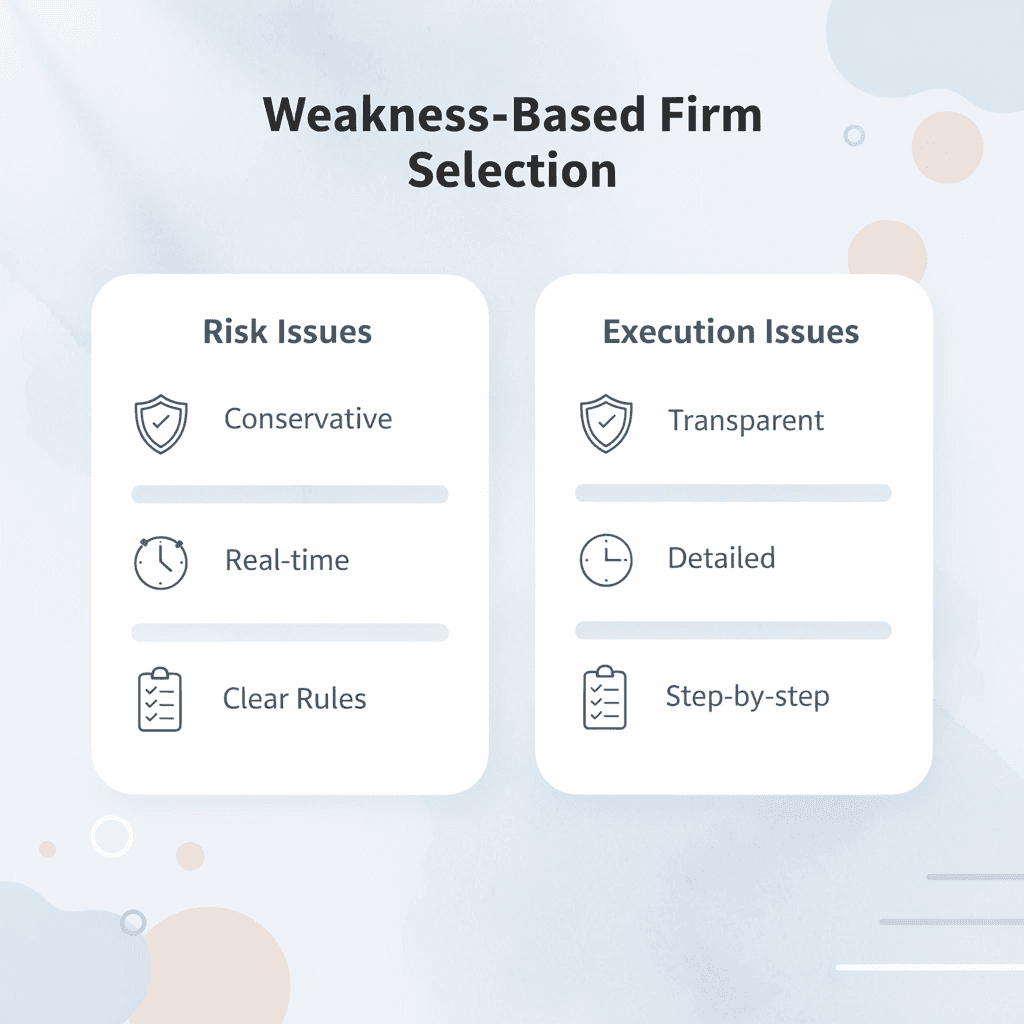
The right prop firm depends on what you're worst at, not what you're best at. If you struggle with risk management, choose firms with straightforward drawdown rules you can monitor in real time. If you're still learning execution discipline, prioritize transparent evaluation structures over large account sizes. If you've successfully traded personal accounts but have never navigated a funded environment, flexibility matters more than simplicity. Match the firm to your weakest skill, and you'll improve faster.
🎯 Key Point: Focus on your trading weaknesses when selecting a prop firm, not your strengths. This approach accelerates your development as a funded trader.

"The most successful prop traders choose firms that challenge their weakest areas, leading to faster skill development and higher pass rates during evaluation periods." — Prop Trading Industry Analysis, 2024
Your Weakness | Recommended Firm Type | Key Features to Look For |
|---|---|---|
Risk Management | Conservative evaluation | Real-time drawdown monitoring, clear risk rules |
Execution Discipline | Transparent structure | Detailed feedback, step-by-step evaluation |
Funded Environment | Flexible policies | Scaling options, adaptive rules |
⚠️ Warning: Many beginners make the mistake of choosing firms based on attractive account sizes or low fees, ignoring whether the firm's structure actually addresses their skill gaps.
Why do risk management failures end more evaluations than bad trades?
Risk management failures end more evaluations than bad market calls. According to research published in the Journal of Finance, individual investors underperform market benchmarks due to behavioral errors such as excessive trading and poor position sizing, rather than flawed forecasts. Beginners often know when to enter a trade but struggle with exit timing, position sizing, and recovering from losing streaks without violating drawdown limits.
How can you choose firms that make risk visible and manageable?
Pick firms that clearly show risk and help you manage it. Look for daily and maximum drawdown calculations you can understand, real-time account dashboards showing your remaining margin, and rules that don't penalize conservative trading. Some firms calculate drawdown from starting balance, others from high-water marks—this difference determines whether a small losing day becomes disqualifying. If the math feels confusing, the structure is wrong for you.
If You've Traded Successfully but Never Been Funded
Some beginners enter prop trading with real experience. They've managed personal accounts, tested strategies over months, and understand position sizing. Their challenge isn't learning to trade but adapting to evaluation constraints they've never faced.
For these traders, flexibility becomes the priority. Multiple evaluation pathways let you choose structures that align with your trading style. If you prefer holding positions overnight, avoid firms with strict intraday requirements. If you trade around economic releases, choose firms that allow news trading. If your strategy requires wider stops, find programs with drawdown limits that accommodate your risk parameters.
If Payout Structure Matters More Than Account Size
Some traders focus on making steady money over time instead of trying to grow their accounts quickly. For these traders, how much money they can take out matters more than how much money the account says it has.
The 2024 Charles Schwab Modern Wealth Survey found that investors prioritize building wealth over time rather than pursuing quick profits. A $50,000 account yielding 90% of profits with flexible withdrawals can outperform a $100,000 account offering only 70% of profits with strict withdrawal restrictions. When evaluating accounts, consider the profit share you retain, withdrawal frequency, minimum withdrawal amounts, and whether the company scales your account based on demonstrated trading performance.
If You Want to Skip Evaluations Entirely
Some traders with a proven track record from their own accounts, practice environments, or past funded account experience may find evaluation phases slow their progress.
How does instant funding work for experienced traders?
Instant funding programs skip this step completely. You pay a fee upfront, gain immediate access to money, and start trading with a live account that has no profit targets or time limits. The downside is higher starting costs and stricter risk rules. If you've finished learning, instant funding lets you focus on trading performance rather than proving skills you've already demonstrated elsewhere. If you're still developing your strategy, an evaluation program provides helpful feedback.
What should beginners consider when choosing a prop firm?
Most beginners choose firms based on what sounds impressive rather than what matches their current development stage. The best prop firm removes the specific obstacles preventing your progress now, which differ for a trader learning risk management versus someone seeking long-term payout optimization. Knowing which structure fits your needs matters only if you understand how that structure works in practice.
Related Reading
Why Beginners Choose Goat Funded Futures
Understanding rules matters more than money when starting out. Goat Funded Futures removes problems that cause most beginners to fail at other firms, offering multiple pathways for different experience levels and learning styles.

🎯 Key Point: Goat Funded Futures specifically designs its programs to eliminate the most common barriers that cause new traders to struggle with traditional prop firms.
"Understanding rules matters more than how much money you have when starting out." — Core principle for beginner success

💡 Tip: Focus on mastering the rules and risk management rather than worrying about your initial capital requirements when choosing a prop firm.
What is the EOD Program structure?
Risk management failures end more trading careers than bad strategies. A trader might execute profitable setups consistently yet still violate drawdown limits because they don't understand how the firm calculates risk thresholds during volatile sessions. The EOD Program evaluates drawdown at the end of each trading day rather than tracking it continuously throughout the session. This structure eliminates confusion from moving thresholds that adjust with every price fluctuation, letting you focus on trade execution and discipline without constantly monitoring intraday swings.
How does the EOD Program benefit beginners?
According to the Goat Funded Futures Detailed Review, the platform offers an 80% profit split with a simplified risk structure, providing beginners with clarity on their obligations and potential earnings.
The Sprint and Instant Funded Programs
The Sprint Program offers traders a flexible alternative to standard assessment models. The Instant Funded Program provides an even faster option for experienced traders seeking to skip lengthy evaluation periods. Research from Goat Funded Futures shows that traders can access up to $250,000 in funding through these pathways, giving beginners multiple choices as their skills develop.
Why do hidden fees destroy beginner trust?
Hidden fees destroy trust faster than failed evaluations. Many prop firms advertise low challenge costs but add activation fees, monthly platform charges, or mandatory buffer requirements that beginners discover only after paying for their first evaluation.
How does transparent pricing benefit new traders?
Goat Funded Futures removes activation fees on EOD plans and offers 100% profit share on the first $10,000 you earn. Clear pricing lets you calculate the exact investment needed to reach funded status without hidden charges. Most prop firms advertise account size and profit splits rather than the structures that help beginners succeed: clear rules, understandable risk calculations, multiple funding pathways, and transparent costs. Goat Funded Futures built its offering around these fundamentals instead of impressive numbers that matter less during your first six months of funded trading.
Start Trading Futures Today with our Futures Prop Firm
If you're searching for the best prop firm for beginners, focus on finding a funding model you can succeed with rather than the largest advertised account. Explore Goat Funded Futures and compare our EOD, Sprint, Instant Funded, and Pro programs to determine which structure fits your trading goals. Review the risk rules of any firm you're considering and understand how drawdown works before purchasing a challenge—this often determines whether you'll face repeated failures or achieve long-term progress.
🎯 Key Point: The right funding model matters more than account size when starting your prop trading journey.
"Success in prop trading comes from understanding risk management and choosing a program structure that matches your skill level, not chasing the biggest account balance." — Industry Analysis, 2024
💡 Pro Tip: Test your strategy with the drawdown limits and risk parameters of your chosen program before committing to a challenge.

Related Reading