Scalping Futures: A Beginner's Guide to Fast-Paced Futures Trading
Learn scalping futures strategies from Goat Funded Trader. Master fast-paced trading techniques, risk management, and profit optimization.

The futures market moves fast, and scalping is one of the most intense approaches to day trading. Traders make split-second decisions on tick charts, entering and exiting positions within seconds or minutes to capture small price movements that add up to significant profits. For traders working with futures prop firms, mastering scalping techniques is essential, as these firms provide the capital and leverage needed to make quick, high-frequency trades profitable. Success requires understanding order flow, market microstructure, and risk management in rapid-fire trading environments.
Developing scalping skills in fast-paced futures trading demands substantial capital and disciplined execution. Professional evaluation processes help traders refine their short-term strategies and assess the buying power required to scalp effectively across various contracts, including ES minis, crude oil, and gold futures. Rather than risking personal capital while learning this demanding discipline, traders can demonstrate their abilities and gain access to funded accounts through a reputable futures prop firm.
Table of Contents
Why Many Traders Are Drawn to Futures Scalping
What Is Scalping Futures?
Why Most Futures Scalpers Lose Money
The Core Skills Every Futures Scalper Needs
4 Best Markets for Scalping Futures
What Futures Scalpers Should Look for in a Prop Firm
How Goat Funded Futures Supports Scalpers
Start Trading Futures Today with our Futures Prop Firm
Summary
Scalping futures attracts traders because it offers immediate feedback and limited overnight exposure, but the fast pace that makes it appealing also creates the conditions for failure. According to research from Bookmap's 2026 analysis, 90% of day traders lose money, largely because frequency becomes a substitute for selectivity. Traders mistake constant activity for productivity, chasing marginal setups simply because the market is moving rather than waiting for high-probability entries that meet their criteria.
Position sizing determines long-term survival more than win rate. A trader can win 70% of their trades and still destroy their account if each loss is three times larger than each win. The focus shifts from being right to being profitable, and that shift is fatal. Research from Tradeciety found that 95% of traders fail, with strategy-hopping and a lack of consistent execution among the primary causes.
Liquidity matters more than almost anything else in scalping. When you're targeting two or three ticks of profit, a single tick of unexpected slippage can erase half your edge. According to NinjaTrader's futures scalping research, execution quality directly impacts profitability in strategies where profit targets are measured in fractions of a percent. This is why certain contracts, like the E-mini S&P 500, dominate the scalping landscape, while less-liquid markets punish even well-designed strategies.
The prop trading industry is projected to reach $12 billion in 2025, according to For Traders, yet most firms impose artificial constraints that penalize scalping. Consistency rules force traders to spread profits evenly across days, activation fees create financial pressure before trading even begins, and news restrictions prevent holding positions through high-volatility events. These barriers transform what should be a supportive environment into an obstacle course that conflicts with how scalpers actually operate.
Profit retention structures determine long-term outcomes more than account size. According to Atmos Funded, the average profit split ranges from 70% to 90%, but that number becomes meaningless if payouts are delayed by weeks or tied to arbitrary milestones. A scalper generating $500 per week through disciplined execution might see those returns reduced by 20 to 30% under standard profit splits, slowing capital accumulation and extending the timeline to scale.
Goat Funded Futures addresses this by eliminating activation fees, removing consistency requirements during evaluation, and offering up to 100% profit share on the first $10,000 in profits, allowing scalpers to retain more of what they generate during the critical early phase when building capital matters most.
Why Many Traders Are Drawn to Futures Scalping
Scalping appeals to traders because it allows entry and exit within minutes or seconds, unlike swing trading, which holds positions for days or weeks. The promise of generating profits multiple times daily attracts those seeking faster results.

🎯 Key Point: The speed and frequency of potential profits make scalping incredibly attractive to new traders looking for immediate gratification.
This has created a common belief: to make money quickly, become a scalper. The allure of quick profits has made scalping one of the most popular trading strategies among beginners.
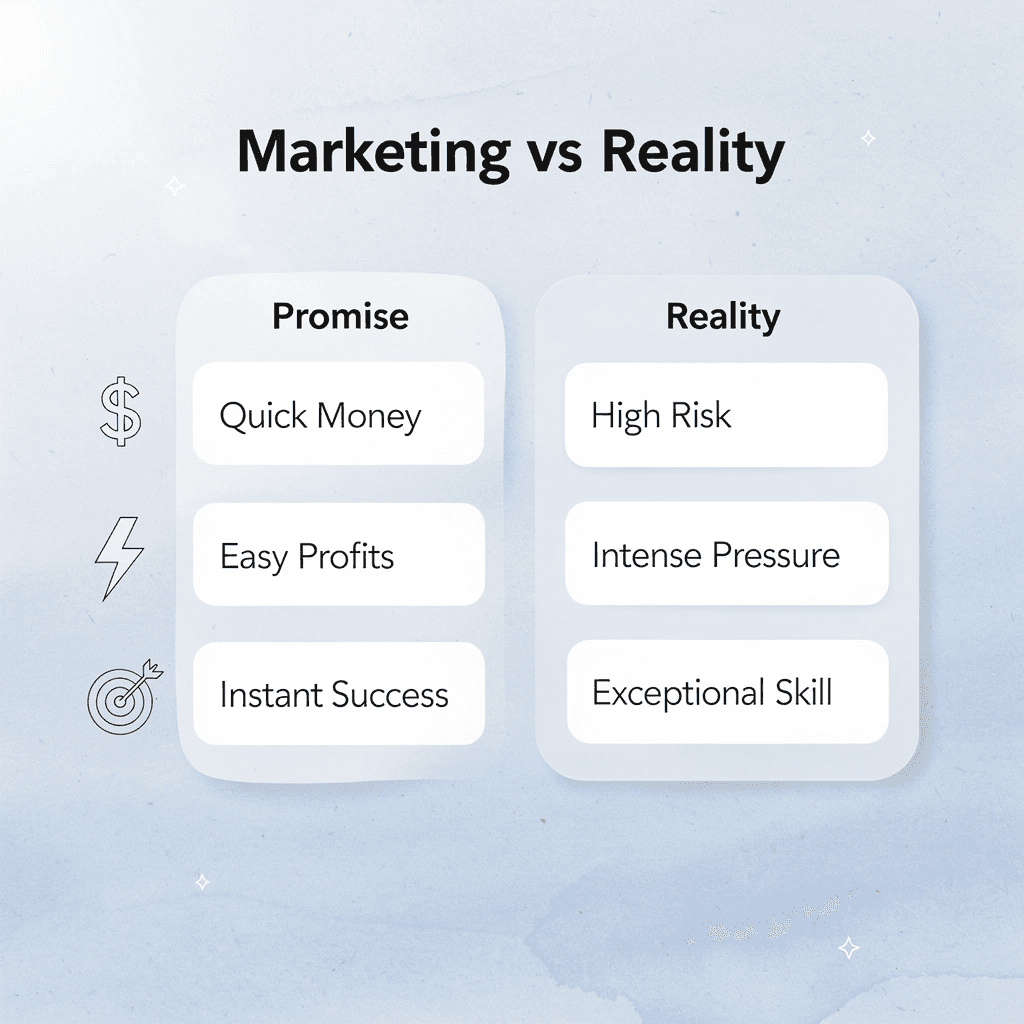
"The appeal of scalping lies in its promise of frequent, small profits that can compound throughout the trading day." — Trading Psychology Research, 2023
⚠️ Warning: The reality is much more complicated than the marketing promises suggest. Successful scalping requires exceptional discipline, lightning-fast execution, and the ability to handle constant pressure.
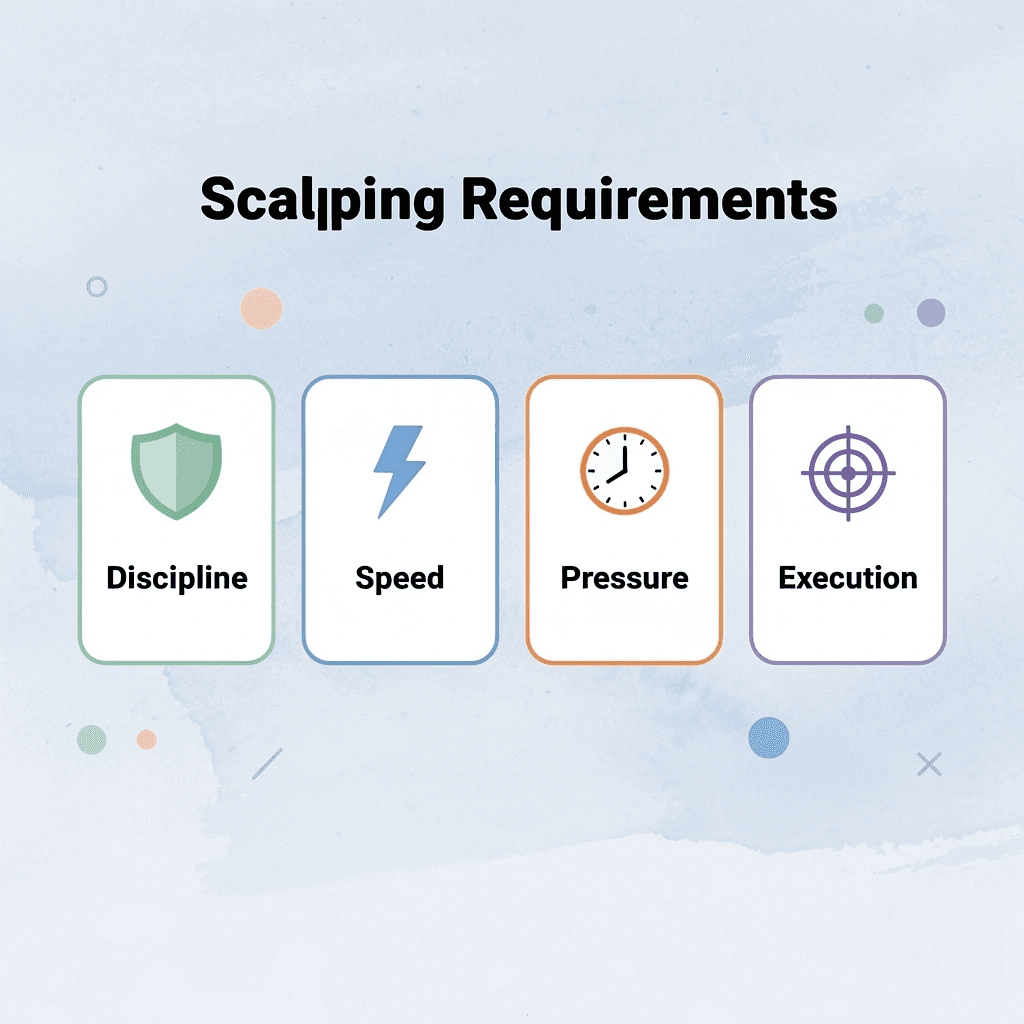
Why do traders believe scalping offers more opportunities?
Many traders are drawn to scalping because it offers more opportunities than other trading styles. A swing trader might take only a few trades each month, while a futures scalper could see dozens of possible setups in a single session. This frequency creates the perception that profits should come more easily.
What makes the fast-paced environment so appealing?
Scalping provides immediate feedback. Positions open and close quickly, allowing traders to see results almost instantly rather than waiting days to learn whether a decision was correct. For many people, this fast-paced environment feels more engaging than longer-term trading.
How does limited overnight exposure benefit scalpers?
Another attraction is limited overnight exposure. Because most scalpers close positions before the session ends, they avoid the risk of overnight news events, earnings announcements, economic releases, or geopolitical developments that could cause unexpected market moves. Many traders view scalping as a way to earn a daily income, generating small profits consistently.
Why does speed create trading challenges?
The characteristics that make scalping appealing—frequent opportunities and quick profits—often create difficult challenges. Because opportunities appear frequently, many traders fall into the trap of overtrading, taking trades simply because the market is moving rather than waiting for high-quality setups. The fast pace amplifies emotional decision-making, leaving less time for objective evaluation.
Losses compound these problems. A scalper may immediately enter another position to recover losses, whereas a swing trader has hours or days to reassess. Transaction costs matter more, too: commissions, fees, and slippage have a greater impact on profitability when executing higher trade volumes.
How are prop firms changing access to scalping?
Most traders start futures scalping by risking their own money as they learn. As the market grows (according to For Traders, the prop trading industry is projected to reach $12B in 2025), more traders are exploring alternatives. Platforms like Goat Funded Trader allow traders to demonstrate their scalping skills through evaluation programs without risking personal capital. Once they prove consistent trading ability, they can access funded accounts designed for active intraday traders.
What separates successful scalpers from active traders?
The biggest challenge is keeping things consistent. Many traders think scalping success comes from speed, but speed alone provides little advantage without disciplined execution. A trader can make hundreds of trades weekly and still struggle to generate consistent results if risk management and trade selection are poor.
The traders who succeed at futures scalping are not necessarily those taking the most trades—they are the ones taking the right trades. Scalping requires identifying a repeatable edge, managing risk effectively, and executing the same process with exceptional discipline. This distinction separates professional scalpers from traders who mistake activity for profitability.
What Is Scalping Futures?
Scalping futures is a short-term trading strategy that captures small, frequent price movements in futures contracts. Scalpers enter and exit positions within seconds to minutes, profiting a few ticks or points per trade. The strategy requires high liquidity, tight spreads, and sufficient intraday volatility to create repeatable opportunities.

"Scalping requires high liquidity and tight spreads to capture small price movements profitably within seconds to minutes." — Trading Strategy Analysis, 2024
Scalpers measure holding periods in seconds to minutes: some trades close in under thirty seconds, others stretch to five or ten minutes. This precise timeframe separates scalping from day trading (hours) and swing trading (days or weeks). The core principle: get in, capture the move, get out, and reset for the next opportunity.
🎯 Key Point: Scalping focuses on rapid-fire trades that capture minimal price movements, requiring split-second decision-making and precise timing.
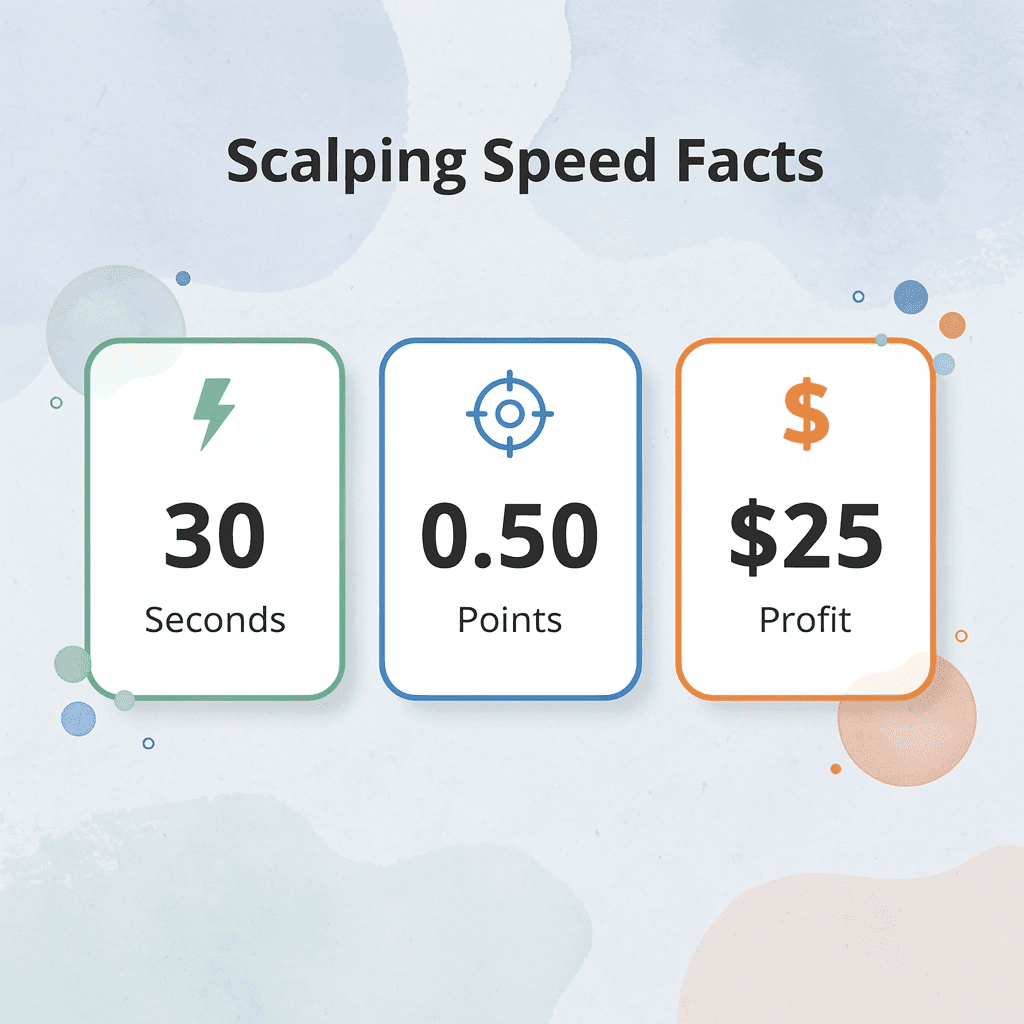
💡 Example: A scalper might buy E-mini S&P 500 futures at 4,250.25 and sell at 4,250.75, capturing a 0.50 point move worth $25 per contract in under two minutes.
What Makes a Market Scalable?
Liquidity matters more than almost anything else. A liquid market has enough buyers and sellers at each price level to fill orders quickly with minimal slippage. When targeting two or three ticks of profit, a single tick of unexpected slippage can erase half your edge. According to NinjaTrader's futures scalping research, execution quality directly impacts profitability in strategies where profit targets are measured in fractions of a percent.
How does volatility affect scalping opportunities?
Volatility creates the movement scalpers need. Too little, and prices stagnate with few opportunities. Too much, and execution becomes difficult: stops trigger prematurely, and risk management breaks down. The best conditions combine steady movement with predictable order flow, which is why certain contracts dominate scalping.
Which futures contracts work best for scalping?
The E-mini S&P 500 (ES) attracts scalpers because of its deep liquidity and steady intraday rhythm. The Nasdaq futures (NQ) offer greater volatility and larger swings for traders comfortable with faster price action. Crude Oil (CL) moves aggressively, rewarding experience but punishing hesitation. Micro contracts, such as the Micro E-mini S&P 500, allow newer traders to participate with smaller position sizes while developing their execution skills.
How do prop firm rules impact scalping strategies?
Most prop firms impose strict consistency rules during evaluation, requiring traders to avoid large daily swings, charging activation fees, restricting news-event trading, and delaying payouts—all penalties for rapid, opportunistic scalping. Futures prop firms like Goat Funded Futures remove these barriers, allowing scalpers to hold positions through news, skip evaluations with Instant Funding, and access premium platforms at no extra cost, enabling short-term strategies to thrive without artificial constraints.
But understanding what scalping is doesn't explain why so many traders who attempt it lose money rather than build consistency.
Related Reading
End Of Day Drawdown
Prop Trading Explained
How Do Futures Prop Firms Work
Best Prop Firm For Swing Trading
Swing Trading Futures
How Do Proprietary Trading Firms Work
Why Most Futures Scalpers Lose Money
Traders lose because they give up on their process when things get stressful, not because they lack speed, indicators, or execution tools.
⚠️ Warning: The biggest mistake futures scalpers make is abandoning their trading plan during volatile market conditions when emotions run high.

"The majority of trading failures stem from psychological breakdowns rather than technical deficiencies in strategy or tools." — Trading Psychology Research, 2023
🎯 Key Point: Successful scalping requires unwavering discipline to stick with your predetermined rules, especially when the market tests your emotional resilience.

The Illusion of Activity
Scalping creates a dangerous feeling of accomplishment. Because futures markets move constantly, traders feel compelled to participate continuously, chasing small opportunities simply because the market is moving, not because the opportunity meets their standards. Activity replaces patience. The trader who takes 40 trades feels more engaged than one who waits for three high-probability entries, but engagement doesn't equal profit. According to Bookmap's 2026 analysis, 90% of day traders lose money, largely because trading frequency substitutes for careful trade selection.
Position Sizing and Risk-Reward Disconnect
A trader can have a real advantage and still lose all their money due to poor position sizing. When a single loss erases a dozen winning trades, the math doesn't work. Many scalpers focus on win rate while ignoring loss size. Winning 70% of trades means nothing if each loss is three times larger than each win. The focus shifts to being right instead of making money, a deadly mistake.
Emotional Cascades
A single losing trade triggers frustration, leading to revenge trading and overtracking. The trader abandons their plan to recover losses through impulsive decisions. This cascade accelerates in scalping because trades occur so rapidly: there's no time to reset between decisions, so one bad choice compounds into five more. The speed that makes scalping attractive becomes the mechanism that amplifies mistakes.
Strategy Abandonment
After a handful of losses, many traders switch to a new indicator, timeframe, or setup without collecting enough data to validate the original strategy. This pattern repeats for months or years, preventing mastery through constant restarts. Research from Tradeciety found that 95% of traders fail, with strategy-hopping and inconsistent execution among the primary causes.
How do prop firm constraints worsen strategy abandonment?
Most prop firms worsen the challenge by adding unhelpful rules: consistency requirements force profits across days, activation fees create financial pressure before trading begins, and news restrictions prevent holding positions through high-volatility events. Futures prop firms like Goat Funded Futures remove these barriers by eliminating consistency requirements during evaluation, offering Instant Funding to skip the testing phase, and allowing traders to hold through news without artificial exit rules. The environment stops punishing the strategy and starts supporting it.
What else is needed beyond removing obstacles?
But even in the right environment, success requires more than removing obstacles.
The Core Skills Every Futures Scalper Needs
Scalping futures requires a specific set of basic skills that most traders underestimate. These are not advanced technical secrets or proprietary indicators, but core capabilities that separate consistent performers from those who lose money despite having access to solid setups.
🎯 Key Point: The difference between profitable scalpers and losing traders isn't access to better information—it's mastering the fundamental skills that enable quick, disciplined execution.

"95% of day traders lose money, with scalpers facing even higher failure rates due to the intense skill requirements and razor-thin margins for error." — FINRA Investor Education Foundation
Essential Scalping Skill | Why It Matters | Failure Without It |
|---|---|---|
Order Execution Speed | Sub-second entry/exit timing | Slippage kills profits |
Risk Management | Protects against catastrophic losses | Account blowouts |
Market Reading | Identifies high-probability setups | Random entries = losses |
Emotional Control | Maintains discipline under pressure | Revenge trading destroys accounts |
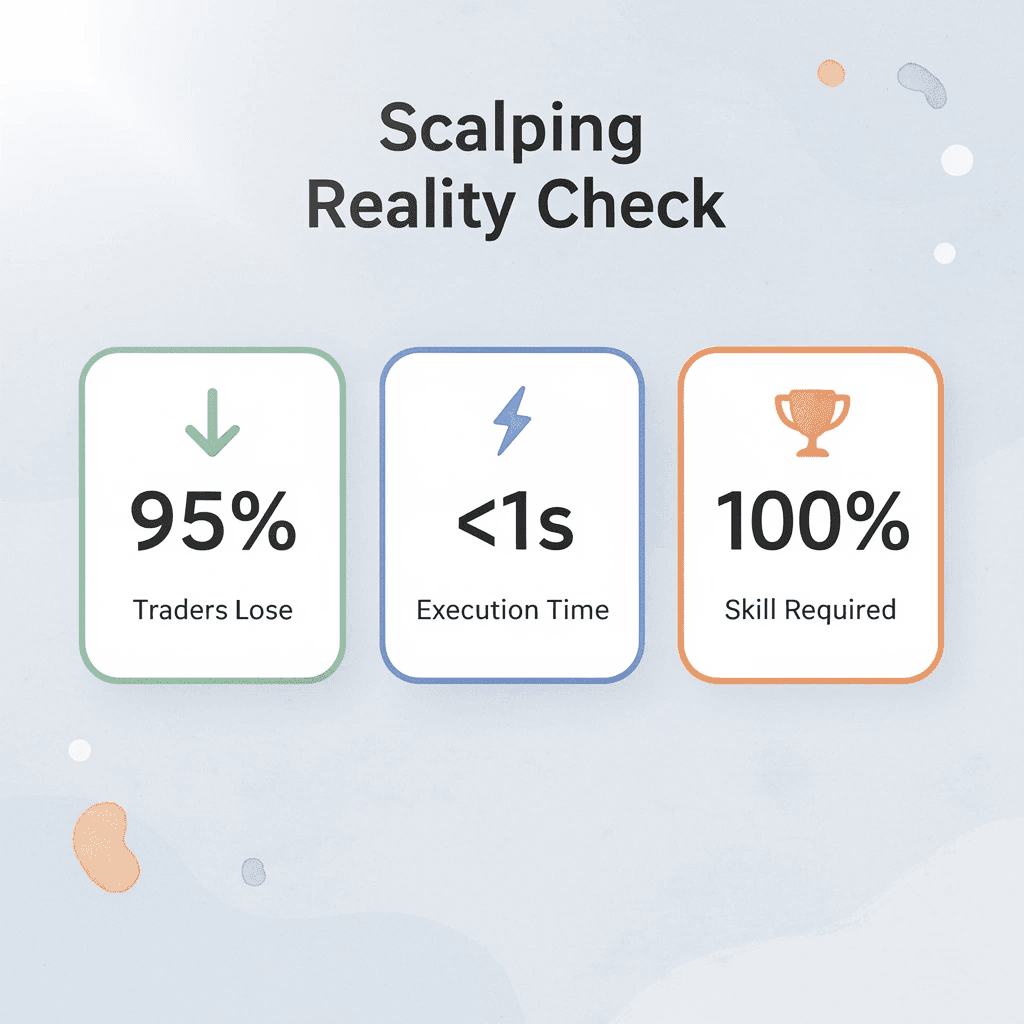
⚠️ Warning: Many traders jump into scalping, thinking they can learn these skills while trading live. This approach typically results in rapid account depletion and expensive lessons that could have been avoided through proper preparation.
Risk Management Comes Before Everything Else
The first and most important skill is risk management. Keeping your capital safe comes before making profits. A scalper can be wrong many times and still recover if losses stay controlled. One big loss can erase days or weeks of careful trading. Successful scalpers consider downside risk before possible profit. They know exactly how much they are willing to lose before entering a position and avoid increasing risk when a trade is not working.
Execution Discipline Separates Knowledge from Performance
Most traders know what they should do. The challenge is executing consistently. A trader may have clear entry rules, defined stop-loss levels, and profit targets, yet abandon them when emotions take over. Successful scalpers execute their plan regardless of whether the previous trade won or lost. Long-term profitability comes from repeating a process, not improvising during every market move.
How does market awareness impact scalping success?
Market awareness is essential to scalping, which depends on liquidity and volatility. Traders must understand when markets are active and when conditions support their strategy. A setup that works during the opening hour may behave differently during slower periods, and highly volatile environments require different expectations than quiet conditions. The best scalpers adapt to changing environments without abandoning their core process.
Why is patience crucial for scalping traders?
Patience is the most underrated skill in scalping. Successful scalpers spend far more time waiting than trading, as most price changes don't present real opportunities. Profitable traders sit through long periods of inactivity, waiting for setups that meet their criteria. This ability to avoid unnecessary trades often has a greater impact on performance than finding additional opportunities.
How does trade journaling improve performance?
Keeping a trading journal is another habit shared by consistent traders. A journal provides an objective record of your decisions, outcomes, and patterns, allowing you to review actual performance data and identify your strengths and weaknesses rather than relying on memory.
Journaling helps answer important questions: Are losses from poor execution or a flawed strategy? Do certain market conditions produce better results? Is overtrading happening repeatedly? Without a journal, traders guess. With one, they decide based on evidence. Futures prop firms like Goat Funded Trader support this development by removing barriers that punish learning, offering environments where traders can focus on skill-building rather than navigating restrictive consistency rules or activation fees during evaluation.
But even with the right skills, choosing the wrong market can undermine everything.
Related Reading
How To Choose A Prop Firm
Cheapest Prop Firm
Prop Firm No Challenge
Best Prop Firm For Beginners
How To Pass A Prop Firm Challenge
Best Prop Firm For Scalpers
4 Best Markets for Scalping Futures
Not all futures markets reward the same approach. Liquidity determines how cleanly you can enter and exit positions. Volatility shapes the size and frequency of opportunities. Contract specifications affect risk exposure and capital requirements. The market that works for one trader may frustrate another because their style and the market's characteristics don't align.

Market Factor | Impact on Scalping | What to Look For |
|---|---|---|
Liquidity | Clean entries/exits | High volume, tight spreads |
Volatility | Opportunity frequency | Consistent price movement |
Contract Size | Risk management | Appropriate position sizing |
Trading Hours | Session availability | Overlap with your schedule |
🎯 Key Point: Market selection is just as important as your trading strategy – the wrong market can turn a profitable approach into a losing one.
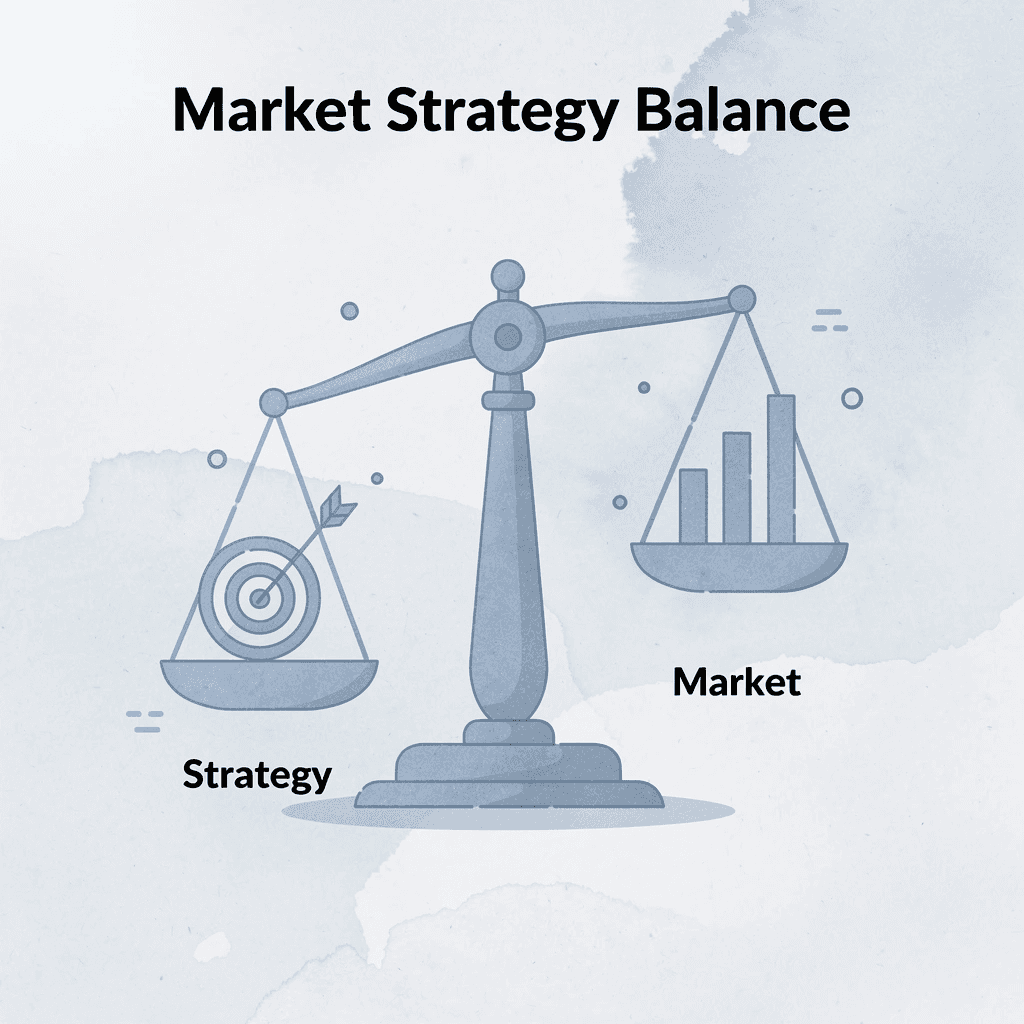
"Successful scalping requires matching your trading style to the market's natural rhythm and liquidity profile." — Futures Trading Analysis, 2024
⚠️ Warning: Don't assume that high volatility always means better scalping opportunities – excessive volatility can create unpredictable gaps that destroy scalping strategies.

1. E-mini S&P 500 (ES) Deep Liquidity, Manageable Movement
The ES remains the most liquid futures contract available. Bid-ask spreads stay tight even during slower periods, and order flow is consistent enough that scalpers rarely struggle to fill positions at expected prices. This reliability matters when profit targets are measured in ticks rather than points.
Price movement tends to be smoother compared to more volatile contracts. Trends develop gradually, reversals signal with warning, and sudden gaps are less common outside major news events. For traders focused on reading order flow or short-term momentum, execution quality becomes the primary variable rather than market chaos.
2. Nasdaq Futures (NQ) Volatility for Experienced Execution
The NQ moves two to three times faster than the ES, creating larger intraday swings and greater distance between entry and profit target in shorter time frames. This volatility generates more frequent setups for scalpers who thrive on momentum and rapid decision-making.
The tradeoff is less forgiveness. Hesitation that might be manageable in the ES can turn a small loss into a larger one before you react. Successful NQ traders typically build consistency in slower markets and adjust position sizing when volatility increases.
3. Crude Oil Futures (CL): High Risk, High Reward
Crude Oil attracts scalpers seeking rapid price action. According to Tradefundrr.com, experienced traders gravitate toward energy markets because price swings respond quickly to inventory data, geopolitical developments, and shifts in global demand. A single news headline can move Crude Oil several dollars in minutes, creating setups unavailable in equity index futures.
What makes crude oil risky for scalpers?
That same quick response time makes Crude Oil one of the riskiest markets for scalping. Losses accumulate as fast as profits, slippage worsens during volatile periods, and stops get hit with less warning. Most traders without prior experience in calmer markets struggle to handle the emotional and financial pressure of faster, less predictable price action.
4. Micro Futures Precision for Smaller Accounts
Micro contracts provide the same market exposure as their full-sized counterparts, but with much smaller position sizes. The Micro E-mini S&P 500, for example, represents one-tenth the value of the standard ES contract, allowing traders to participate in major markets without large account balances or oversized risk per trade.
For newer scalpers, Micro futures provide a practical testing ground for refining entry timing, practicing risk management, and building execution discipline without the financial consequences of full-sized contracts. Market behavior remains identical; only the risk per tick changes. Once consistency develops, transitioning to larger contracts becomes a matter of scaling position size.
Why Market Characteristics Matter More Than Popularity
Many traders choose markets based on activity levels, but liquidity doesn't determine suitability. A highly active market can still be unsuitable for a trader whose risk tolerance or experience doesn't match its volatility.
How do different markets affect trading performance?
The ES might feel too slow for someone who thrives on quick momentum shifts. The NQ might feel too unpredictable for someone still building execution discipline. Crude Oil might offer exciting setups, but harm unprepared accounts. Micro futures might feel limiting to traders ready for larger position sizes. These judgments reflect fit, not market quality.
What should traders test before committing to a market?
Successful scalpers test multiple markets before committing to one. They compare how their strategy performs across different liquidity and volatility conditions, observe whether their emotional responses change as price action accelerates, and track whether execution quality improves or deteriorates as market conditions shift. This process prevents forcing a strategy into an unsuitable market.
How do prop firm restrictions limit market exploration?
Most prop firms penalize exploration through consistency requirements, activation fees, and restrictive evaluation structures. Futures prop firms like Goat Funded Futures remove these barriers by eliminating consistency rules during evaluation and offering instant funding, allowing traders to discover which markets align with their approach rather than navigate arbitrary restrictions designed to increase failure rates.
Which markets work best for newer traders?
New traders often benefit from starting with the ES or Micro ES, where liquidity and moderate volatility make mistakes less costly and patterns easier to recognize. As execution improves and confidence builds, moving to the NQ or testing Crude Oil becomes reasonable.
What should experienced traders consider when choosing markets?
Experienced traders may prefer the NQ or Crude Oil from the start, especially if they've developed strong risk management habits and can process information quickly under pressure. Trading a volatile market doesn't prove skill; it reveals whether your current skill level matches what the market demands.
How do you find the right market match?
The goal isn't to move from one market to another as if one is better than the other, but to find the market where your strengths match available opportunities, and your weaknesses won't be exacerbated by conditions you can't yet handle.
But picking the right market is only part of the answer. The environment where you trade it matters equally.
What Futures Scalpers Should Look for in a Prop Firm
The trading environment matters as much as your strategy. For scalpers, this is critical: the margin for error is small. A firm with restrictive rules, unclear payouts, or poor execution can turn a profitable strategy into a frustrating grind. Find a prop firm that supports how you trade, not one that forces you to adapt your approach to survive their limitations.

🎯 Key Point: Your prop firm should enhance your scalping strategy, not hinder it with unnecessary restrictions or poor infrastructure.
"The margin for error in scalping is so small that even minor execution delays or rule violations can turn a profitable trader into a struggling one." — Trading Performance Analysis, 2024

💡 Tip: Before committing to any prop firm, test their platform execution speed during peak market hours when slippage and latency issues are most likely to surface.
Drawdown structure and how it's calculated
Drawdown rules determine how much breathing room you have when trades move against you. For scalpers who enter and exit positions frequently throughout a session, the calculation method matters more than the percentage itself. Some firms use static drawdowns that lock in your starting balance, while others use trailing drawdowns that adjust as your account grows. Static drawdowns provide consistent risk parameters but can feel restrictive when you're building momentum. Trailing drawdowns offer more flexibility but mean your risk limit moves with your equity. What matters is whether the structure aligns with how you manage risk across multiple trades in a single day.
Why does execution speed matter for scalpers?
Scalping relies on speed and precision. Execution delays or platform limitations erode profits before you notice. Some firms charge extra for premium platforms or restrict access to certain order types.
Scalpers need direct market access, fast order routing, and reliable data feeds. If a firm treats these as optional upgrades, that reveals how seriously they take your trading style.
How do account size restrictions affect scalping profits?
Most prop firms offer impressive account sizes and profit splits, but scalpers often discover that the largest accounts come with restrictive conditions. Firms impose activation fees, consistency requirements, or complex payout schedules that delay access to earnings.
According to Atmos Funded, the average profit split ranges from 70% to 90%, but this becomes meaningless if payouts are delayed by weeks or tied to arbitrary milestones. Platforms like Goat Funded Trader eliminate activation fees and consistency rules during evaluations, allowing scalpers to focus on execution rather than navigating hidden costs.
Payout transparency and withdrawal terms
Many traders spend weeks preparing for an evaluation, but never review payout policies. Withdrawal terms vary widely: some firms require minimum thresholds, others impose waiting periods, and a few restrict withdrawal frequency. For scalpers generating consistent daily profits, access to earnings matters more than account size. A firm advertising a $150,000 account with 30-day payout delays offers less practical value than one offering a $50,000 account with weekly withdrawals.
Evaluation flexibility and funding pathways
Scalpers work at different skill levels with different goals. Some want to demonstrate consistent trading through an evaluation; others have an established track record and need immediate funding. Companies offering multiple funding paths—quick access for experienced traders and evaluation programs for newer ones—recognise these differences. A firm requiring all traders to go through the same process ignores their actual needs.
But the best rules and systems won't matter if the firm doesn't understand how scalpers operate.
How Goat Funded Futures Supports Scalpers
Goat Funded Trader structures its programs to address specific problems that undermine scalping strategies: overly rigid evaluation models, hidden costs that erode profits, and payout structures that create barriers between executing trades and accessing capital.

🎯 Key Point: Unlike traditional prop firms that penalize high-frequency trading, Goat Funded Trader recognizes that scalpers need flexibility in their evaluation criteria and faster access to their earned profits.
"Scalping strategies require specialized support systems that traditional prop firms simply don't provide, creating barriers that prevent profitable traders from accessing the capital they need." — Trading Industry Analysis, 2024
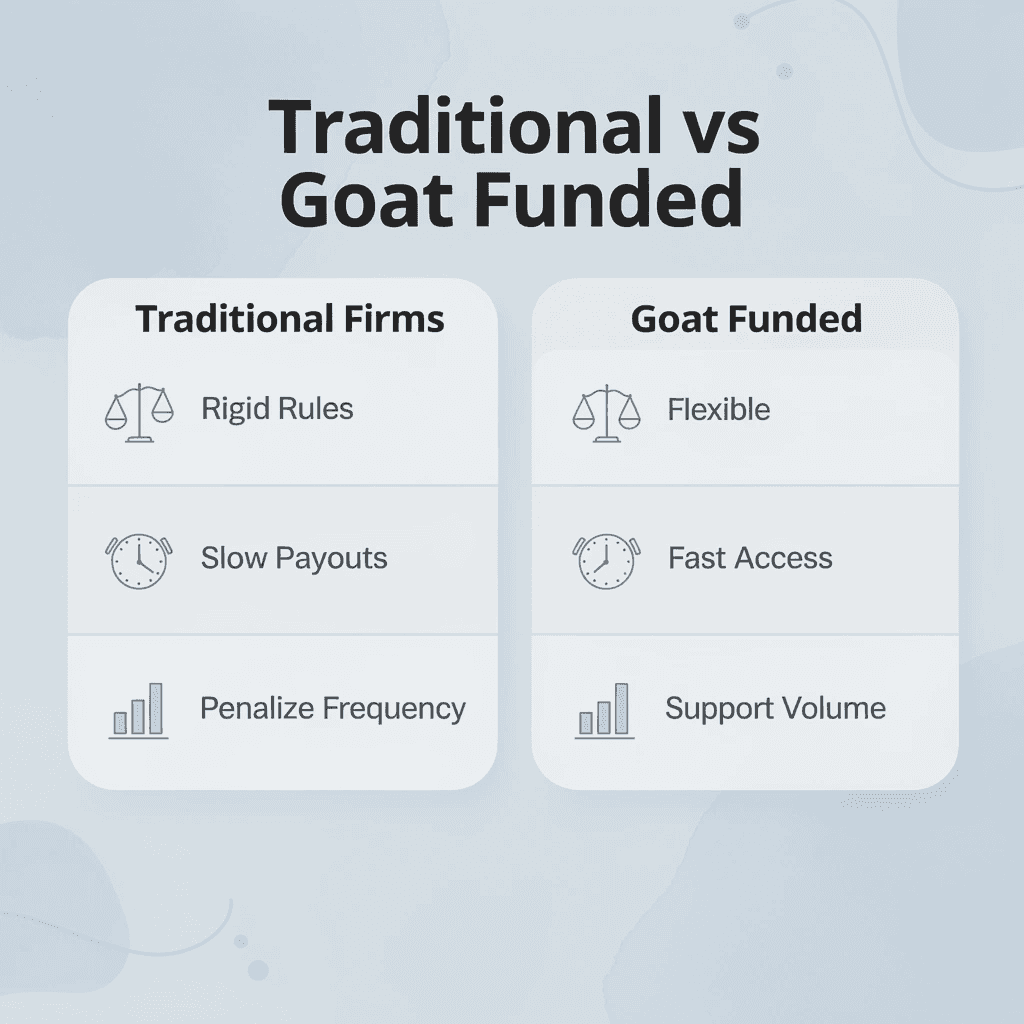
⚠️ Warning: Many prop firms use evaluation models designed for swing traders, which can unfairly penalize scalpers who make frequent trades with smaller profit margins but consistent results.
Multiple Pathways to Capital
Goat Funded Trader offers four funding programs: the EOD Program provides structured evaluation with clear parameters; the Sprint Program offers an alternative testing environment; the Instant Funded Program eliminates evaluation for experienced traders; and the Pro Program provides flexibility as traders' approaches evolve.
This variety reflects reality: a trader executing 30 trades per day during the New York session has different needs than someone taking five selective setups during the London open. Matching a program to actual trading behavior matters more than account size alone.
Removing Common Cost Barriers
Many prop firms advertise attractive profit splits but introduce friction through additional fees. Goat Funded Trader eliminates activation fees and mandatory profit buffers, creating a direct connection between profitable trading and payout access. According to Goat Funded Trader, traders can access up to $2,500,000 in funding, but that capital only creates value if the cost structure doesn't erode returns through unexpected charges.
The transparent one-time fee structure lets traders evaluate total program expenses upfront. For scalpers operating on tight margins where a few ticks determine profitability, cost clarity is essential for accurate risk-reward calculations.
Profit Retention That Reflects Performance
Account size gets attention, but keeping profits determines long-term results. Goat Funded Trader offers 100% profit share on the first $10,000 in profits, allowing traders to retain more during the critical early phase when building capital matters most. This structure recognizes that scalpers build profits through consistent execution rather than occasional large wins. Keeping a higher percentage of incremental gains compounds faster than splitting every dollar from the first trade.
How does higher profit retention accelerate capital growth?
A scalper making $500 per week by following a strict plan might see those returns reduced by 20-30% under normal profit splits, slowing capital growth. Retaining more profits early accelerates this process, building momentum that strengthens confidence and reinvestment capacity.
But having the right tools and profit structures matters only if traders can get started.
Start Trading Futures Today with our Futures Prop Firm
The path from understanding scalping to executing it narrows at one critical point: starting. You can study order flow, master risk calculations, and analyze tick charts, but none of that builds real capability until capital is at risk. The question isn't whether you're ready (you'll never feel completely ready), but whether you have access to an environment that supports learning through live execution.

Most traders delay by confusing preparation with readiness. They wait for the perfect setup, ideal account size, or one more month of simulated trading. But scalping futures isn't theoretical. It's a skill built through repetition under real market conditions, where slippage matters, where emotional response to losing streaks teaches more than any backtest, and where feedback between decision and outcome happens in seconds. Waiting doesn't improve your edge. Trading does.
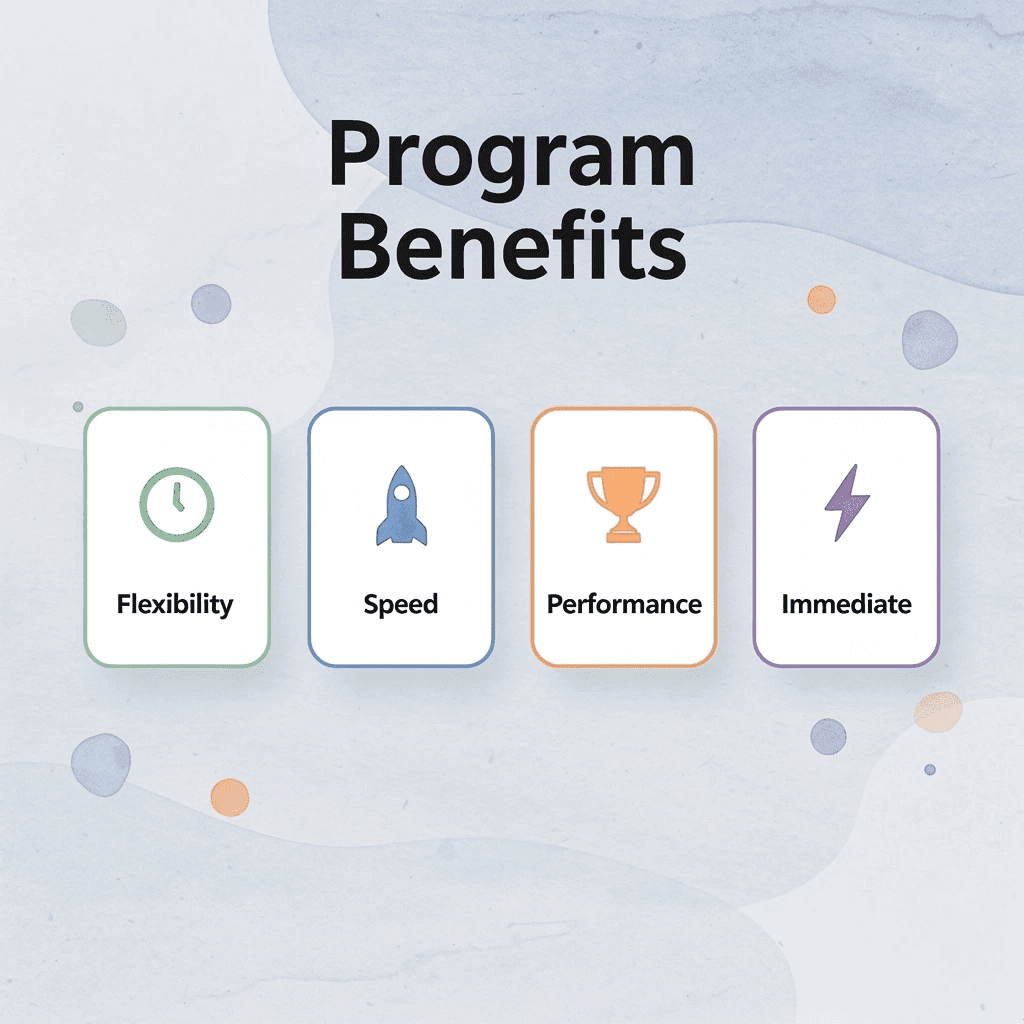
🎯 Key Point: If the biggest takeaway from this guide is that successful futures scalping requires both discipline and the right trading environment, Goat Funded Trader offers funding programs designed to support different trading styles. The EOD program gives end-of-day evaluations without intraday drawdown restrictions. Sprint compresses the evaluation timeline for faster access. Instant Funded skips evaluation entirely, putting you directly into a funded account. Pro offers the highest capital limits with profit splits up to 90% for experienced scalpers.

"Each program removes a different barrier. Some traders need time flexibility. Others need speed." — Trading Environment Analysis
Each program removes a different barrier. Some traders need time flexibility, others need speed. Some want to prove themselves through performance, while others want to skip the proving ground and start immediately. A scalper executing 20 trades per session needs different constraints than someone taking three high-conviction setups per day.
Program Type | Key Benefit | Best For |
|---|---|---|
EOD Program | No intraday restrictions | Flexible traders |
Sprint | Faster evaluation | Quick access seekers |
Instant Funded | Skip evaluation | Immediate starters |
Pro | Up to 90% profit splits | Experienced scalpers |
🔑 Takeaway: Start where the friction is lowest. If evaluation pressure disrupts your execution, choose a path that reduces that variable. If capital access is the bottleneck, prioritize programs that fund quickly. The goal isn't to find the perfect fit, but to remove enough obstacles so you can begin building the repetition that develops skill. Scalping futures becomes viable when the environment supports your process.

Related Reading
Prop Firm Trading Strategy
Best Prop Firms 2026
Prop Firm Risk Management
Futures Prop Firm Comparison
Prop Firm Rules Explained
Leeloo Trading Review