9 Best Futures Prop Firms for Traders & Which is Right for You?
Discover the 9 best futures prop firms compared by Goat Funded Trader. Find your perfect match with our detailed analysis and start trading today.
Traders with proven strategies often face a common bottleneck: limited capital restricts their profit potential despite strong performance. Futures prop firms address this challenge by providing substantial trading capital in exchange for a share of profits, allowing skilled traders to scale beyond the limitations of personal accounts. These firms evaluate traders through specific programs and fund those who demonstrate consistent profitability.
Selecting the right firm requires careful consideration of profit splits, evaluation requirements, and trading conditions that match individual goals. Professional traders need clear rules, realistic targets, and supportive environments to maximize their funded account potential. Goat Funded Futures provides these essential elements through their comprehensive futures prop firm platform.
Table of Contents
Why Choosing a Futures Prop Firm Is Harder Than It Looks
What to Look for in a Futures Prop Firm
9 Best Futures Prop Firms Compared
Why Many Traders Focus on the Wrong Metrics
Which Futures Prop Firm Is Right for You?
Why Goat Funded Futures Stands Out
Start Trading Futures Today with our Futures Prop Firm
Summary
90% of traders fail their first prop firm evaluation according to World Business Outlook, with risk rule violations accounting for most failures. The issue isn't finding profitable trades. It's that firm structures often punish normal drawdowns that would be acceptable in personal accounts. Trailing drawdowns that tighten as accounts grow force defensive trading even when strategies are working, while static drawdowns provide consistent room to operate regardless of profit levels.
Payout structures create more obstacles than evaluation difficulty. Many firms impose profit buffers, minimum trading-day requirements, or waiting periods that extend for weeks beyond initial withdrawal requests. The average payout time across funded traders is 14 days, but that number hides significant variation. Some firms process requests within days, while others layer on requirements that delay access to earnings long after profit targets are met.
Hidden costs extend well beyond advertised evaluation fees. Activation fees to begin trading funded accounts, reset fees after failed evaluations, recurring platform costs, and monthly maintenance charges add up quickly. A $150 evaluation, requiring a $200 activation fee and $50 monthly maintenance costs, is significantly more than a $300 evaluation with no additional fees. Total participation costs often become clear only after commitment.
Bigger accounts don't guarantee better outcomes when drawdown rules restrict position sizing. A $150,000 account with tight risk parameters may offer no more tradable capital than a $50,000 account with flexible rules. Similarly, 70% of traders focus on win rate rather than risk-reward ratio when evaluating strategies. The same pattern appears in firm selection, where traders optimize for account size rather than for profit retention and withdrawal accessibility.
Profit split percentages matter less than what happens after the first payout. Top firms now offer 90% profit splits, but some lock traders into initial percentages regardless of consistent performance, while others increase splits based on results. A $100,000 account with 90% retention often outperforms a $200,000 account with 70% retention on identical winning months, especially when compounded over time.
More than 7,900 traders in 136 countries have accessed funded accounts through platforms that prioritize transparent profit structures and straightforward withdrawal processes. Pass rates at most futures prop firms range from 5% to 15%, meaning evaluation difficulty matters less than post-funding conditions. The firms that retain successful traders remove friction between generating profit and accessing it, rather than creating barriers after funding.
Goat Funded Futures addresses these common barriers by offering four distinct funding pathways, zero activation fees, profit splits up to 100% on the first $10,000 in earnings, and transparent payout structures without mandatory profit buffers or hidden consistency requirements.
Why Choosing a Futures Prop Firm Is Harder Than It Looks
Choosing a futures prop firm requires more than comparing account sizes and evaluation fees. Firms advertising the largest funded accounts or lowest challenge costs often conceal problems in their rules, payout structures, and conditions. What appears promising on a marketing page can become frustrating under their terms.

🎯 Key Point: The most attractive marketing offers often mask restrictive trading conditions that only surface after you've paid evaluation fees and started trading.
"What appears to be the best deal upfront can quickly turn into the worst experience once you're locked into their trading requirements." — Industry Analysis, 2024

⚠️ Warning: Don't fall for firms that lead with massive account sizes but bury crucial details about profit splits, withdrawal restrictions, and rule violations in fine print.
Why don't account size and fees tell the whole story?
Many traders assume the decision comes down to finding the biggest account for the smallest fee. However, these numbers matter far less once you understand how the firm structures drawdowns, enforces consistency rules, or processes withdrawals.
How do risk management frameworks differ between firms?
Two firms can advertise identical account sizes and profit targets while operating under completely different risk management frameworks. One might use a trailing drawdown that tightens as your account grows, restricting how you manage positions during market volatility. The other might offer a static drawdown that doesn't move, allowing you to trade without constantly checking whether a temporary pullback will breach your limit. In practice, one feels impossible to trade while the other feels manageable.
What causes most traders to fail their evaluations?
According to World Business Outlook, 90% of traders fail their first evaluation, with violations of risk rules accounting for a significant share of those failures. Most traders lose evaluations not because they can't find profitable trades, but because the rules don't match how real trading works or because the structure punishes normal drawdowns that would be acceptable in a personal account.
How do payout structures create hidden obstacles?
Getting funded matters, but accessing your profits matters more. Many traders overlook how firms handle withdrawals after funding. Profit buffers, consistency requirements, payout schedules, and withdrawal restrictions can all limit your ability to access earnings, even after meeting profit targets.
What specific restrictions limit profit access
A firm might require you to maintain a certain percentage of your account balance before requesting a payout or enforce minimum trading days between withdrawals. Some process payouts quickly; others delay payments for weeks. These details rarely appear in marketing materials but determine whether a funded account delivers the financial outcome you seek.
How does Goat Funded Futures address these barriers?
Goat Funded Trader removes common barriers by offering zero activation fees, transparent payout structures, and profit splits ranging from 80% to 100% without hidden consistency requirements during evaluation. The prop firm model prioritizes trader access to capital and earnings rather than creating obstacles that make funding difficult to maintain or profits hard to withdraw.
What hidden costs should you expect beyond evaluation fees?
The advertised challenge fee is the starting point. Depending on the firm, you might encounter activation fees to begin trading your funded account, reset fees if you fail an evaluation and want to try again, recurring platform costs, or data fees.
These expenses add up quickly, making the cheapest advertised evaluation far more expensive than initially apparent.
How do ongoing fees affect your trading costs?
Some firms charge monthly fees to maintain a funded account or require traders to meet minimum activity thresholds to avoid penalties.
The total cost of participation often becomes clear only after you've committed to the program, making comparisons based solely on evaluation price misleading.
What to Look for in a Futures Prop Firm
The best firms let you trade your actual strategy, not what their marketing promotes. Focus on what determines whether you can make money consistently over time. The difference between a good firm and an average one comes down to how much friction exists between your advantage and your ability to keep what you earn.

🎯 Key Point: The most successful traders choose firms that support their existing profitable strategies rather than forcing them to adapt to restrictive rules or incompatible platforms.
"Successful prop trading isn't about finding the firm with the flashiest marketing—it's about finding the one that gets out of your way and lets you execute your proven edge consistently." — Professional Trading Analysis, 2024

⚠️ Warning: Many firms use attractive profit splits and low fees to mask hidden restrictions that can severely limit your ability to trade effectively and withdraw profits when you need them most.
Profit Split Structure
A 90% profit split sounds attractive until you realize the firm takes 10% of everything you make, forever. According to propfirmapp.com, top prop firms now offer 90% profit splits, but the critical question is what happens after your first payout. Some firms increase your split over time based on performance, while others lock you into the starting percentage regardless of how consistently you perform or how much money you generate for them. A smaller account with a better split often outperforms a larger account with strict profit sharing over the long term.
Drawdown Rules and Risk Parameters
Drawdown structures determine how much room you have to execute your strategy when market conditions turn against you. A $100,000 account with a $2,000 trailing drawdown behaves differently from the same account with a $5,000 static drawdown. The first tightens as you profit, forcing you to trade defensively even when your edge is working. The second provides consistent breathing room regardless of profits. Scalpers need different risk parameters than swing traders, and firms offering multiple program structures outperform those forcing every trader into the same framework.
Payout Speed and Withdrawal Requirements
Getting funded matters less than getting paid. Research from propfirmapp.com shows the average payout time for funded traders is 14 days, though payout times vary significantly between firms.
Some require you to hit profit targets multiple times before your first withdrawal, while others impose waiting periods stretching weeks beyond your initial request. A few firms process withdrawals within days without additional requirements. The difference becomes clear when you try to access earnings and discover the firm's policies don't match their marketing promises.
What hidden costs should you watch for?
Most traders evaluate firms by comparing challenge fees and account sizes because those numbers are readily available. However, challenge fees don't account for activation costs, reset expenses, or monthly maintenance charges.
A $150 evaluation, which requires a $200 activation fee and $50 in monthly maintenance costs, is significantly more than a $300 evaluation with no additional fees. Firms like Goat Funded Trader eliminate activation fees and offer instant funding options that skip traditional evaluations, removing upfront friction that makes many programs expensive before trading begins.
Program Flexibility and Scaling Options
Not every trader needs the same path to capital. Some prefer proving themselves through organized testing; others want to pay upfront and start immediately. Firms offering both options understand that trading skill exists on a spectrum. Flexibility extends to scaling opportunities: a firm that allows you to manage multiple accounts or increase capital based on performance offers more growth paths than one that limits you to a single funded account.
Even with the right profit split, reasonable drawdown rules, and fast payouts, choosing a firm requires comparing specific programs side by side to find the best fit for your strategy.
Related Reading
End Of Day Drawdown
How Do Futures Prop Firms Work
How Do Proprietary Trading Firms Work
Swing Trading Futures
Scalping Futures
Prop Trading Explained
Best Prop Firm For Swing Trading
9 Best Futures Prop Firms Compared
Comparing futures prop firms requires examining evaluation processes, risk parameters, and trader support beyond account sizes and profit splits. The firms below represent different funding approaches suited to various trading styles, experience levels, and growth objectives.

Firm | Key Strength | Best For | Account Sizes |
|---|---|---|---|
TopStep | Structured evaluation | New traders | $50K - $150K |
Earn2Trade | Educational focus | Learning-oriented traders | $25K - $200K |
OneUp Trader | Fast funding | Experienced traders | $25K - $150K |
Leeloo Trading | High profit splits | Performance-focused | $25K - $100K |
The5%ers | Flexible rules | Swing traders | $20K - $100K |
FTMO | Global reach | International traders | $10K - $200K |
MyForexFunds | Quick payouts | Active scalpers | $5K - $300K |
FundedNext | Low fees | Cost-conscious traders | $6K - $200K |
City Traders Imperium | Professional environment | Institutional-style trading | $25K - $100K |
Evaluation difficulty varies significantly across firms, with some requiring 30-day challenges while others offer immediate funding after skill assessments. Risk management rules also differ substantially: daily loss limits range from 3-5%, while maximum drawdown limits range from 6-12%, depending on the firm's risk tolerance.
"The best prop firm isn't necessarily the one with the largest accounts or highest profit splits - it's the one that matches your trading style and risk management approach." — Prop Trading Industry Report, 2024
1. Goat Funded Futures
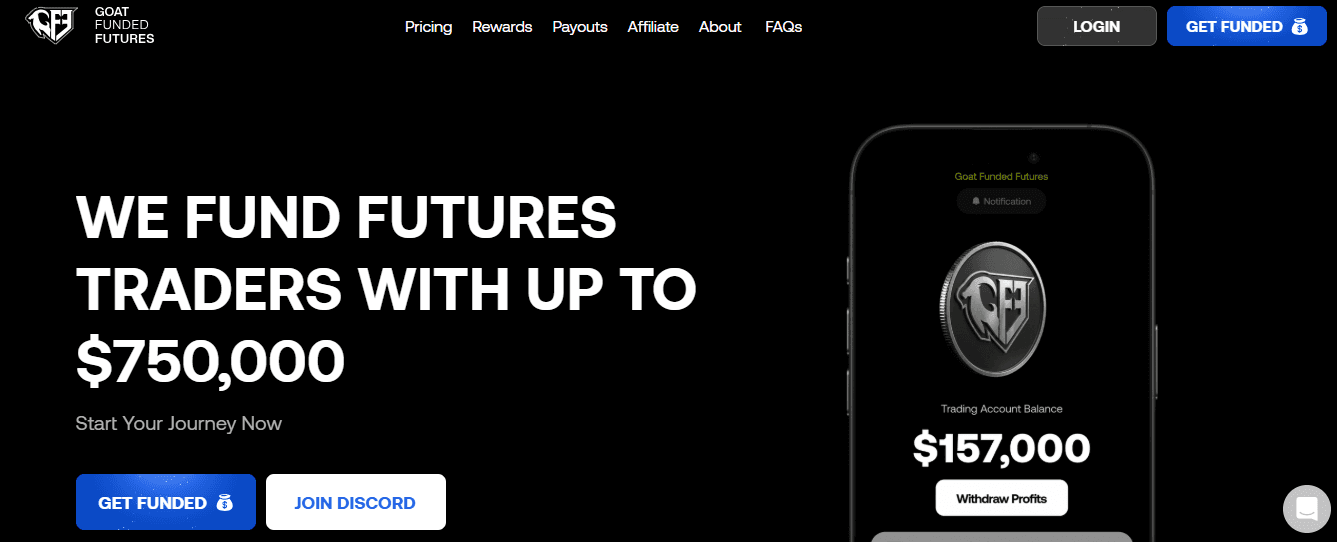
Goat Funded Trader removes barriers that slow ready traders through four distinct funding pathways: the EOD Program, Sprint Program, Instant Funded Program, and Pro Program. This allows traders to choose an evaluation structure matching their strategy rather than accepting a one-size-fits-all process.
What makes their profit-sharing structure unique?
The firm commits to reducing friction at every stage: no activation fee after evaluation, no profit-buffer requirement, and up to 100% profit share on the first $10,000 of profits. This structure lets traders keep more earnings and face fewer administrative hurdles between evaluation and payout.
Who benefits most from their platform approach?
The platform suits active traders and day traders who need flexible access to capital. Goat Funded Trader offers multiple programs tailored to your experience and goals, so you won't need to switch firms as you grow.
2. Apex Trader Funding
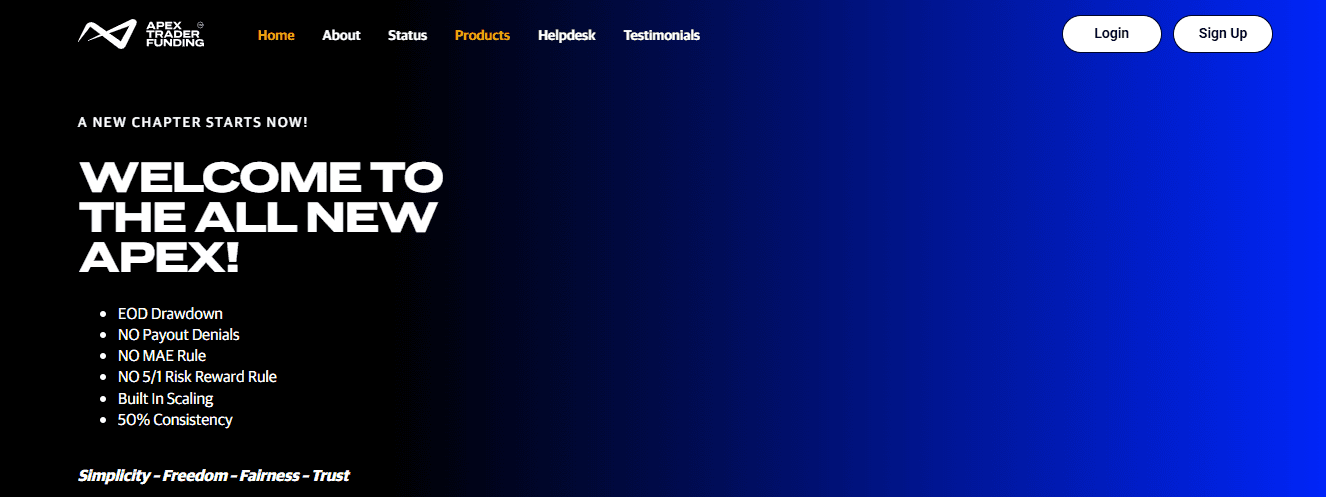
Apex Trader Funding offers one of the widest ranges of account sizes in the industry, providing flexibility for different risk exposures and scaling opportunities.
Apex Trader Funding offers a 100% profit split on the first $25K, then 90% thereafter, incentivizing traders to reach profitability quickly. The broad account selection appeals to traders seeking multiple funding level options.
This platform works best for traders prioritizing account variety and multiple funding levels as they develop their trading approach.
3. Topstep

Topstep combines funding opportunities with trader education, positioning itself as a development platform rather than a capital provider. It offers coaching resources, educational content, and community support designed to help traders improve their skills alongside the evaluation process.
The educational component benefits newer futures traders seeking guidance as they work toward funding. Topstep structures its support resources around the premise that better-trained traders are more likely to succeed with funded capital.
Topstep suits traders who value learning resources and community engagement on their path to funding.
4. My Funded Futures
My Funded Futures offers multiple account types and funding pathways, allowing traders to select programs based on their preferred risk management style and evaluation timeline.
This variety suits traders seeking flexibility in evaluation structures and account options.
5. Take Profit Trader
Take Profit Trader focuses on creating a straightforward evaluation process with simpler rule structures. This approach appeals to traders who want to spend less time understanding requirements and more time executing, with clear transparency about expectations during the evaluation process.
Take Profit Trader suits traders who value simplicity and clear evaluation requirements.
6. TickTickTrader
TickTickTrader follows a traditional prop firm model with an evaluation structure focused on disciplined risk management and consistent execution. This approach appeals to experienced futures traders familiar with conventional prop trading frameworks and those seeking predictable, straightforward evaluation processes.
7. TradeDay
TradeDay helps traders improve through analytics and performance feedback, providing tools to review their performance and identify areas for development. This commitment to continuous improvement distinguishes TradeDay from firms that simply provide capital without supporting trader development.
TradeDay suits traders who want to improve their performance and analyze their performance.
8. Elite Trader Funding
Elite Trader Funding offers various account sizes and funding options for traders with different goals. This flexibility allows traders to adjust their funding level as they gain experience and confidence based on their performance.
9. BluSky Trading
BluSky Trading appeals to traders seeking lower-cost entry into futures prop trading. Smaller account evaluations let traders gain experience with funded trading models without committing to larger programs immediately, making it ideal for those with limited budgets or testing a prop firm's structure before pursuing higher funding levels.
Which Futures Prop Firm Is Best?
The best prop firm depends on what you value most: education and coaching, account size, analytics, evaluation simplicity, or program variety.
What makes Goat Funded Futures stand out?
Goat Funded Trader stands out for traders seeking flexibility, transparent costs, multiple funding pathways, no activation fees, and higher profit retention. The structure reflects a belief that traders shouldn't face unnecessary barriers between evaluation and profitability.
What factors determine long-term success?
The most successful traders focus on factors that affect actual experience: payouts, rules, flexibility, and long-term scalability. These determine whether a funded account becomes a meaningful opportunity or another challenge to overcome.
According to QuantCrawler, pass rates for most futures prop firms range between 5-15%. Understanding why most traders don't receive funding reveals more about what matters than any marketing claim about account sizes or profit splits.
Why Many Traders Focus on the Wrong Metrics
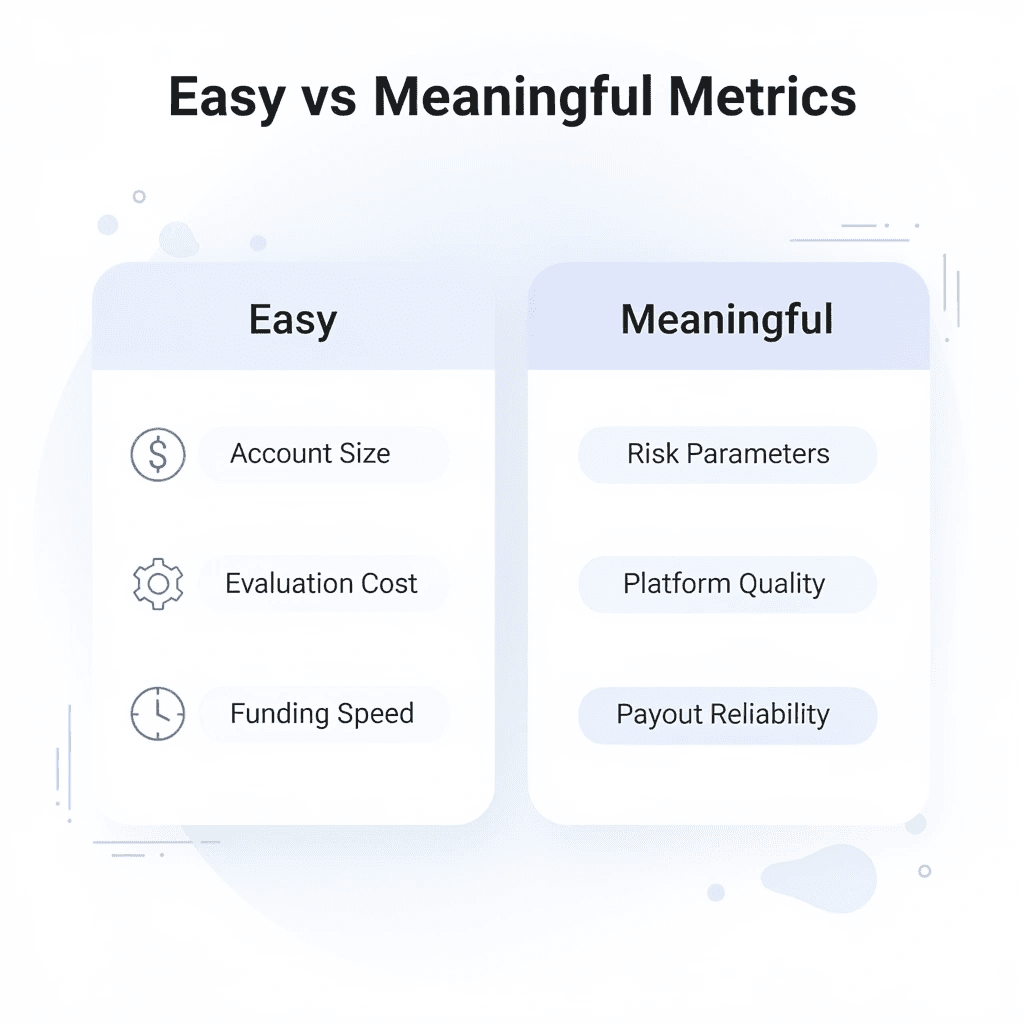
Traders often compare futures prop firms using the easiest metrics to measure: account size, evaluation cost, and funding speed, rather than the most meaningful ones. These numbers rarely predict actual success once funded. Long-term profitability depends on how well a firm's structure aligns with a trader's risk management, execution, and withdrawal strategy.

🎯 Key Point: The metrics that are easiest to compare across prop firms are often the least predictive of your trading success. Focus on operational factors that impact your daily trading performance.
"Surface-level metrics like account size and evaluation cost create a false sense of comparison, while the real determinants of trading success—risk parameters, platform quality, and payout reliability—remain hidden beneath the marketing."
⚠️ Warning: Many traders get distracted by flashy numbers in marketing materials and miss the critical details that will actually determine whether they can scale profitably with a prop firm.
Why do larger account sizes often disappoint traders?
A $150,000 account feels more valuable than a $50,000 account. But if drawdown rules force a trader to reduce position sizes to levels nearly identical to the smaller account, the extra capital becomes decorative. I've watched traders chase the largest available accounts only to realize they can't use more than 30% of the balance without violating risk limits. The account size looked impressive in marketing materials, but the tradable capital was identical to what they could have accessed elsewhere.
How does the risk-reward ratio compare to account size in importance?
According to LuxAlgo Blog, 70% of traders focus on win rate rather than risk-reward ratio, a pattern that extends to how traders evaluate prop firms. A trader with a 45% win rate and a 3:1 risk-reward ratio will outperform someone with a 65% win rate and a 1:1 ratio over time. Similarly, a trader with a $50,000 account and flexible risk parameters may extract more profit than someone with a $150,000 account and restrictive risk parameters.
Why do evaluation costs mislead traders?
Saving $100 on an evaluation fee sounds appealing, but cheaper evaluations often come with stricter consistency rules, longer payout timelines, or lower profit retention. The initial savings disappear quickly. A trader who pays slightly more upfront but operates within a structure that allows faster payouts and higher profit retention often comes out ahead financially in the first few months. The critical question isn't what it costs to get funded—it's what happens after.
How does funding speed affect overall profitability?
The same logic applies to funding speed. Getting an account in three days instead of ten days feels like progress, but faster processing that leads to withdrawal restrictions or complicated profit-sharing tiers eliminates that advantage. What matters is the total timeline from generating profit to holding it in your account, including funding speed, payout processing, withdrawal limits, and any buffers the firm imposes.
What factors actually determine trading success with prop firms?
The traders who get the most value from prop firms focus on three things: how much of their profit they keep, how easily they can access that profit, and whether the firm's risk structure allows them to trade their strategy. These factors require understanding how drawdown rules align with your strategy, how payout schedules align with your cash flow needs, and whether the firm's scaling path aligns with your growth trajectory.
How do modern prop firm structures reduce friction for traders?
Our Futures prop firm removes activation fees, offers flexible profit splits up to 100% on early earnings, and provides instant funding options. These structures reduce friction between generating profit and accessing it, which matters more than headline account size once a trader is consistently profitable. The question isn't how much capital you can access—it's how much of what you earn you can keep and withdraw.
But knowing which metrics matter solves only half the problem. The harder question is which structure fits the way you trade.
Which Futures Prop Firm Is Right for You?
Matching Your Trading Style to the Right Firm
The right futures prop firm removes friction from your trading style. Start with your strategy, risk tolerance, and goals, then work backward to find the structure that supports them.
If You're Building Foundations
New traders need structure more than flexibility. The goal is to develop consistency, an understanding of position sizing, and the ability to operate within professional risk parameters without blowing accounts.
Firms offering coaching, performance feedback, or clearly defined evaluation processes provide more long-term value than those advertising the fastest path to funding. A structured environment builds habits that compound over the years. Learning to manage a $25,000 account properly matters more than gaining access to $100,000 you're not ready to handle.
If You're Trading High Frequency
Scalpers face a different calculation entirely. When taking dozens of entries per session, execution speed and rule flexibility become critical. A prop firm's drawdown structure can eliminate a profitable strategy if it is designed for swing traders who hold positions overnight.
DNA Funded offers over 800 trading instruments, giving scalpers the market access they need. However, instrument availability means nothing if the firm's risk rules don't permit the trade frequency your strategy requires. Scalpers should prioritize how a firm's parameters align with their execution style over headline account sizes.
If You're Prioritizing Steady Income
Consistent traders prioritize reliable withdrawals over aggressive growth. Clear profit-sharing and straightforward withdrawal processes deliver greater long-term value than firms that advertise larger accounts while obscuring payout requirements in the fine print.
Most prop firms offer profit splits of up to 90%, but the structure behind that percentage determines how much you keep. Some firms impose consistency rules or minimum trading day requirements before releasing funds, while others process payouts quickly with minimal restrictions. This difference compounds over months of profitable trading.
If You're Scaling Proven Strategies
Experienced traders view prop firms as capital partners, not teachers. They need quick access to larger positions and the ability to grow without artificial limits.
What matters most for capital growth?
For this group, diversified funding options, multiple account tiers, and long-term profit-sharing structures matter more than the difficulty of evaluation. A firm that lets you scale from a $50,000 account to $200,000 as you prove performance offers more opportunity than one that offers a single large account with no growth path.
Why don't the best firms always stand out?
But knowing your trading style only gets you halfway there, since firms that deliver on these priorities don't always resemble those dominating the ads.
Related Reading
How To Pass A Prop Firm Challenge
How To Choose A Prop Firm
Prop Firm No Challenge
Cheapest Prop Firm
Best Prop Firm For Scalpers
Best Prop Firm For Beginners
Why Goat Funded Futures Stands Out
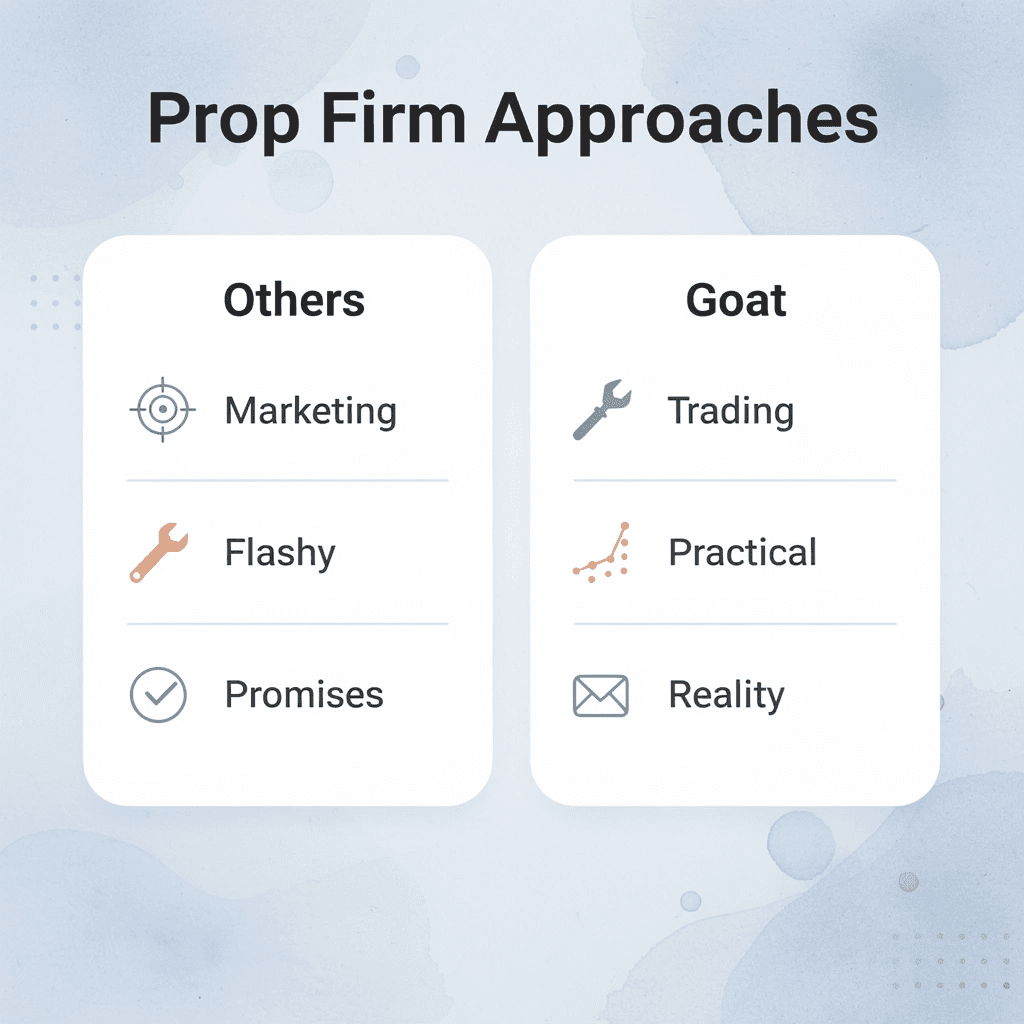
Most prop firms focus on marketing reach, building programs around what sounds impressive in ads. Goat Funded Trader does the opposite: structuring our programs around what traders need to execute consistently, then marketing that reality.

🎯 Key Point: While other firms prioritize flashy marketing, Goat Funded Trader builds programs based on real trading needs first.
"Goat Funded Trader structures programs around what traders need to execute consistently, then markets that reality." — Trading-First Approach
💡 Best Practice: This trader-centric approach means you get practical tools and support rather than just marketing promises.
Multiple Pathways, Not a Single Funnel
Traders come with different skill levels and goals. Some need time to demonstrate consistent trading ability; others have established track records and want funding immediately. Goat Funded Trader offers four funding models (EOD Program, Sprint Program, Instant Funded Program, and Pro Program) so traders can choose a path that matches their experience rather than following a one-size-fits-all plan. A scalper trading 20 times per day needs different rules than a swing trader holding positions overnight. Forcing both through the same evaluation creates unnecessary friction.
Removing Friction Between Evaluation and Execution
Passing an evaluation should mean you're ready to trade. At many firms, it means you're ready to pay another fee. Activation fees create a second barrier after traders have already demonstrated competence, adding cost without value. Goat Funded Trader eliminates activation fees entirely, allowing traders to move directly from passing their challenge to managing funded capital. Requiring traders to maintain a profit buffer before accessing payouts delays the realization of performance benefits. With no mandatory buffer, traders can request withdrawals based on actual profits earned rather than arbitrary milestones.
How does account size compare to profit retention rates?
Account size matters less than how much you keep. A $200,000 account with a 70% profit split returns less on a $5,000 winning month than a $100,000 account with 90%. Goat Funded Trader offers up to 100% profit share on the first $10,000 in profits, allowing early wins to compound faster. Prop Firm Match on Threads reports that more than 7,900 traders in 136 countries have accessed funded accounts through platforms that prioritize transparent profit structures, reflecting improved retention rates when traders see direct value from performance.
Why do transparent fee structures matter for traders?
Most prop firms require traders to navigate complex payout schedules and shifting profit splits as account sizes grow. Goat Funded Futures simplifies this by publishing clear, upfront fee structures and profit-sharing terms, allowing traders to calculate potential earnings before committing. Our platform at a futures prop firm reduces decision fatigue by presenting straightforward terms that don't require spreadsheet modeling to understand.
What separates Goat Funded Futures is its trader-focused approach: flexible pathways that respect different strategies, elimination of unnecessary costs, profit structures that reward performance immediately, and transparent rules that reduce surprises. For traders evaluating options, these operational details determine whether a prop firm enables growth or merely provides access.
Start Trading Futures Today with our Futures Prop Firm
Goat Funded Trader offers four different pathways to funding: EOD, Sprint, Instant Funded, and Pro programs. Each is built around how traders work. You can explore each program to find which structure matches your risk tolerance, time horizon, and profit goals.

Choosing a prop firm means picking one that removes friction instead of adding it. Our Goat Funded Trader program eliminates activation fees, offers clear rules without consistency requirements during evaluation, and provides profit splits up to 100% on your first $10,000. This structure rewards performance immediately rather than delaying it behind arbitrary milestones.
Pick the program that matches where you are now. If you need flexibility, the EOD program lets you trade without intraday drawdown constraints. If you want speed, Instant Funded skips the evaluation entirely. Each pathway serves a different trading style, and your funding experience should support your strategy rather than force you to adapt to someone else's framework.

Related Reading
Leeloo Trading Review
Best Prop Firms 2026
Prop Firm Risk Management
Prop Firm Trading Strategy
Futures Prop Firm Comparison
Prop Firm Rules Explained