How to Pass a Prop Firm Challenge Without Breaking Rules
Learn how to pass a prop firm challenge with proven strategies from Goat Funded Futures. Master risk management, trading psychology, and rules compliance to secure funding fast.

You've studied the charts, practiced your risk management, and spent countless hours refining your trading strategy. Now comes the moment that separates aspiring traders from funded ones: passing a prop firm challenge. Futures prop firms offer incredible opportunities to trade with substantial capital, but their evaluation processes are designed to test your discipline, consistency, and ability to follow strict rules under pressure. This article will walk you through proven strategies to successfully complete your prop firm challenge without falling into common traps that disqualify most traders.
Understanding the challenge requirements is only half the battle. Goat Funded Futures provides traders with clear evaluation parameters and realistic profit targets that reward skillful trading rather than reckless gambling. Their approach focuses on helping you develop sustainable trading habits during the evaluation phase, which means you're not just chasing a quick payout but building the foundation for long-term success as a funded trader.
Table of Contents
Why Most Traders Fail Prop Firm Challenges Before They Reach Profit Targets
The Belief That Keeps Traders Stuck
Why Profitable Traders Still Fail Evaluations
The Framework for Passing a Prop Firm Challenge Consistently
What to Look for in a Prop Firm Challenge
How Goat Funded Futures Helps Traders Pass Challenges With More Consistency
Start Trading Futures Today with our Futures Prop Firm
Summary
Pass rates across prop trading firms typically fall between 5% and 10%, meaning roughly nine out of ten traders never reach the funded stage. According to multiple industry studies and firm disclosures reported in 2024, some datasets show success rates as low as 6%-7%. These numbers remain consistent across firms, suggesting the problem reflects how traders approach challenges rather than any single evaluation structure.
Industry reports consistently identify drawdown violations, emotional trading, and rule breaches as the primary reasons traders fail challenges, not an inability to generate profits. Research published by proprietary trading education platforms in 2024 found that traders who violate drawdown limits during evaluations report that position sizing errors, not directional mistakes, caused over 70% of their failures. They read the market correctly but sized the trade incorrectly.
The way a firm measures drawdown determines how you manage every position. Intraday calculations can trigger violations during normal market volatility, even if the trade would have been profitable by the close. End-of-day drawdown gives your strategy room to breathe and measures risk over a timeframe that matches how profitable trading actually unfolds, not punishing you for normal market movement.
Monthly fees create pressure beyond market performance. If you're paying $100 or more each month just to keep the account active, you're trading against a countdown timer that penalizes patience. Firms that eliminate monthly costs during evaluation remove the artificial urgency, letting you wait for quality setups rather than forcing trades to justify the recurring expense.
The traders who consistently pass prop firm challenges treat the evaluation as a stress test of their discipline, not a race to hit a profit target. They ask how they can remain eligible long enough for their edge to work rather than how fast they can reach the goal. That shift in mindset changes decision-making, prioritizing protected challenge eligibility and preserved capital over the speed of gains.
Futures prop firm addresses this by offering end-of-day drawdown calculations, zero activation fees, and no consistency requirements during evaluation, which removes structural barriers that cause traders to abandon their proven risk management processes.
Why Most Traders Fail Prop Firm Challenges Before They Reach Profit Targets
Most traders fail prop firm challenges not because they lack the ability to make money, but because they cannot stay disciplined under the specific rules of an evaluation environment. The challenge structure exposes weaknesses in risk management, emotional control, and rule adherence that remain hidden in a personal trading account. A single rule violation ends the evaluation, regardless of how profitable your previous sessions were.
🎯 Key Point: Discipline and rule adherence matter more than trading skill in prop firm evaluations. Technical ability won't save you from a single violation.

"Rule violations account for the majority of prop firm challenge failures, even among profitable traders who demonstrate consistent gains throughout their evaluation period." — Prop Trading Industry Analysis, 2024
⚠️ Warning: One mistake can eliminate weeks of profitable trading. The evaluation environment demands perfect compliance, not just profit generation.
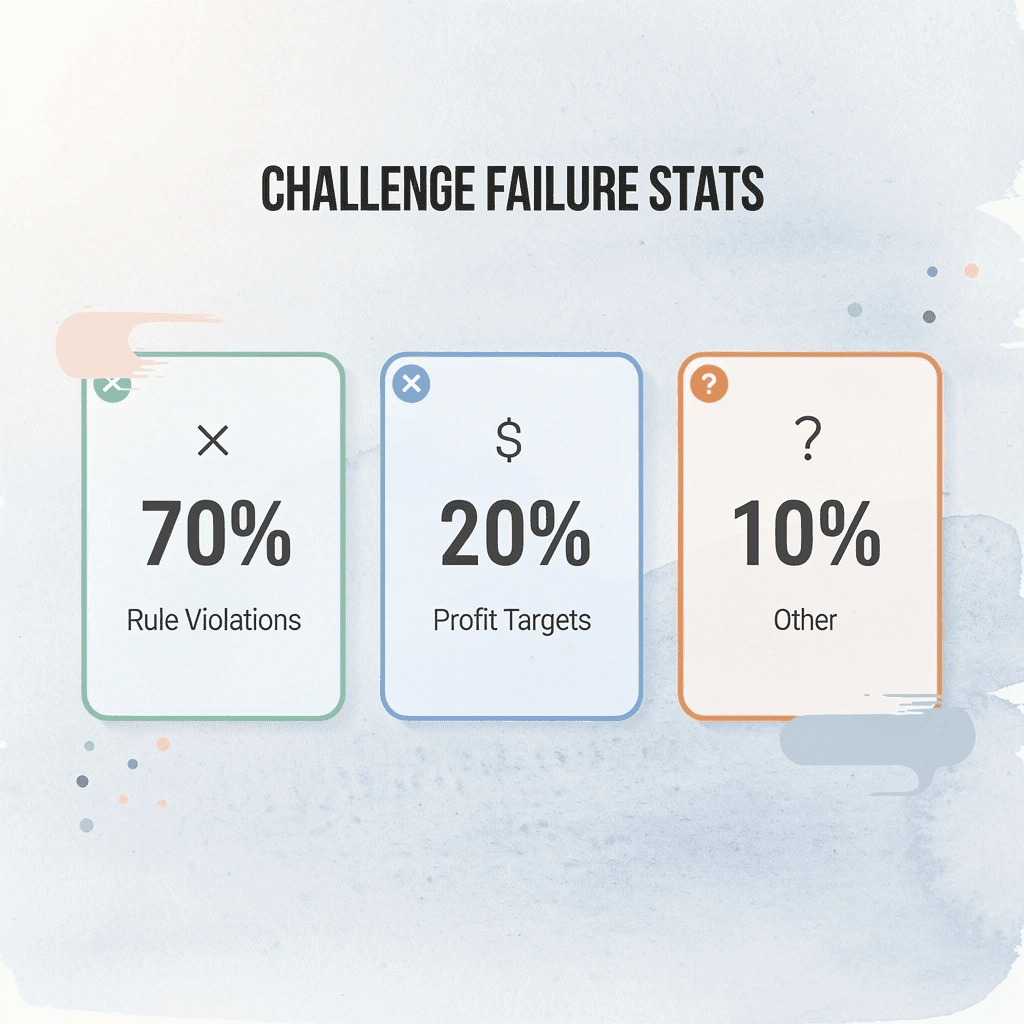
What do the actual pass rates reveal about trader performance?
Pass rates across prop trading firms typically fall between 5% and 10%, meaning roughly nine out of ten traders never reach the funded stage. According to industry studies and firm disclosures reported by Apex Trader Funding in 2024, some datasets show success rates as low as 6%-7%. These consistent numbers across firms suggest the problem stems from how traders handle challenges rather than from issues unique to any single evaluation structure.
What causes traders to fail after becoming profitable?
Traders often become profitable during their evaluation, executing winning trades and building account growth. Then a losing trade triggers frustration. The profit target feels distant, and the evaluation deadline approaches. They increase position size to accelerate progress, abandon their trading plan to chase a recovery, or hold past their stop-loss, expecting a reversal. The account may show net gains, but breaching the drawdown limit ends the evaluation immediately.
Why do traders get trapped in costly challenge cycles?
Industry reports identify drawdown violations, emotional trading, and rule breaches as the primary reasons for failure, rather than an inability to generate profits. This creates a costly cycle: traders pay for multiple challenge resets, increase risk to recover losses, make emotionally driven decisions under pressure, and delay funding by months. Confidence erodes even when their core strategy has an edge.
What Separates Success from Failure
Successful traders understand that a prop firm challenge is not a profit contest—it's a test of capital preservation under specific constraints. Profitable trading days don't guarantee success if profits come with excessive risk, rule violations, or inconsistent position sizing. The challenge rewards traders who prove they'll protect the firm's capital once funded, not those who generate the highest returns during evaluation.
How do prop firms remove structural barriers to success?
Companies like Goat Funded Futures help by removing structural barriers that cause unnecessary failures. Zero activation fees eliminate financial pressure before your first trade, and the absence of consistency requirements during evaluation removes the need to make trades to meet arbitrary frequency rules. Transparent drawdown parameters and the ability to hold trades during news events give traders clarity about what matters: disciplined risk management and sustainable profitability, not gaming a complex ruleset.
What is the real challenge traders must overcome?
The real challenge is proving you can make money while protecting capital, respecting risk limits, and staying consistent under pressure when emotions run high. Understanding why traders fail is only the beginning. The bigger problem is the story traders tell themselves about their repeated failures.
Related Reading
How Proprietary Trading Firms Work
Prop Trading Explained
Swing Trading Futures
End Of Day Drawdown
Scalping Futures
How Do Futures Prop Firms Work
The Belief That Keeps Traders Stuck
Most traders approach prop firm challenges believing that speed equals success. They assume that hitting the profit target quickly proves their skill and secures funding.

🎯 Key Point: The rush to complete challenges fast often leads to overleveraging and unnecessary risks that can destroy an otherwise profitable trading account.
"Speed in trading is often the enemy of consistency - the very trait prop firms are actually looking for in funded traders." — Trading Psychology Research, 2024
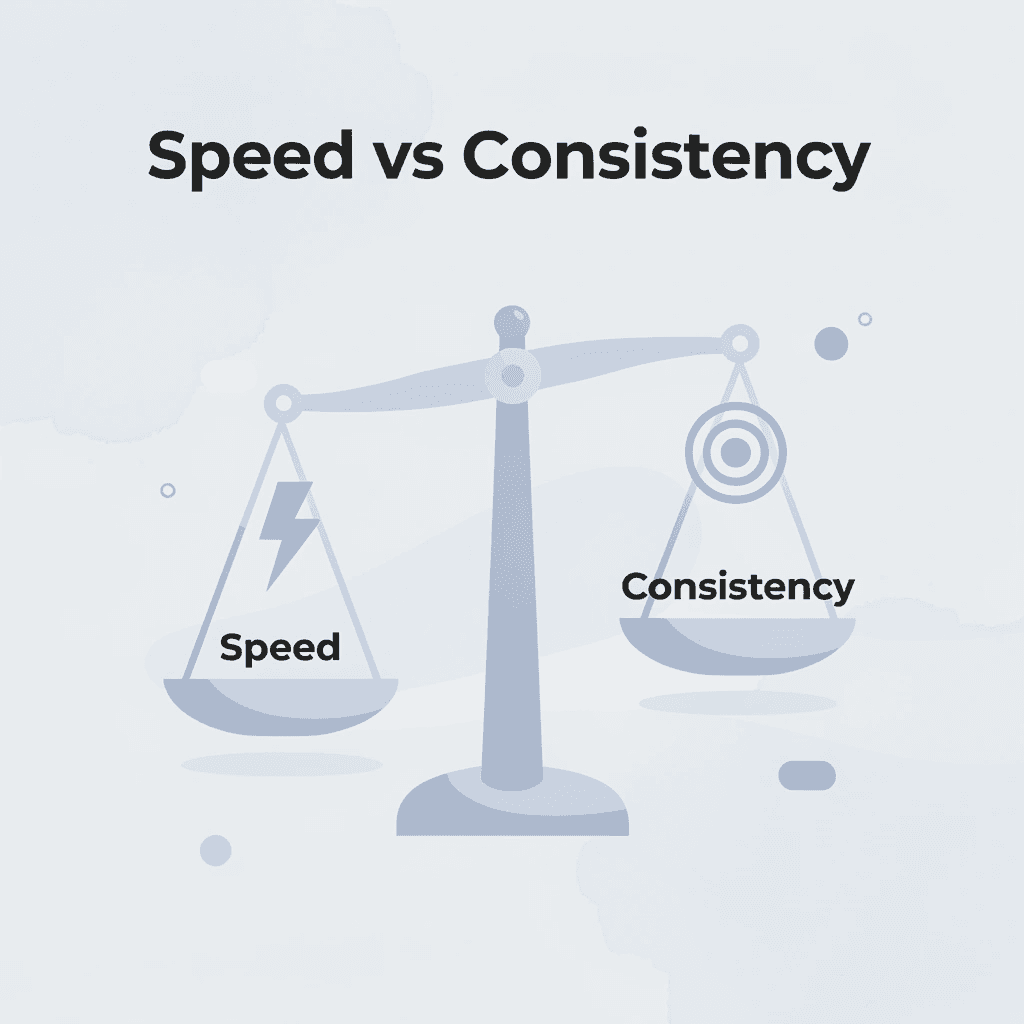
⚠️ Warning: This speed-focused mindset creates a dangerous cycle where traders sacrifice their risk management principles for the illusion of quick success, ultimately failing challenges they could have easily passed with patience.
How does social media amplify this dangerous mindset?
The trading industry reinforces this mindset. Social media feeds overflow with images of funded accounts and stories of reaching targets in days rather than weeks. Payout announcements garner thousands of views, while discussions of drawdown management, position-sizing discipline, and trade-selection criteria receive little attention. When profit becomes the main story, risk becomes the footnote.
What happens when traders focus only on profit targets?
This creates a dangerous inversion. Traders measure progress by points captured rather than capital protected. A trader needing $3,000 to pass calculates how many winning trades that requires, how many contracts per trade, and how quickly they can compound gains. The evaluation rules transform from guardrails into obstacles.
When speed becomes the priority
The problems show up in predictable ways. A trader who normally risks one contract suddenly takes three to reach the target faster. Someone behind schedule takes trades outside their plan to make up ground. After a losing day, pressure to recover overrides discipline to wait for quality setups. Each decision prioritizes acceleration over protection.
Why do position sizing errors cause most failures?
Every change increases the chance of breaking a rule. A trader might have the skill to reach the profit goal, but exceeding the drawdown limit on day twelve negates those twelve days of work. According to research from proprietary trading education platforms in 2024, traders who broke drawdown limits reported that position-sizing errors, not directional mistakes, caused over 70% of their failures. They read the market correctly but sized the trade incorrectly.
How do transparent rules reduce gaming behavior?
Companies like Goat Funded Futures set up challenges to reward disciplined trading over aggressive profit chasing. Their challenges feature clear rules without consistency requirements, instant funding that skips multi-phase testing, and the ability to hold trades during news events. This environment lets traders focus on process rather than speed, and when the ruleset removes unnecessary barriers, they manage risk properly rather than gaming the system.
What mindset shift helps traders pass consistently?
Traders who consistently pass challenges operate from a different premise: they understand evaluation tests, risk management, and not profit maximization. Instead of asking how quickly they can hit the target, they ask how they can stay within risk parameters while executing their strategy consistently. This shift transforms the challenge from a race into a demonstration of control. Understanding the right belief system is only half the equation. Even traders with profitable strategies and proper risk awareness still fail evaluations, revealing something uncomfortable: how skill translates under pressure.
Why Profitable Traders Still Fail Evaluations
Making money alone does not guarantee funding. Prop firms examine how profits are made, not just whether profits occur. A trader who reaches the profit goal while repeatedly violating risk parameters demonstrates a fundamentally different skill set from one who achieves similar results through disciplined execution and controlled risk.

🎯 Key Point: Prop firms evaluate trading process quality, not just profit outcomes. Risk management consistency often weighs more heavily than total returns in funding decisions.
"Disciplined execution and controlled risk demonstrate the sustainable trading habits that prop firms seek in funded traders." — Trading Psychology Research, 2024
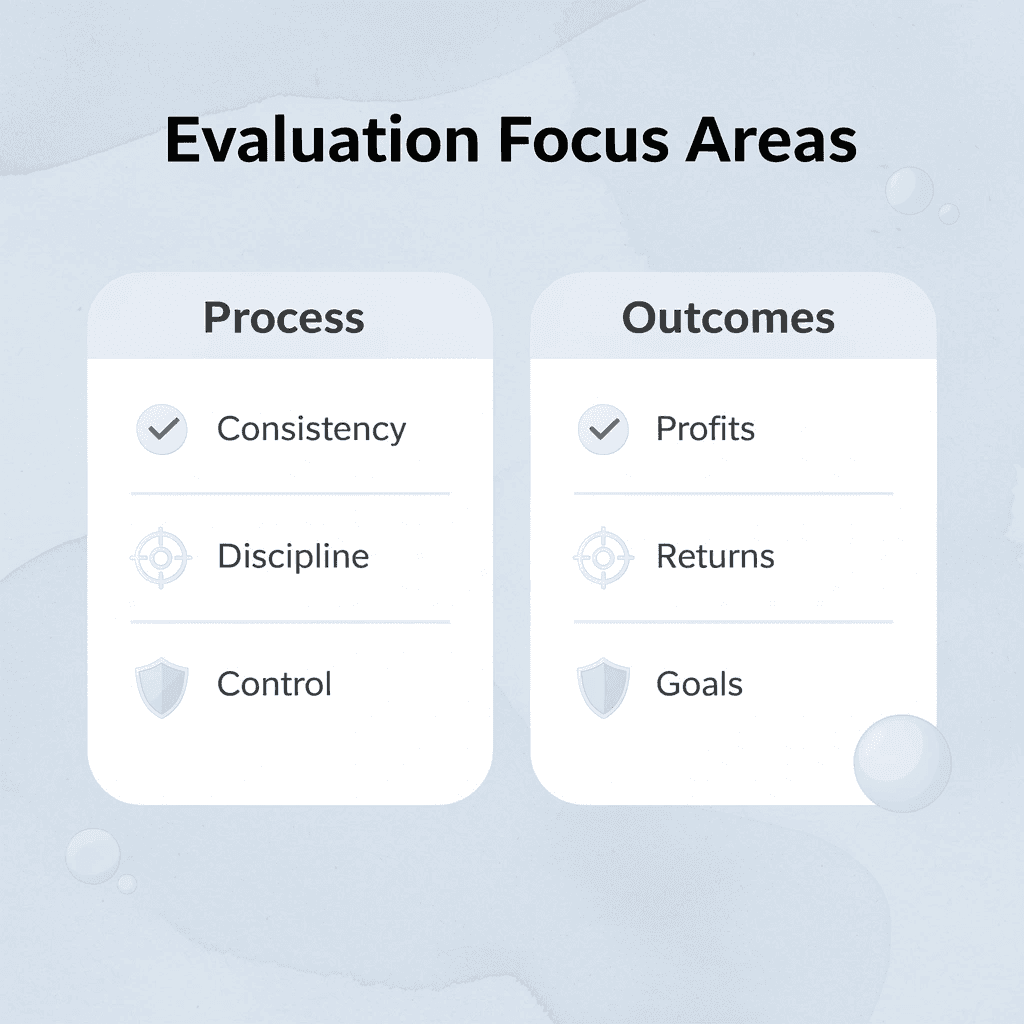
⚠️ Warning: Frequent risk violations during evaluation periods signal to prop firms that a trader may not maintain capital preservation standards when managing larger account sizes.
Overtrading Destroys Otherwise Solid Performance
The urge to constantly participate in the market undermines more evaluations than most traders realize. After a profitable trade, confidence breeds unnecessary entries. After a losing trade, the impulse to recover losses pushes traders into marginal setups. More trades do not create better results; they simply create more opportunities to break a trading plan and increase the probability of crossing a drawdown threshold or violating position limits.
Inconsistent Position Sizing Makes Risk Unpredictable
A trader risks one contract on a moderate setup, then increases to three contracts on the next trade because the pattern looks stronger. This makes risk management impossible to evaluate. Risk becomes unpredictable, and prop firms cannot fund traders whose exposure varies with subjective confidence levels rather than objective risk parameters. When position sizing is driven by emotion rather than process, capital preservation becomes a gamble rather than a system.
Emotional Revenge Trading Erases Days of Progress
Revenge trading damages evaluations faster than almost any other behavior. After a loss, pressure to recover immediately overrides discipline, causing traders to enter positions based on emotion rather than process. These trades are often larger, less disciplined, and disconnected from the original trading plan. A single emotional decision can erase days of careful progress, and the pattern rarely stops with one trade. As losses accumulate and time pressure intensifies, urgency compounds into larger position sizes and lower-quality entries, triggering the exact violations that end evaluations. Our Goat Funded Futures program addresses this by removing consistency requirements during evaluation and eliminating monthly fees, reducing the artificial time pressure that fuels emotional trading decisions.
What happens when traders abandon proven setups?
Traders skip good opportunities during normal markets, then become aggressive when they feel behind. They trade unfamiliar patterns, enter lower-probability trades, or try untested markets. The desire to reach goals quickly causes them to abandon the process that made them money. This shift occurs gradually as they become rushed rather than patient, losing the ability to distinguish real setups from forced opportunities.
Why do profitable traders still fail prop firm challenges?
The real challenge is not whether traders can make profits—most can—but keeping the discipline, consistency, and capital preservation that prop firms require. This explains why profitability and failure can coexist in the same evaluation.
The Framework for Passing a Prop Firm Challenge Consistently
Traders who pass prop firm challenges consistently treat the evaluation as a stress test of their discipline, not a race to hit profit targets. They ask how they can stay eligible long enough for their edge to work: a mindset shift that changes everything.

🎯 Key Point: The fundamental difference between successful and failed prop traders lies in their approach: discipline-first versus profit-first mentality.
"Successful prop traders focus on risk management and consistency rather than chasing quick profits during evaluation periods." — Prop Trading Industry Report, 2024

💡 Pro Tip: Before entering any prop firm challenge, ask yourself: "Can I execute my trading plan under pressure while maintaining strict risk parameters for 30-60 days straight?" If the answer is no, you're not ready yet.
Failed Trader Mindset | Successful Trader Mindset |
|---|---|
Profit-focused | Process-focused |
Rushes to hit targets | Focuses on consistency |
Ignores risk limits | Respects drawdown rules |
Trades with emotion | Maintains discipline |
Views challenge as opportunity | Views challenge as a stress test |
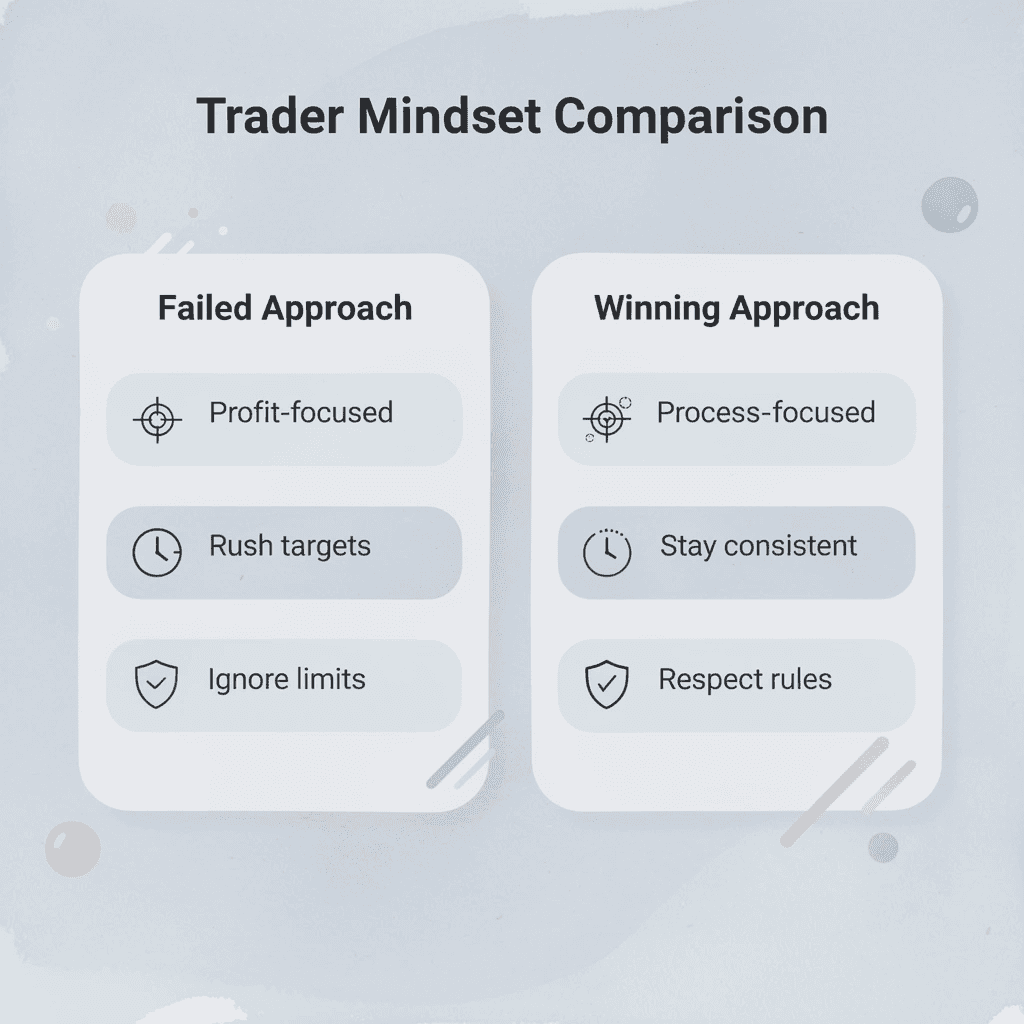
Build a Challenge Plan Before Trading
Most traders analyze price action extensively but rarely define how they'll operate in a challenging environment. A challenge plan removes emotional decisions that lead to rule violations. Before trading, define maximum risk per trade, maximum daily risk, trading hours, approved setups, and stop-trading rules. For example, risk 1% per trade, trade only during the first two hours after market open, and stop after losing 2% of account equity. These rules create consistency and prevent emotions from taking control during difficult periods. Without a predefined plan, traders often create new rules in response to losses, typically when the biggest mistakes occur.
Prioritize Drawdown Management
Successful challenge participants focus on protecting their ability to keep trading, not on reaching the profit target as quickly as possible. This fundamentally changes decision-making: disciplined traders ask how they can avoid breaking risk limits rather than how quickly they can reach the target. This approach prioritizes protecting challenge eligibility, preserving capital, and thinking in terms of consistency rather than speed. A trader who stays within risk limits throughout evaluation has far more opportunities to reach the target than one who repeatedly approaches maximum drawdown in pursuit of faster gains.
Trade the Same Strategy You Intend to Use When Funded
One of the biggest mistakes traders make is treating the challenge as a special event requiring a different approach. They increase leverage, take trades outside their tested strategy, or become more aggressive to pass quickly. These changes introduce unnecessary risk and reduce consistency.
How should you approach the challenge phase?
Instead, trade the challenge as you would a funded account: avoid system changes midway through, avoid increased leverage to accelerate progress, focus on repeatable execution, and treat it as a practice run for funded trading. If a strategy cannot pass using normal risk parameters, becoming more aggressive rarely solves the problem.
What alternatives exist to traditional challenge structures?
Goat Funded Futures removes barriers that tempt traders to deviate from their plan by offering instant funding that skips evaluation entirely, eliminating pressure to rush through a challenge. The structure removes activation fees and consistency requirements, allowing traders to focus on executing their strategy without worrying about hidden restrictions or monthly costs that create a sense of urgency. Passing a prop firm challenge requires building a repeatable process that balances profitability with risk control. The traders who pass consistently are rarely the most aggressive; they are usually the most disciplined.
Related Reading
Cheapest Prop Firm
How To Choose A Prop Firm
Best Prop Firm For Scalpers
Best Prop Firm For Beginners
Prop Firm No Challenge
Best Prop Firm For Swing Trading
What to Look for in a Prop Firm Challenge
The challenge you choose shapes your path to funding as much as your trading strategy does. Not all evaluations are built the same: the structure can either support disciplined trading or force you into unsustainable risk behaviors. The right challenge aligns with how you trade at your best.

🎯 Key Point: Your prop firm challenge selection is just as critical as your trading plan—choose one that complements your natural trading style rather than forcing you to adapt to unrealistic parameters.
"The structure of your evaluation can either support disciplined trading or force you into unsustainable risk behaviors." — Trading Psychology Research
⚠️ Warning: Many traders fail not because of poor trading skills, but because they choose challenges with drawdown limits or profit targets that don't match their risk management approach.
How do prop firms calculate drawdown differently?
The way a firm measures drawdown determines how you manage every position. Some firms calculate drawdown during the trading day, so your account equity changes with every price movement during market hours. Others use end-of-day calculations, measuring drawdown only after the session closes.
Calculations during the trading day can trigger violations during normal market changes, even if the trade would have been profitable by close. You might hold a position that moves against you temporarily during a news spike, only to recover minutes later, but a drawdown rule during the trading day ignores recovery. It only measures the lowest point your equity touched.
Why does end-of-day drawdown benefit traders?
Ending the day by reducing your positions gives your strategy space to work. If your edge depends on holding through intraday fluctuations or managing positions over several hours, a drawdown structure that penalizes temporary changes works against you. The challenge should measure risk over a timeframe that matches how profitable trading actually happens.
What are the upfront costs and hidden fees?
Challenge fees fund the evaluation process, but transparency distinguishes firms that want traders to succeed from those that profit primarily from repeated attempts. Know exactly what you're paying upfront: the initial challenge fee, monthly platform costs, reset fees after rule violations, and activation fees before trading a funded account. Some firms advertise low entry costs but add fees at every stage, turning a $150 challenge into a $400+ commitment before you see a payout.
How do monthly fees affect your trading strategy?
Monthly fees create artificial urgency. Paying $100+ monthly means you're trading against a countdown timer, not the market. Firms that eliminate monthly costs during evaluation let you wait for quality setups instead of forcing trades to justify recurring expenses.
What should you know about profit split percentages?
Passing the challenge only matters if you keep enough of what you earn. Profit splits range from 80% to 100%, but the percentage alone doesn't tell the whole story. Some firms offer higher splits only after you reach specific milestones or trade for a certain amount of time. Others start at 80% and never increase it. The best structures reward consistency with better terms over time, but you need to understand what you're earning from day one.
How do payout frequency and withdrawal rules affect your earnings?
How often you get paid and the rules for withdrawals matter equally. If a company holds your profits for 60 days or requires you to meet multiple goals before requesting a withdrawal, you must wait longer to access your money. You should be able to get your share of profits without unclear conditions.
Rule Flexibility and Evaluation Design
Rigid evaluation structures assume every profitable trader operates the same way. Some traders perform best with instant funding models that skip evaluation entirely, while others prefer structured challenges with clear milestones. The critical question is whether the firm offers options that match your trading style or forces you into a single format regardless of your strategy or experience level.
How do consistency rules impact your trading strategy?
Consistency rules during evaluation create friction. Some firms require minimum trading days, profit targets within specific windows, or penalize behaviors normal for your strategy: holding positions overnight, trading around news events, or taking fewer high-conviction setups. The most trader-friendly evaluations measure whether you generate profits while managing risk, not whether you conform to arbitrary activity requirements.
Which firms remove unnecessary evaluation barriers?
Most firms treat evaluations as gatekeeping mechanisms, but a growing number recognize that removing unnecessary barriers helps capable traders reach funding faster. Platforms like Goat Funded Futures offer instant funding, zero activation fees, and end-of-day drawdown calculations that align with how disciplined traders manage positions. When the structure supports your process rather than fighting it, passing becomes less about adapting to artificial constraints and more about executing the strategy you've already proven to work. But choosing the right challenge is only half the equation. The other half is understanding how specific firms convert those structural advantages into trader success.
How Goat Funded Futures Helps Traders Pass Challenges With More Consistency
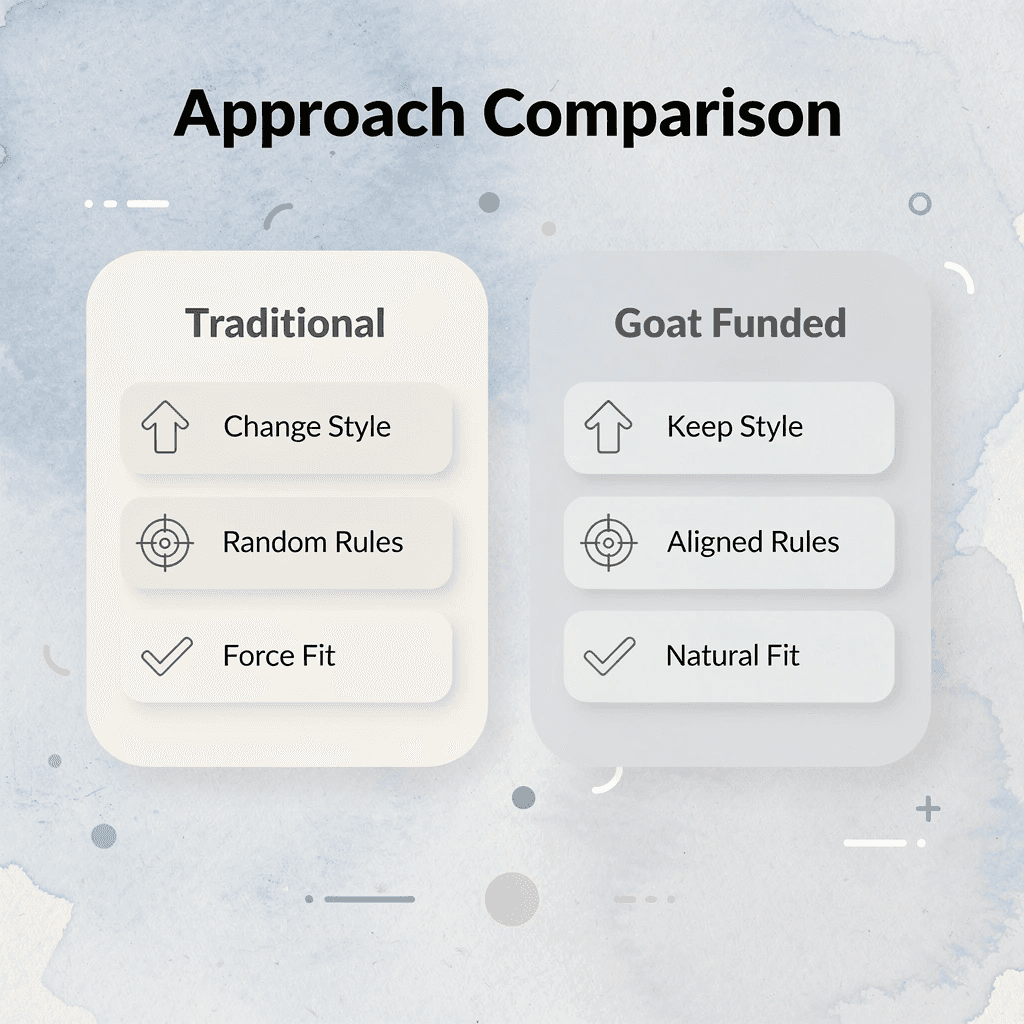
How well a prop firm's rules match your actual trading process matters more than your win rate when it comes to passing or failing. Goat Funded Futures was built on the idea that traders shouldn't have to change their risk management to fit random evaluation rules; instead, the evaluation should support the behaviors that already create consistent results.
🎯 Key Point: The alignment between your natural trading style and the firm's evaluation criteria is the single most important factor in determining your success rate in the challenge.
"Traders shouldn't have to change their risk management to fit random evaluation rules—the evaluation should support behaviors that create consistent results." — Goat Funded Futures Philosophy
💡 Best Practice: Before choosing any prop firm, evaluate whether their daily loss limits, maximum drawdown rules, and profit targets align with your existing position sizing and risk management approach.
End-of-Day Drawdown Changes Everything
The EOD Program uses an end-of-day drawdown calculation that eliminates a common failure pattern: exits triggered too early by intraday volatility. When drawdown is measured at market close rather than tick-by-tick, you stop making defensive decisions that conflict with your strategy. A swing trader can hold through temporary adverse movement without triggering a violation. This structural shift removes the psychological friction that causes traders to abandon their plan mid-trade, where most rule violations occur.
Multiple Funding Paths Reduce Pressure
Not every trader needs the same path to capital. Some benefit from a structured evaluation period that reinforces discipline, while others already possess the consistency required and need only access. Goat Funded Futures offers the Sprint Program for faster evaluations, the Instant Funded Program for traders who want to skip evaluation entirely, and the Pro Program for enhanced payout structures. Choosing a path that matches your skill level and timeline eliminates unnecessary stress.
Transparent Costs Eliminate Reset Traps
Many traders spend more on repeated challenge attempts than they would have lost trading their own capital. Goat Funded Futures addresses this with straightforward one-time fees and no activation charges. Without hidden monthly costs or surprise fees, budgeting becomes predictable. The firm also offers up to 100% profit share on the first $10,000, meaning early trading gains stay with you rather than being split into structures that favor the firm.
How does full capital access impact your trading strategy?
Some firms require you to keep extra money above the drawdown limit, effectively reducing your usable capital before you start trading. Goat Funded Futures removes that barrier. You can use the full account size within the stated risk parameters, so that your position-sizing calculations match the actual capital available. For traders who've already built strategies around specific risk-per-trade percentages, this eliminates the need to recalculate.
What separates traders who pass consistently?
The traders who consistently pass aren't the ones with the highest win rates or the fastest profit curves. They're the ones who found a funding structure that supports the process they've already proven works. When the rules align with how you manage risk, passing becomes execution rather than adaptation. But structure alone doesn't guarantee success if you're still guessing at your next move.
Start Trading Futures Today with our Futures Prop Firm
Check out Goat Funded Futures' EOD Program to see how our end-of-day drawdown structure supports disciplined evaluation. Start your challenge with a clear risk plan: maximum daily loss, position sizing rules, and stop-trading thresholds.

🎯 Key Point: Traders who pass consistently aren't those with the highest win rates—they're those who found a funding structure supporting their proven process. When the rules line up with how you manage risk, passing becomes execution, not adaptation.
"When the rules line up with how you manage risk, passing becomes execution, not adaptation." — Successful Futures Trading Principles

💡 Tip: The most successful traders focus on risk management alignment rather than chasing perfect win rates—find a prop firm structure that supports your trading methodology.
Related Reading
Best Prop Firms 2026
Leeloo Trading Review
Prop Firm Risk Management
Prop Firm Trading Strategy
Futures Prop Firm Comparison
Prop Firm Rules Explained