Swing Trading Futures: Build Consistency With Less Screen Time
Swing trading futures strategies from Coworker help you build consistent profits with minimal screen time. Master timing and risk management today.

Staring at trading screens for hours, watching every tick and price swing, creates the kind of burnout that drives many traders away from futures markets. Swing trading futures offers a sustainable alternative, allowing traders to capture multi-day price movements in commodities, indices, and other contracts without the constant pressure of intraday decisions. This approach focuses on daily and weekly chart analysis, quality setup identification, and disciplined position management rather than split-second scalping decisions.
Success in swing trading futures requires adequate capital and a framework that rewards patience over quick profits. The right trading environment supports longer holding periods and strategic position sizing, both of which are essential for capturing meaningful price movements over multiple trading sessions. Traders looking to implement this approach effectively often benefit from partnering with a futures prop firm that understands and supports swing trading strategies.
Table of Contents
Why Most Futures Traders Struggle to Stay Consistent
The Hidden Cost of Treating Every Market Move as an Opportunity
Why Swing Trading Futures Appeals to Growing Traders
What Separates Successful Futures Swing Traders From Everyone Else
The Biggest Obstacle: Aligning Funding With Your Trading Style
How Goat Funded Futures Helps Swing Traders Scale With Confidence
Start Trading Futures Today with our Futures Prop Firm
Summary
Swing trading futures attracts nearly half of all active traders according to the 2024 Charles Schwab Trader Sentiment Survey, making it one of the most common trading styles among market participants. This preference reflects a practical reality: most traders need an approach that balances market participation with manageable time commitments and fewer high-stress decisions. The strategy removes the pressure to react to every tick, allowing traders to focus on multi-day directional trends and higher timeframe structure that develops over sessions rather than minutes.
Excessive trading activity destroys more accounts than market volatility. Research tracking equity futures traders in Brazil found that 97% of traders who day-traded for more than 300 days lost money, while a separate study from Taiwan found that fewer than 1% of day traders achieved persistent profitability after accounting for costs and fees. The pattern holds across markets because constant decision-making under pressure creates mental exhaustion that leads to poor choices, not because traders lack technical knowledge or chart-reading ability.
Transaction costs accumulate faster than most traders calculate, especially for high-frequency approaches. A trader executing 15 round-turn contracts daily at $4.50 per side pays $2,700 monthly in fees alone before accounting for a single losing trade. Research published by the Futures Industry Association in 2023 shows that transaction costs can consume 18 to 25% of gross profits for lower-frequency traders, making selectivity a mathematical advantage rather than just a psychological preference.
Disciplined swing traders risk no more than 1 to 2% of capital per trade, according to Forbes, ensuring that even a string of losses doesn't eliminate their ability to participate in future opportunities. This risk management approach becomes critical when holding positions for days rather than minutes, as market gaps and overnight moves pose real risks that can't be mitigated by constant monitoring. Position sizing protects traders from scenarios they can't predict while allowing probabilities to work in their favor over time.
Most prop firm evaluation models create structural conflicts for swing traders by imposing consistency rules, short evaluation windows, and daily loss limits that force traders into shorter timeframes, whether or not those align with their strategy. These requirements measure activity distribution rather than process quality, penalizing the patience and selectivity that actually predict long-term success. The mismatch between how markets reward swing trading and how traditional funding programs measure performance becomes the obstacle, not the trading itself.
Goat Funded Futures addresses this by removing consistency rules during evaluation and offering end-of-day drawdown plans that give swing traders the flexibility to hold positions overnight without worrying that intraday volatility will trigger account violations.
Why Most Futures Traders Struggle to Stay Consistent
Traders lose consistency by confusing activity with progress. More screen time and trades don't create better results—they destroy performance. When you treat every price movement as requiring action, you stop following a plan and start reacting to noise.

🎯 Key Point: The most successful traders understand that fewer, higher-quality trades consistently outperform high-frequency reactive trading. Quality over quantity is the foundation of sustainable trading performance.
⚠️ Warning: Overtrading is the fastest way to turn a profitable strategy into a losing one. When you chase every market move, you're not trading—you're gambling with your capital.

"Excessive trading destroys more trading accounts than any other single factor, with overactive traders underperforming the market by 3-7% annually due to transaction costs and poor timing." — Financial Markets Research, 2023
What does the research reveal about overactive trading?
The evidence is clear: Brad Barber and Terrance Odean's research found that the most active traders underperformed less active participants because excessive trading increased costs and reduced returns. A study of equity futures traders in Brazil found that 97% of traders who day traded for more than 300 days lost money. Research from Taiwan showed that fewer than 1% of day traders made consistent profits after costs and fees. This pattern holds across markets, timeframes, and experience levels.
What behavioral patterns destroy trading careers?
The problem isn't market knowledge or technical skill. Most struggling traders can read charts, identify support and resistance, and explain momentum indicators. What breaks them is the behavioral loop that forms when trading becomes constant activity. You open a position, watch it move against you by a few ticks, and immediately question whether to exit. A winning trade gains momentum, and you close it early for fear of giving back profits. The next setup doesn't meet your criteria, but you take it anyway because sitting still feels like a waste of time.
This cycle accelerates emotional fatigue faster than it builds skill. According to Cultural Daily, 90% of traders fail within their first year. Constant decision-making under pressure creates mental exhaustion, leading to poor choices. You stop trusting your process because too many micro-decisions obscure it.
How does swing trading futures break the overtrading cycle?
Swing trading futures removes the pressure to constantly act. Holding positions across multiple sessions lets setups develop without monitoring every tick. Daily and weekly charts show clearer structure with less noise, allowing you to follow rules instead of improvising under stress.
Traditional prop firms reinforce overtrading by imposing daily profit targets that pressure traders to force setups. When you need to hit specific metrics within tight windows, patience becomes a liability. Futures prop firms like Goat Funded Futures eliminate consistency rules during evaluation, allowing traders to focus on quality setups rather than arbitrary daily benchmarks. This structure rewards disciplined position management, the skill that separates sustainable traders from those trapped in the activity cycle.
Why does selectivity become an advantage in futures swing trading?
The question most traders avoid is whether their struggle stems from insufficient knowledge or overtrading. Swing trading futures rewards selectivity over speed. You're identifying structural moves that unfold over days, managing risk across sessions, and letting time work in your favor instead of against it. But reducing trade frequency only solves half the problem.
The Hidden Cost of Treating Every Market Move as an Opportunity
The hidden cost shows up in your account balance and mental energy. Treating every price change as a trade multiplies exposure to commissions, slippage, and poor timing while reducing your ability to recognize setups that matter. The market rewards patience, but most traders pay a premium for the illusion of productivity.

🎯 Key Point: Overtrading creates a double penalty - you lose money on bad entries while missing the high-probability setups that could have been profitable.
"The market rewards patience, but most traders pay a premium for the illusion of productivity."
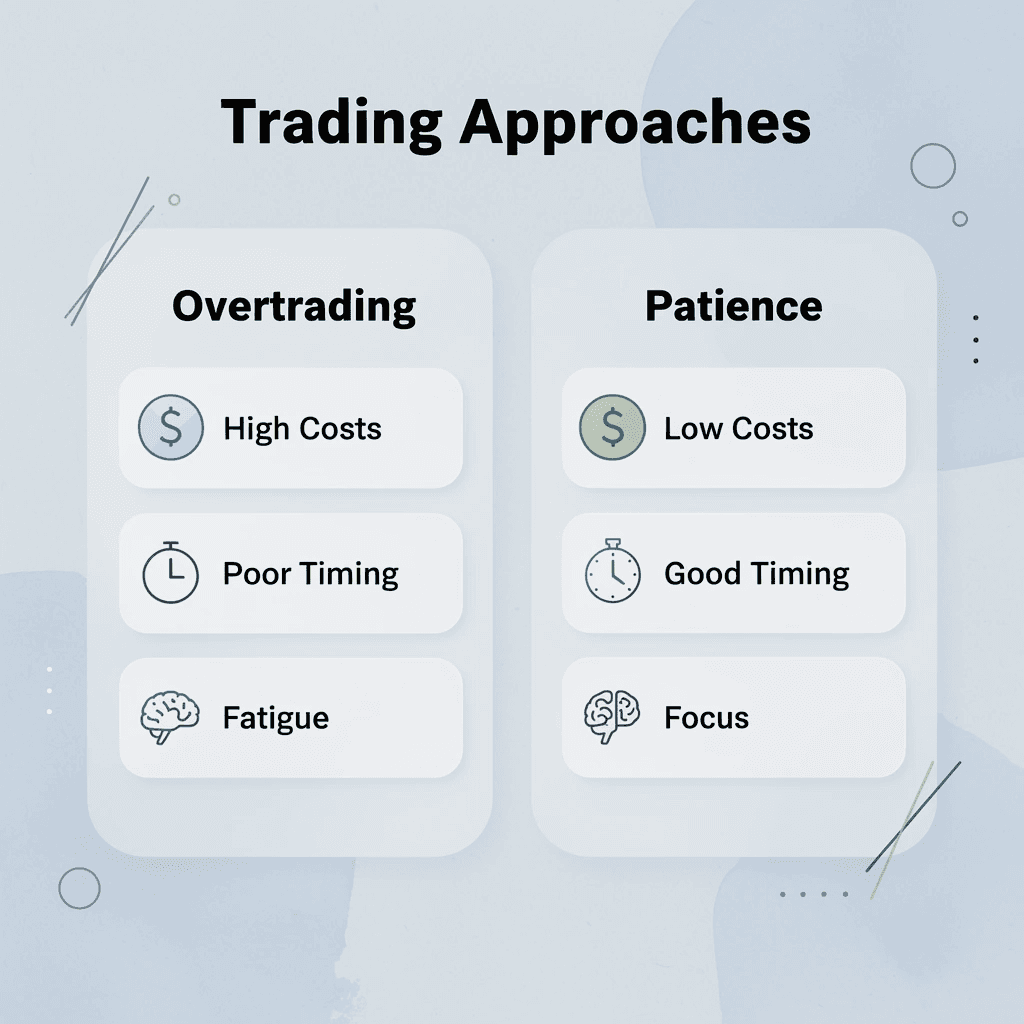
⚠️ Warning: Each unnecessary trade compounds the damage through transaction costs and emotional fatigue, making it harder to execute when real opportunities emerge.
The Arithmetic of Excessive Activity
Commission costs add up faster than most traders realize. A trader executing 15 round-turn contracts per day at $4.50 per side pays $135 daily in fees. Over a 20-day trading month, that's $2,700 in costs before accounting for losing trades or slippage. To break even, this trader must generate enough profit to cover those fees and account for losing trades. Traders focused on swing positions in futures markets might instead execute three to five trades per week, reducing monthly commission costs by 60% or more while maintaining similar profit potential through larger, more selective moves.
How does decision fatigue impact trading discipline?
Your brain treats every trade decision as a separate choice, depleting your thinking power. Decision quality deteriorates after you make many choices throughout the day—a problem called decision fatigue. In a 2011 study published in the Proceedings of the National Academy of Sciences, researchers found that judges were significantly more likely to allow parole at the start of their sessions than at the end, regardless of case details, across more than 1,000 decisions. Trading creates the same problem: after watching dozens of price changes and evaluating multiple entry opportunities, your ability to stick to your trading plan weakens precisely when you need discipline most.
Why does cognitive load worsen with screen time?
Your brain gets tired when balancing trading with other responsibilities. You plan to make only high-probability trades, but after three hours of watching every five-minute price change and analyzing every support level, you execute a trade that barely makes sense simply because of the time invested. This is the sunk cost fallacy, and it unfolds in real time.
What is the noise-to-signal problem in futures trading?
Most intraday price action represents repositioning rather than trend development. Liquidity providers adjusting inventory, algorithmic systems executing programmed patterns, and short-term speculators reacting to headlines create constant movement that appears as opportunity but functions as a distraction. A futures contract might move 20 points during a session, but only four to six of those points represent directional momentum worth trading. The rest is chop, reversion to mean, and volatility without conviction. Traders who attempt to capture every move spend their capital and attention on the 70% of price action that goes nowhere, missing the 30% that trends.
How does swing trading solve the noise problem?
Swing trading futures shifts focus toward multi-day price structures where noise matters less than direction. A two-point intraday reversal becomes irrelevant if the three-day trend remains intact. You stop reacting to every small movement and respond to actual changes in market structure.
The Evaluation Advantage
Traditional prop firm evaluation models penalize hyperactivity with consistency rules that make frequent trading nearly impossible. Firms like futures prop firm have removed those constraints during evaluation, recognizing that traders develop better habits when not forced to manufacture trades to meet arbitrary frequency requirements. This allows traders to wait for genuine setups rather than fill quotas, making selectivity an advantage rather than a compliance burden.
How does activity replace strategy in swing trading futures?
The dangerous cycle starts innocently. You open your platform planning to trade only A-grade setups. After two hours of watching the price move without taking action, impatience creeps in. You lower your standards, taking a B-grade setup to justify the time spent. That trade loses. Now you're frustrated and behind, which makes the next marginal setup look more appealing. More trades follow, each slightly less aligned with your original plan. By day's end, you've made eight trades instead of one, paid substantial fees, and can't remember which setups matched your criteria. You were busy, but not strategic.
What does the market actually reward?
The market doesn't reward effort; it rewards accuracy.
Related Reading
Why Swing Trading Futures Appeals to Growing Traders
Swing trading futures attracts developing traders because it removes the pressure to make constant decisions while still offering exposure to meaningful price movements. Traders focus on multi-day directional trends, higher timeframe structure, and key technical levels that develop over sessions rather than minutes.

🎯 Key Point: Swing trading allows traders to capitalize on major market moves without the stress of minute-by-minute decision-making that characterizes day trading.
"Swing trading provides the perfect balance between time commitment and profit potential, making it ideal for traders who want substantial market exposure without constant monitoring." — Futures Trading Institute, 2024

💡 Tip: Focus on weekly and daily charts to identify the strongest trend signals while avoiding the noise of shorter timeframes that can lead to premature exits.
How does swing trading create better trading conditions?
This shift from overactivity to selective trading creates space for better preparation, clearer risk management, and more thoughtful trade evaluation.
What do trader surveys reveal about swing trading popularity?
According to the 2024 Charles Schwab Trader Sentiment Survey, almost half of active traders identified as swing traders, making it one of the most common trading styles. This reflects a practical reality: most traders seek to participate in the market while maintaining time for other commitments and minimizing decision-related stress.
How does decision fatigue impact trading performance?
One of the most underestimated challenges in futures trading is decision fatigue. Every entry, exit, stop adjustment, and position size calculation depletes mental energy. When you're making 10 or 15 decisions per session, decision quality deteriorates over the course of the day. Swing trading naturally limits the number of choices required. You define your thesis, set your risk parameters, and allow the trade time to develop without constant interference. This slower pace improves execution quality by reducing reactions to noise and hourly second-guessing.
Why does focusing on quality over quantity matter?
The urge to trade too much often stems from boredom or impatience rather than genuine opportunities. When watching a screen for something to happen, mediocre trades begin to look appealing. Swing trading removes that pressure by design. You're waiting for two or three strong opportunities that match your criteria, not seeking 20 setups each week. This shift from quantity to quality trades becomes one of the most important steps in building a repeatable process.
Why do higher timeframes align better with real-life schedules?
Most traders cannot watch the markets all day and night. Futures move 23 hours a day across multiple sessions, making it unrealistic to track them constantly while balancing a job, business, school, or family. Swing trading lets you participate in big price movements without constantly staring at your screen. You can study charts in the evening, set alerts for important price levels, and manage your positions without sacrificing other responsibilities.
How do prop firms support swing trading strategies?
Futures prop firms like Goat Funded Futures have removed traditional barriers by eliminating consistency rules during evaluation and offering end-of-day drawdown plans. This allows traders to hold positions overnight without intraday volatility triggering account violations, enabling swing strategies to capture multi-day moves without artificial pressure to close positions early.
What separates selective traders from busy ones?
New traders think they can make money by finding more trading opportunities. Experienced traders learn that making money comes from finding better trading opportunities. Swing trading shifts this perspective by focusing on longer-term opportunities where your advantage is clearer, and noise is reduced. Instead of reacting to every market change, you create a plan, set your risk limits, and let trades develop over time. That patience is strategic discipline applied where it matters most: choosing which trades to make.
Why does accuracy matter more than effort?
The market doesn't reward effort; it rewards accuracy. Accuracy improves when you stop treating every price movement as an opportunity. Knowing swing trading and executing it well are two different challenges.
What Separates Successful Futures Swing Traders From Everyone Else
Successful swing traders in futures markets survive through execution discipline, not superior market knowledge. They outperform by making fewer decisions, protecting capital aggressively, and allowing their best ideas time to work.

🎯 Key Point: The difference between winning and losing traders isn't about predicting markets - it's about managing risk and staying disciplined when emotions run high.
"The best traders make fewer trades but execute them with superior discipline and risk management." — Market Psychology Research, 2023
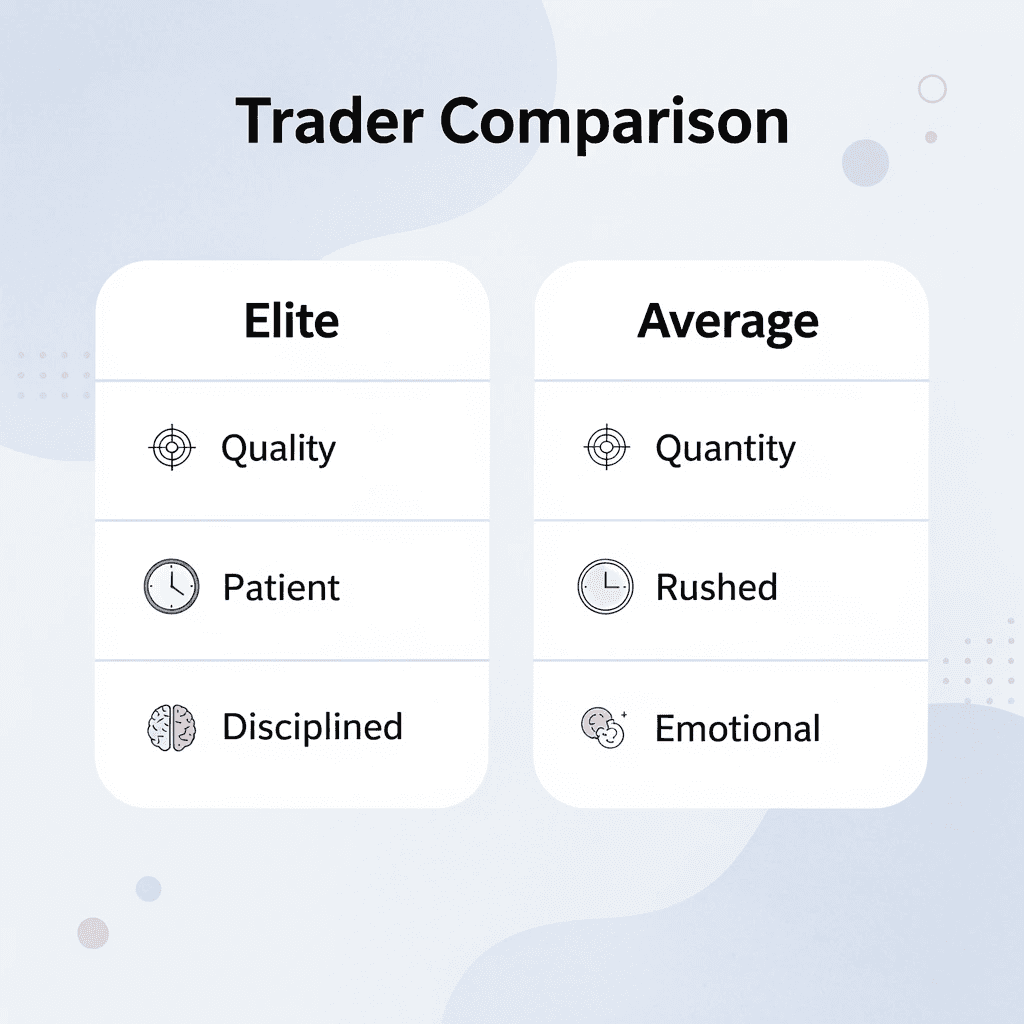
Successful Traders | Average Traders |
|---|---|
Fewer, high-conviction trades | Frequent trading based on emotions |
Strict risk management rules | Inconsistent position sizing |
Patient with winning positions | Quick to exit profitable trades |
Disciplined stop-loss execution | Hope losing trades will recover |
⚠️ Warning: The biggest mistake new futures swing traders make is overtrading - thinking more trades equals more profits. Elite traders know that quality beats quantity every time.
Why should traders analyze market structure before looking for entries?
Most traders start their analysis looking for entry signals. Successful swing traders do the opposite, beginning by mapping the market's current state: Where are the major support and resistance zones? What timeframe is controlling price action? Can you see institutional participation through volume patterns or key levels? This context determines whether conditions justify a trade, not where to enter one.
How does understanding structure first change trading decisions?
When you understand structure first, you stop reacting to isolated price movements. A breakout means nothing against the dominant trend on a higher timeframe. A pullback only matters at levels where buyers or sellers have previously shown interest. Structure provides the filter that separates noise from opportunity.
Why do successful traders prioritize risk over profit?
Traders who last don't start with profit targets. They start with acceptable loss. Forbes reports that disciplined swing traders risk no more than 1 to 2% of capital per trade, ensuring a string of losses doesn't eliminate their ability to participate in future opportunities.
How does position sizing protect against overnight market gaps?
When you hold positions for days rather than minutes, market gaps and overnight moves become real risks. Position sizing protects you from scenarios you cannot control. The calculation happens before entry. If your stop-loss sits 50 ticks away and you're risking 1% of a $50,000 account, your position size is already determined. Risk management allows you to stay in the game long enough for probabilities to work in your favor.
Why does patience matter more than activity in swing trading?
Being active and being productive aren't the same thing in trading. Successful swing traders understand this difference: they're comfortable staying out of the market when conditions don't match their criteria. No FOMO. No pressure to justify screen time with positions. Markets reward good execution, not trading frequency. A trader who takes three high-conviction setups per month and manages them well often outperforms someone taking three trades per day with inconsistent discipline.
How does patient trade management improve profitability?
This patience extends to trade management. When market structure supports their original idea, they don't exit after small profits. Holding winning trades long enough to offset inevitable losses requires emotional control built through practice and an understanding that one or two big wins often offset a quarter of smaller losses.
Why do successful traders focus on saying no rather than yes?
The traders who survive multiple market cycles share one trait: they excel at saying no. Their edge comes not from finding more opportunities but from filtering out everything that doesn't meet specific criteria. When a setup lacks clear structure, defined risk, or alignment with the broader market context, it passes.
How do prop firms evaluate trader discipline over profits?
Every trade carries costs, emotional weight, and opportunity costs. Futures prop firms like Goat Funded Futures have built evaluation programs around this principle, rewarding traders who demonstrate consistency and risk management over raw profit generation, since long-term success correlates more strongly with discipline than aggression. But even with the right process, most traders hit a wall unrelated to strategy. The challenge isn't knowing what to do; it's finding the capital to do it at a meaningful scale.
Related Reading
Prop Firm No Challenge
The Biggest Obstacle to Aligning Funding With Your Trading Style
The biggest obstacle isn't finding a strategy that works: it's finding a funding structure that doesn't force you to abandon what makes that strategy profitable. Most swing traders discover this critical gap only after committing to an evaluation program, when the tension between their trading process and the firm's requirements becomes impossible to ignore.

🎯 Key Point: The mismatch between your natural trading style and a firm's evaluation criteria can destroy even the most profitable strategies before you get funded.
"Most swing traders discover this gap only after committing to an evaluation program, when the tension between their process and the firm's requirements becomes impossible to ignore."

⚠️ Warning: Don't let rigid funding requirements force you to abandon the trading approach that made you consistently profitable in the first place.
Why do evaluation timelines conflict with swing trading strategies?
Swing traders typically need weeks to build a meaningful track record. Their edge comes from waiting for specific market conditions, entering with conviction, and holding positions long enough for directional moves to develop. Many prop firm evaluations impose 30-day windows with aggressive profit targets that assume daily activity. A trader who takes three high-quality setups in a month might produce excellent risk-adjusted returns yet fail an evaluation designed around constant execution. The structure itself becomes the problem, not the trading.
How do time pressures force traders to abandon their edge?
This creates a predictable pattern: traders force entries during suboptimal conditions because the calendar is running, and they exit winners early to lock in evaluation progress rather than letting trades reach their natural profit targets. The behaviors that built their edge—patience and selectivity—become liabilities in an environment optimized for frequency.
How do fixed costs impact swing trading profitability?
Activation fees, monthly platform charges, and data costs accumulate differently for swing traders than for scalpers or day traders. A trader making 200 round-trip turns monthly spreads those fixed costs across many trades. A swing trader making 15 carefully selected entries carries the same fee burden with far fewer opportunities to offset it. According to research published by the Futures Industry Association in 2023, transaction costs can consume 18 to 25% of gross profits for lower-frequency traders, a threshold that converts marginally profitable strategies into breakeven or losing propositions.
Why do prop firms penalize patient trading approaches?
Some funding environments add extra costs that swing traders resent. Weekly or bi-weekly reset fees, inactivity penalties, or evaluation extensions punish the patience their approach demands. The traditional prop firm model wasn't designed for multi-day holding periods; it assumes that activity generates revenue and penalizes traders for the selectivity their strategies require.
How do consistency rules conflict with swing trading timeframes?
Consistency rules create friction for swing traders. Some firms require profits across a minimum number of trading days within the evaluation period. A trader with four trades spread across 12 calendar days (three winners and one small loss) demonstrates discipline and risk management, but if the evaluation requires profit on ten separate days, that performance fails. The rule measures activity distribution rather than process quality.
Which prop firms eliminate consistency requirements?
Platforms like Goat Funded Futures removed consistency rules entirely, allowing traders to demonstrate profitability without artificial limits on trading frequency. This separates process quality from arbitrary requirements, letting swing traders prove their edge on terms matching how they actually trade. The question isn't whether you can change your strategy to fit a funding environment. The question is whether that change destroys the edge you spent months building.
How Goat Funded Futures Helps Swing Traders Scale With Confidence
Growing as a swing trader requires funding conditions that support patience, selective execution, and the ability to capture larger moves without artificial pressure to trade more frequently than your edge demands.
🎯 Key Point: Swing trading success depends on having the right funding structure that aligns with your natural trading rhythm rather than forcing high-frequency execution.
"The most successful swing traders are those who can wait for high-probability setups without the pressure of daily profit targets constraining their decision-making process." — Trading Psychology Research, 2023
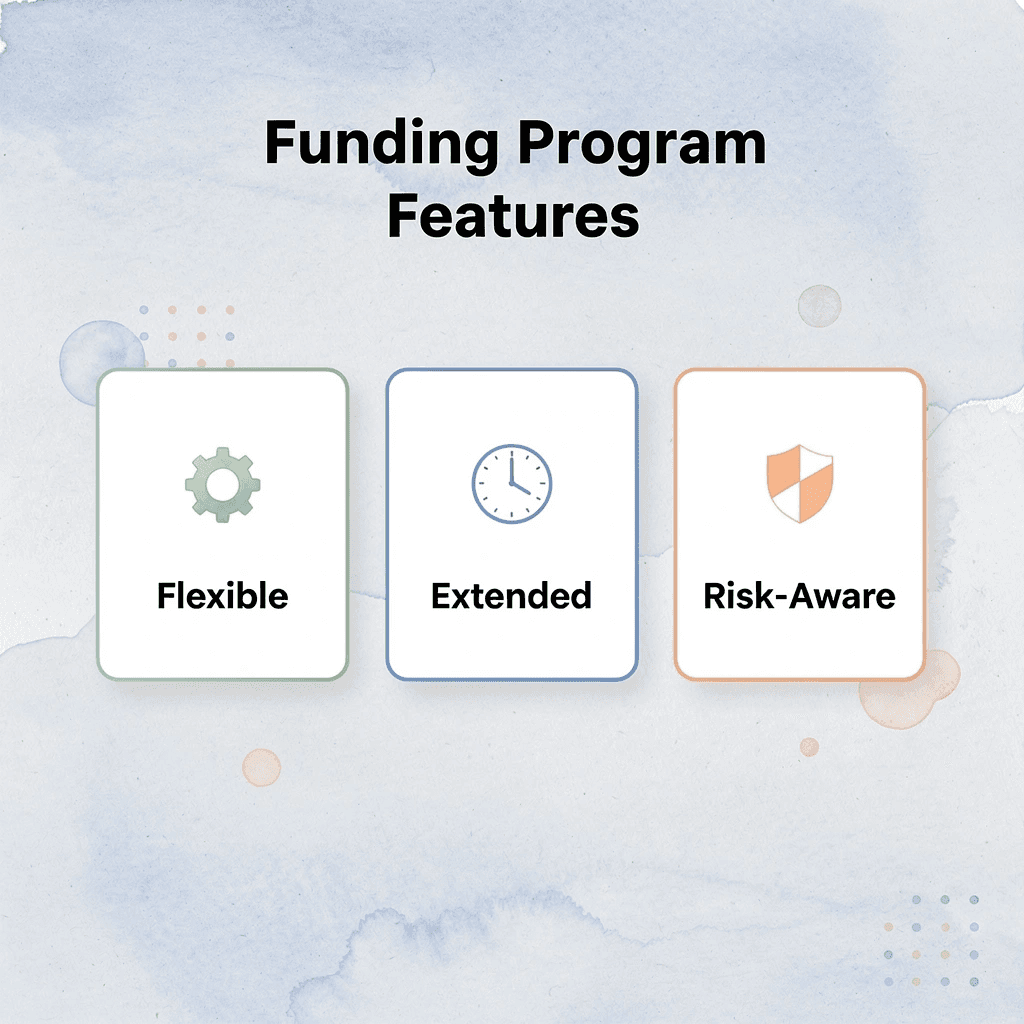
💡 Pro Tip: Look for funding programs that offer flexible profit targets and extended holding periods to maximize your swing trading potential without compromising your risk management strategy.
Multiple Pathways for Different Trading Goals
Goat Funded Futures offers four program structures: EOD, Sprint, Instant Funded, and Pro. This flexibility lets traders choose evaluation conditions matching their experience level and risk tolerance. A swing trader holding positions for three to seven days can select a program that allows multi-day holds without penalizing time spent waiting for quality setups.
Transparent Costs Without Hidden Barriers
Most prop firms charge activation fees, monthly subscriptions, or platform costs that accumulate regardless of trading volume. Swing traders, who execute fewer trades monthly than scalpers, bear this burden disproportionately. Goat Funded Futures eliminates activation fees and employs transparent one-time evaluation costs, allowing traders to direct capital toward position management rather than recurring overhead. When your edge relies on five high-conviction trades monthly instead of fifty marginal ones, cost structure becomes a competitive advantage.
Profit Retention That Rewards Discipline
Goat Funded Trader provides traders up to $600,000 in buying power with 100% profit splits on the first $10,000 earned. A $10,000 winning month at 100% split versus 80% yields $2,000 extra: capital you can deploy for position sizing on the next high-probability setup.
Flexibility That Supports Your Process
Swing trading works best when you are selective. Rules requiring daily trades or a minimum number of trades push traders toward poor choices to meet those requirements. Goat Funded Futures removes these limits during the evaluation period, allowing traders to demonstrate profitability through quality trades rather than volume. You prove your skill through execution, not by meeting arbitrary trading quotas. Scaling is not about abandoning the process that made you profitable. It is about finding an environment that amplifies what already works. But knowing the structure exists and stepping into it are two different decisions.
Start Trading Futures Today with our Futures Prop Firm
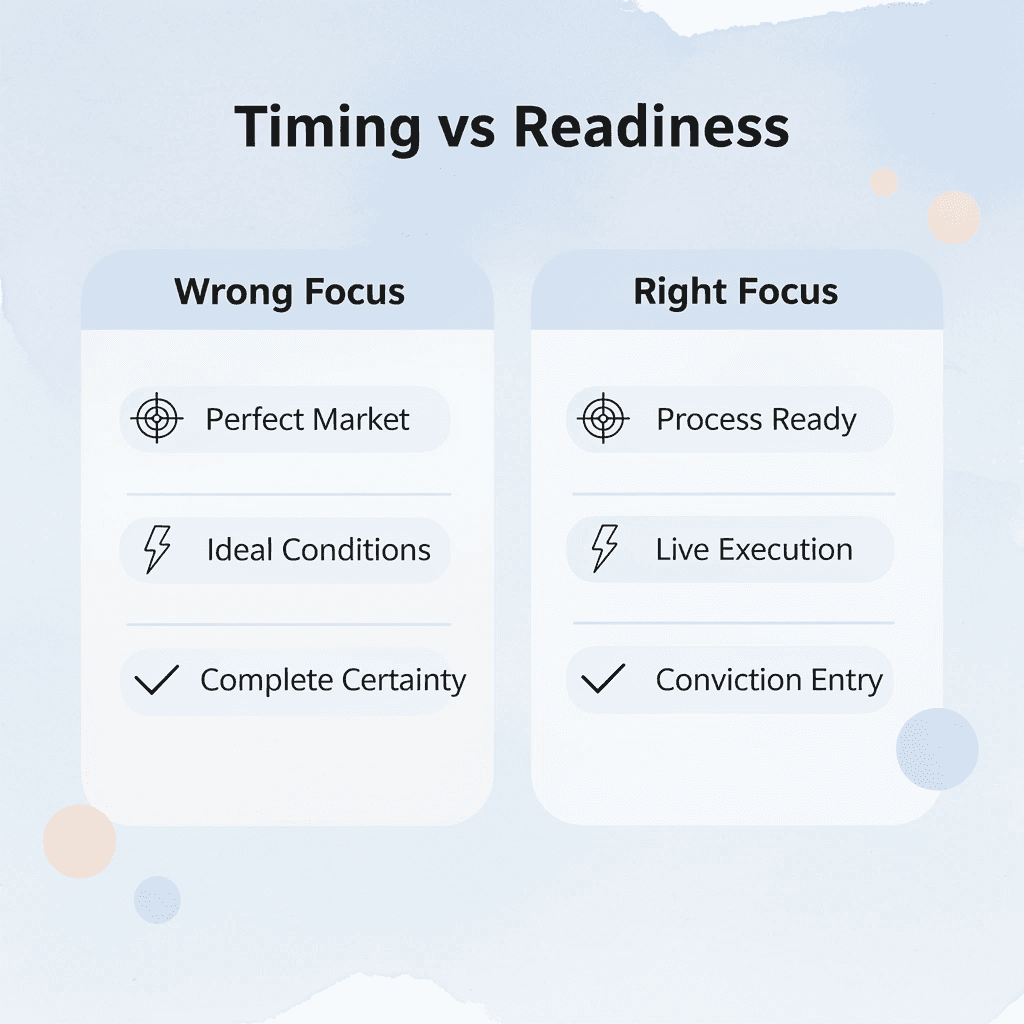
The decision to start a funded evaluation is less about timing and more about readiness. You either have a process that works on your current account, or you need more practice time before scaling. If you can identify three high-conviction setups in a week and hold them without second-guessing every tick, you possess what most evaluations test for.

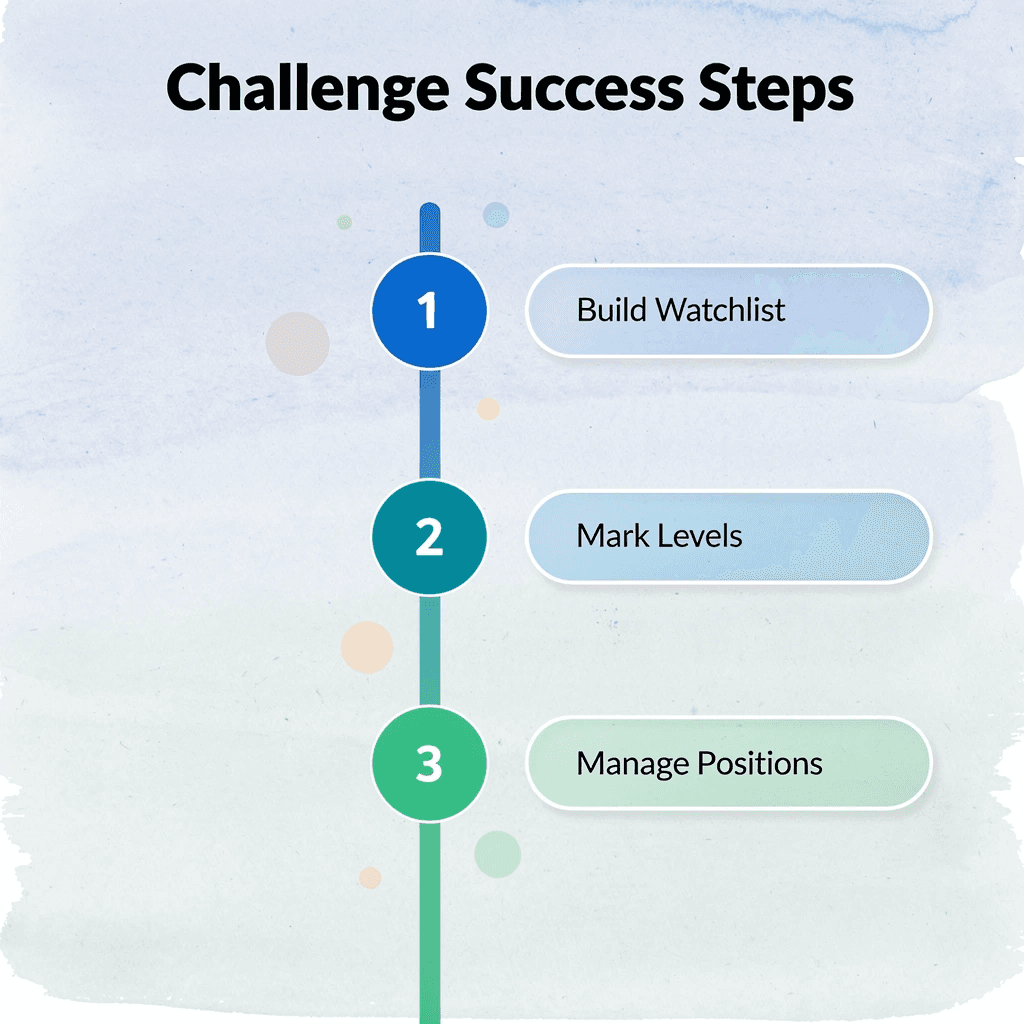
Starting a Goat Funded Futures challenge gives you immediate clarity on how your swing trading approach performs under real capital conditions. Use your first trading session to build a structured watchlist around multi-day setups rather than forcing trades. Mark your support and resistance zones, identify where institutional volume clusters appear, and plan your entries with stop-loss distances that reflect actual market structure rather than arbitrary percentages.
💡 Tip: Most traders hesitate because they confuse preparation with perfection. You will never feel completely ready, and waiting for ideal market conditions means missing the learning that only comes from live execution. Swing trading futures rewards patience during position management but punishes hesitation at the entry decision. If you have been trading your own capital and consistently identifying quality setups, the evaluation simply removes the capital ceiling that limits your growth.
"The goal is not to prove you can win immediately but to show you can follow your process consistently across multiple setups."
You can spend another six months refining your strategy on a small account, or you can test it in an environment designed to amplify what already works. Goat Funded Futures does not require you to abandon your edge for arbitrary activity metrics. It asks you to demonstrate profitability through the same selective, high-conviction approach that built your confidence in the first place.
🔑 Key Point: Your first evaluation trade matters less than your tenth. The goal is not to prove you can win immediately but to show you can follow your process consistently across multiple setups. If you risk 1-2% per trade, respect your stop-loss levels, and only enter when structure aligns with your thesis, the results will reflect your actual skill rather than luck.
Start your challenge when you are ready to execute your process, not when the market feels perfect. The best swing traders do not wait for certainty. They prepare thoroughly, enter with conviction, and manage positions without emotional interference. This approach works whether you are trading $5,000 or $500,000.
Related Reading
Leeloo Trading Review
Prop Firm Risk Management
Prop Firm Trading Strategy
Best Prop Firms 2026
Prop Firm Rules Explained
Futures Prop Firm Comparison