Prop Firm No Challenge: 7 Options for Seeking Alternative Funding
Discover 7 prop firm no-challenge funding options with Goat Funded Futures. Skip evaluation phases and start trading immediately with instant funding.

Traditional futures prop firms require traders to navigate lengthy evaluation periods, pay upfront fees, and adhere to strict assessment criteria before accessing funded accounts. Many experienced traders find these challenging phases unnecessarily restrictive, especially when they already possess proven strategies and risk management skills. The evaluation process can take weeks or months, during which traders risk their own capital without any guarantee of funding.
No challenge prop firms eliminate these barriers by providing immediate access to trading capital without evaluation periods or upfront costs. Traders can begin executing their strategies from day one, focusing on generating profit rather than proving themselves in artificial testing environments. For those seeking direct access to professional trading capital, partnering with an established futures prop firm offers the fastest path to funded trading accounts.
Table of Contents
Summary
The traditional prop firm evaluation model fails 95% of traders within the first 30 days, according to industry data. These structures often filter out profitable traders not because of poor market decisions, but because of arbitrary consistency rules, restrictive drawdown calculations, and minimum trading day requirements that conflict with natural trading rhythms. The evaluation itself becomes harder than actual market trading, forcing traders to manage firm-specific metrics while simultaneously navigating market risk.
Challenge fees create substantial financial barriers before traders ever access funded capital. One trader reported spending close to $900 on evaluation attempts alone, while others were disqualified for a single profitable trade that violated obscure consistency thresholds. This recurring cost structure generates revenue for firms while consuming trader capital through repeated qualification attempts rather than actual trading opportunities.
The global proprietary trading market reached approximately $7.1 billion in 2024 and is projected to exceed $9.8 billion by 2030. This expansion brought increased competition and innovation, leading to alternative funding structures beyond the traditional evaluation model. Over 2,000 prop firms now operate worldwide, with many offering instant funding pathways that provide experienced traders with immediate capital access without multi-phase assessments.
Profit-sharing structures and payout terms impact long-term profitability more than initial account size. A trader consistently generating $5,000 monthly benefits more from a 90% profit split with weekly payouts than from a larger account with delayed withdrawals and lower profit retention. Payout frequency, scaling opportunities, and profit retention rules compound quickly for active traders, making these factors more significant than the specific route used to access funding.
Risk management frameworks determine whether trading strategies can function naturally or require constant adjustment. End-of-day drawdown calculations, which assess risk at market close rather than continuously throughout sessions, reduce artificial pressure on traders experiencing normal intraday position fluctuations. Transparent drawdown rules, clear loss limits, and straightforward position sizing create frameworks traders can actually follow under pressure, regardless of account size.
Goat Funded Futures addresses these barriers by offering multiple funding pathways, including instant access, EOD drawdown structures, and alternative evaluation formats that let traders select approaches matching their experience level rather than adapting to rigid frameworks.
Why Traders Start Looking for Prop Firms With No Challenge
Traders seek prop firms that don't impose challenges after encountering evaluation structures that punish their trading style rather than measure profitability. This shift occurs when accumulated challenge fees, multiple qualification phases, and failures due to unclear consistency rules transform the traditional path into an obstacle course rather than a genuine assessment.
🎯 Key Point: Traditional prop firm challenges often become expensive barriers that discourage profitable traders rather than effectively identifying them.

"The traditional path feel like an obstacle course instead of a real assessment when challenge fees and unclear consistency rules accumulate." — Trading Industry Analysis, 2024
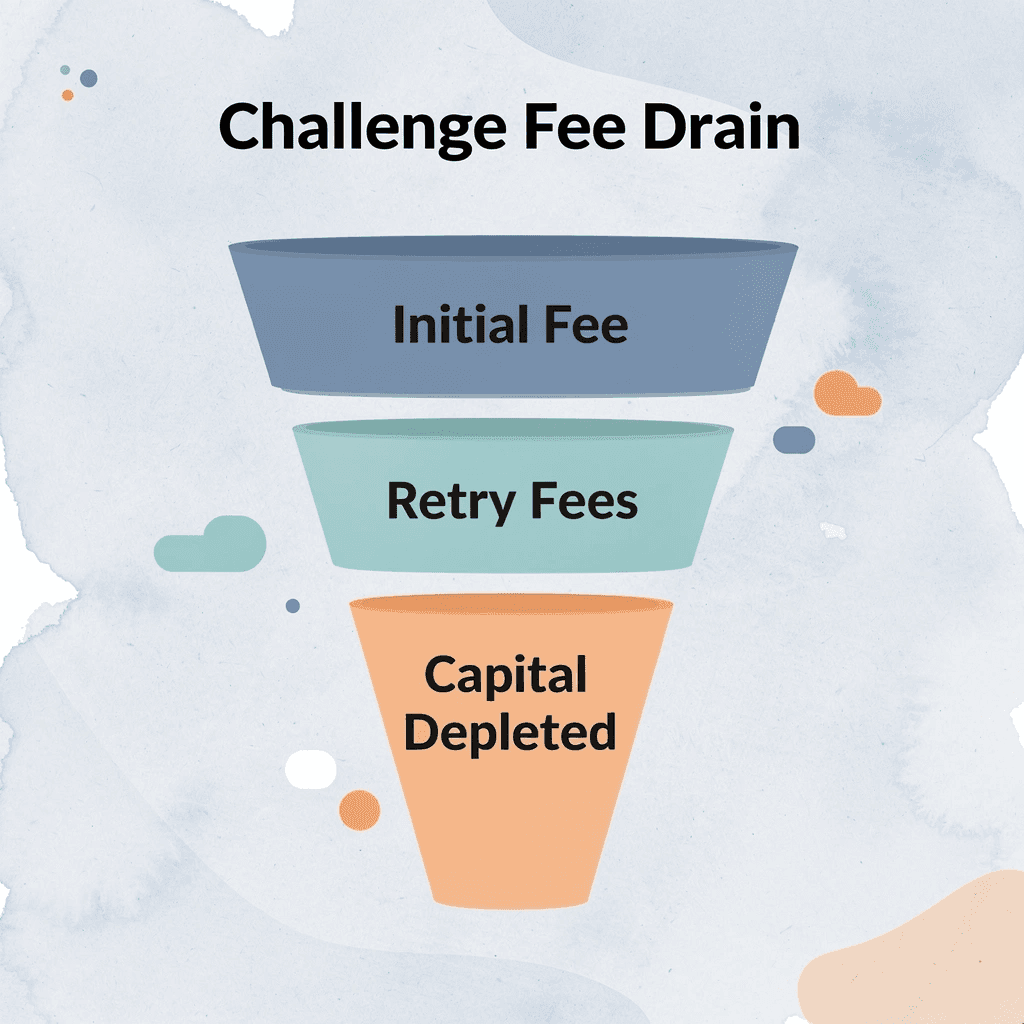
⚠️ Warning: Multiple qualification phases can drain your trading capital through repeated challenge fees before you even get the chance to prove your profitability.
What are the real costs of traditional challenge structures?
The frustration becomes concrete in the form of real costs. One trader spent close to $900 on challenge fees before accessing funded capital. Another was disqualified because a single profitable trade represented too large a percentage of total gains, violating a consistency rule they didn't know existed. These cases reveal a pattern in which evaluation frameworks designed to protect firms from risk filter out traders who could generate consistent profits across different conditions.
How do evaluation rules create trading conflicts?
Traditional prop firm evaluations create a dual-challenge environment. You're managing market risk while navigating firm-specific rules: trailing drawdowns that tighten as you profit, daily loss limits that conflict with volatile trading sessions, minimum trading day requirements that force activity during unfavorable conditions, and consistency metrics that penalize concentration even when justified by sound risk management.
Why do profitable strategies fail evaluations?
Active traders feel this tension most acutely. Strategies involving short-term equity fluctuations that prove profitable over weeks or months struggle within arbitrary 30-day evaluation windows. You can identify correct market opportunities, execute disciplined entries and exits, and still fail because your natural trading rhythm doesn't align with the evaluation's structural requirements. Managing these firm rules becomes as demanding as managing the market itself.
Why do 95% of traders fail traditional evaluations?
According to the Axcera Blog, 95% of traders fail their evaluation within the first 30 days. This explains why experienced traders shift from "How do I pass the next challenge?" to "Why am I proving myself through a system designed for failure?"
The evaluation model generates recurring revenue for firms through challenge fees while consuming trader capital through repeated qualification attempts rather than actual trading.
How does time delay impact trader opportunity costs?
Time exacerbates the problem. Three months of multi-phase evaluations mean three months without meaningful access to capital and three months of opportunity cost. For traders with proven strategies and documented track records, this delay feels like institutional gatekeeping rather than professional development.
What assumptions drive the traditional challenge model?
Solutions like instant funding from futures prop firms address this friction by providing immediate access to capital on a different premise: experienced traders shouldn't need to prove basic skill through arbitrary challenges, and real trading behavior under funded conditions reveals more about capability than simulated performance on evaluation.
The challenge model rests on fundamental assumptions about how prop firms should operate.
The Belief That Every Prop Firm Requires a Challenge
The idea that all prop firms need multi-phase evaluations is universal among traders exploring funded opportunities. Evaluation challenges became the industry standard because they solve a specific problem: allocating capital to traders without direct access to their track record or experience.

That model worked well enough to become the only model most traders encountered.
Why the Challenge Model Became the Default
The evaluation structure spread quickly across the prop trading industry because it solved real business problems. Firms needed to verify that traders could perform before allocating capital. Challenges provided a clear set of metrics: achieving profit goals, staying within drawdown limits, and demonstrating consistent trading performance. Pass these tests, and you qualify for funding with Goat Funded Futures.
How did market growth shape trader expectations?
According to Research and Markets, the global proprietary trading market reached $7.1 billion in 2024 and is expected to reach $9.8 billion by 2030. As the market grew, the evaluation model transformed how traders access prop firms.
Marketing materials centered on challenge pricing and profit targets. YouTube content focused on funded account journeys that always started with a challenge purchase. Most traders never questioned whether other options existed, assuming that evaluations were part of the process, including margin requirements and contract specifications.
When the Default Becomes the Only Option
The problem isn't that evaluations exist—it's when they become the only option. A trader with ten years of live futures experience and a documented track record faces the same entry path as someone purchasing their first challenge. Both must prove competency through identical metrics, regardless of existing real-world trading evidence.
This creates friction for experienced traders who view lengthy evaluations as unnecessary gatekeeping. They don't need to prove they understand risk management or position sizing; they need access to capital that matches their skill level, without arbitrary consistency rules or minimum trading-day requirements.
Why have alternative funding structures emerged in prop trading?
The industry has evolved beyond a single approach. Alternative funding structures emerged as experienced traders sought different ways to access capital. Instant funded programs provide faster access to funded opportunities through streamlined qualification processes, bypassing multi-phase evaluations.
How does market competition drive innovation in prop firm models?
This growth reflects a broader pattern in financial services: making it easier for users to reach their goals. When Best Prop Firms reported over 2,000 firms operating worldwide, competition intensified. Firms recognized that different traders need different paths, and a one-size-fits-all evaluation process misses opportunities.
For traders who want to start right away, firms like Goat Funded Futures now offer instant funding options. Their instant funding programs operate on a simple premise: experienced traders should not need to prove basic skills in practice environments when their goal is to access capital quickly and trade with real money from day one.
Why Evaluations Are One Model, Not the Only Model
Evaluations serve as risk-management tools that let firms assess traders before allocating capital. For newer traders building their first track record, the structured discipline of a challenge provides valuable experience, clear metrics, and progressive confidence-building.
But evaluations aren't the best choice for everyone. A consistently profitable trader might prioritize speed and flexibility over structured testing. An experienced market participant might prefer to access capital immediately rather than spend weeks proving their trading competence. Each approach addresses different needs for different traders.
How do you choose the right funding model?
The best funding model depends on the trader, not industry defaults. Your experience level, trading style, and specific goals should determine which path makes sense. This requires understanding what options exist beyond the evaluation model most traders assume is mandatory.
Knowing alternatives exist is only the first step. The harder question is determining which structure fits your situation and what that choice reveals about how to evaluate any prop firm.
Related Reading
What to Look for in a Prop Firm With No Challenge
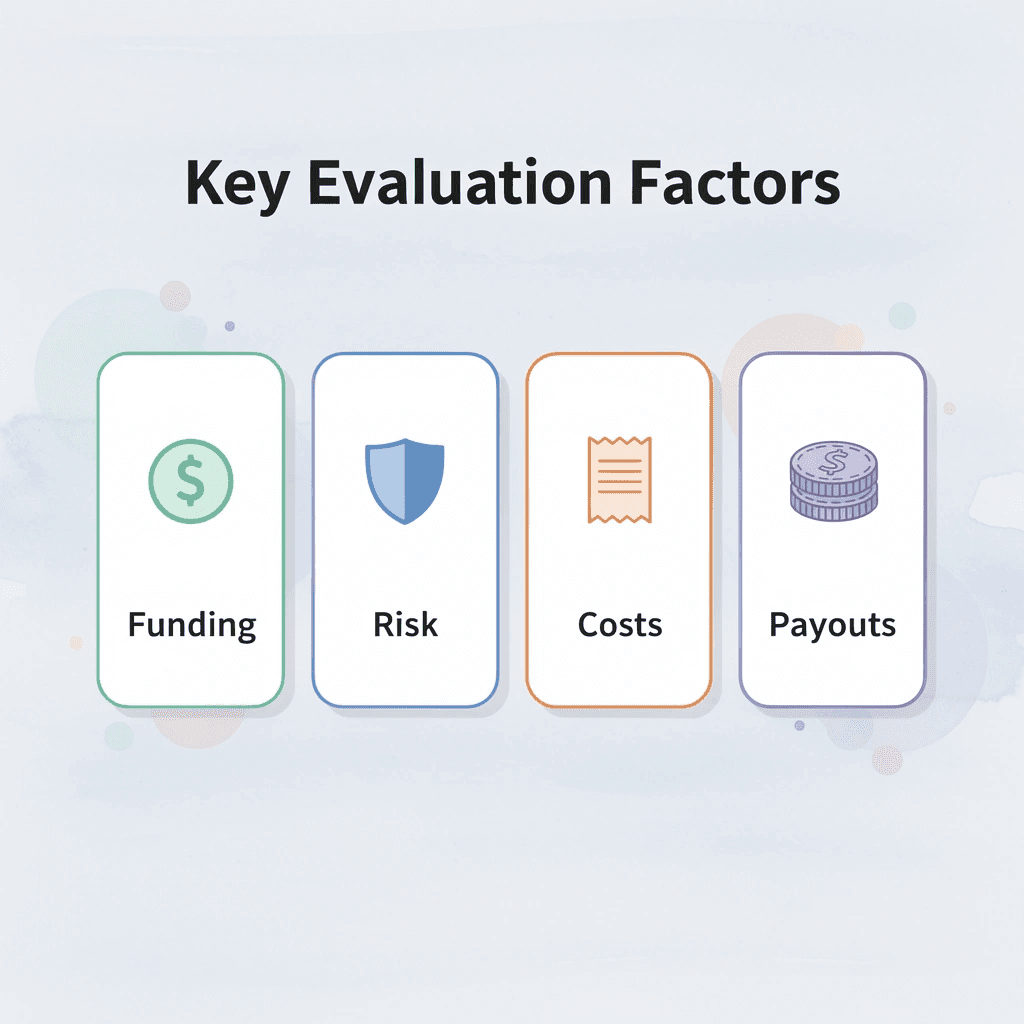
Without a challenge, evaluation shifts to funding structure, risk framework, costs, payout terms, and operational flexibility. These elements matter far more than the marketing headline.
🎯 Key Point: The absence of a challenge means you need to scrutinize the actual trading conditions and profit-sharing terms more carefully, as these become the primary differentiators between firms.

"When prop firms eliminate challenges, the real evaluation criteria become funding terms, risk parameters, and operational transparency rather than marketing promises." — Trading Industry Analysis, 2024
Evaluation Factor | Why It Matters | What to Check |
|---|---|---|
Funding Structure | Determines capital access | Maximum account size, scaling options |
Risk Framework | Controls trading freedom | Drawdown limits, daily loss rules |
Payout Terms | Affects profit retention | Split percentage, withdrawal frequency |
Operational Flexibility | Impacts trading style | Allowed strategies, time restrictions |
⚠️ Warning: No-challenge firms often compensate with stricter risk parameters or lower profit splits, so always compare the total package rather than focusing solely on the absence of evaluation phases.
Funding Structure
Capital access varies significantly across futures prop firms. Some provide instantly funded accounts, while others use alternative qualification models without profit targets, affecting how quickly you can trade and whether the path suits your experience level.
Key questions: How quickly is funding accessed? What qualification requirements exist beyond payment? What account sizes are available, and can you scale? Experienced traders prioritize speed; newer traders may prefer progression requirements and safeguards. The best structure depends on your needs, not marketing claims.
Risk Framework
Risk frameworks remain important after evaluations conclude: they define how you operate post-funding and determine whether your strategy can function independently or requires constant adjustment to avoid regulatory breaches.
How do you evaluate the compatibility of risk frameworks?
Pay close attention to drawdown calculations, daily loss limits, account management requirements, position sizing restrictions, and scaling rules. A funding model that looks good might become frustrating if its risk framework doesn't align with your trading style. The goal isn't to find the loosest rules, but rules that are clear, realistic, and aligned with your strategy. According to QuantCrawler, many firms offer substantial discounts (80% off sales, bringing $50K accounts to $35K), but those savings don't matter if the risk framework makes the account difficult to use.
Costs
Without a challenge fee, examine the total cost of participation, which may include upfront fees, activation fees, platform fees, data fees, or ongoing subscription charges. Some programs charge higher upfront fees to access funding faster; others use recurring payment structures.
Calculate total cost over three to six months, not just the initial payment. The cheapest option isn't always the most cost-effective if it limits flexibility or earning potential.
Profit Potential and Payout Terms
Payout structures directly affect your earnings over time. Key considerations include profit splits, withdrawal rules, payment frequency, growth opportunities, and the company's profit retention.
A generous payout structure significantly improves outcomes for active traders. Some firms offer 100% profit splits on starting earnings or promise payouts within specific timeframes, while others use tiered structures that improve as you demonstrate consistency. These differences compound quickly.
Trading Flexibility
Figure out whether the firm's rules support how you like to trade. Look at strategy compatibility, new trading policies, overnight holding rules, position management flexibility, and instrument availability. A futures scalper prioritizes different features than a swing trader. The key question is whether the firm's structure allows you to execute your strategy naturally, without constant adjustment or second-guessing.
How do instant funding programs reduce trading friction?
Programs like Goat Funded Futures offer quick funding that skips evaluations, no activation fees after you pass challenges, and guaranteed payouts within two business days. Our approach reflects a belief that traders shouldn't face unnecessary restrictions or hidden costs.
What factors matter most when choosing non-challenge firms?
The rise of no-challenge prop firms has expanded funding options for traders. However, the absence of an evaluation should not be the sole reason for choosing a firm. Funding structure, risk management, costs, profit potential, and trading flexibility are more important in determining whether a program will support long-term success. AquaFutures identifies 11 distinct no-challenge prop firm options, each with different approaches to capital allocation and risk management.
7 Prop Firms Traders Should Consider
Each company below focuses on different goals: some make things easier by giving you quick access, while others give rewards for staying with them over long periods. Pick one based on what matters most to you: how fast you can get started, how much you can grow, how easily you can get paid, or how much money you need upfront.

🎯 Key Point: The right prop firm depends on your trading experience level and financial goals—beginners should prioritize lower entry costs and educational support, while experienced traders can focus on higher profit splits and scaling opportunities.
"Choosing the wrong prop firm can cost traders thousands of dollars in fees and months of wasted time—the key is matching your risk tolerance with their payout structure." — Trading Industry Report, 2024

⚠️ Warning: Never choose a prop firm based on marketing promises alone—always verify their track record, withdrawal policies, and actual trader reviews before committing your capital and time.
1. Goat Funded Futures
Best fit
Traders seeking multiple funding options and quicker access to capital
Goat Funded Futures offers multiple funding paths tailored to traders' experience levels, goals, and trading styles, rather than requiring all traders to follow the same route.
What funding programs does Goat Funded offer?
It offers the EOD Program, Sprint Program, Instant Funded Program, and Pro Program. The EOD Program uses an end-of-day drawdown structure that focuses on account balances at the close of trading rather than constantly adjusting throughout the session, making it easier to manage than more restrictive drawdown models.
How does Goat Funded reduce trading friction?
The platform removes common problems by eliminating activation fees, required buffers, and hidden costs with clear, upfront one-time fees. Traders can get up to 100% profit share on the first $10,000, allowing them to keep more of their profits.
Ideal trader profile
Traders seeking flexibility, multiple funding options, and structures designed around active trading workflows.
2. Instant Funding
Best fit
Traders seeking large account access without traditional evaluations
Instant Funding provides access to large account sizes through various funding structures. According to TradingView News, some firms now offer up to $2,000,000 in funding.
Main strengths include large account availability, high profit-sharing potential, and funding structures that avoid delays inherent in traditional challenge models. The no-daily-drawdown approach appeals to traders seeking greater flexibility in managing trades.
Ideal trader profile
Experienced traders who want immediate access to larger account sizes and prioritize capital availability.
3. Atlas Funded
Best fit
Traders seeking a balanced funding option with low barriers to entry and high profit retention.
Atlas Funded offers account sizes ranging from entry-level to larger funded opportunities, with profit-sharing structures that reach high percentages. The firm emphasizes trader flexibility, making it attractive within the no-challenge funding category.
Ideal trader profile
Traders seeking a balance between accessibility, profit potential, and account flexibility.
4. FundYourFX
Best fit
Traders focused on account scaling
FundYourFX appeals to traders with long-term growth in mind. The firm's funding structure supports traders who demonstrate consistency, prioritizing development and scaling over initial access to capital.
Ideal trader profile
Traders are seeking larger account allocations as performance improves.
5. The 5%ers

Best fit
Traders building long-term trading careers
The 5%ers focus on steady growth and account scaling instead of quick funding. Its programs reward consistency and disciplined risk management. This appeals to traders who view prop trading as a career rather than a short-term test. Scaling opportunities provide successful traders access to substantial capital.
Ideal trader profile
Traders committed to developing a long-term trading career who prioritize growth over speed.
6. FTUK
Best fit
UK-based traders and international traders seeking diverse funding options
FTUK offers funding structures that differ from traditional evaluation-based programs, providing flexibility while maintaining clear risk-management guidelines. This appeals to traders seeking alternatives to standard challenge models without sacrificing structure.
Ideal trader profile
Traders seeking a different funding structure with balanced flexibility and risk controls.
7. SabioTrade
Best fit
Traders who prioritize payout speed
For many traders, the most important question is not how quickly they become funded but how quickly they can access profits once funded.
SabioTrade has attracted attention for its focus on payout accessibility and trader earnings. The firm's emphasis on efficient payouts appeals to traders who prioritize cash flow management and access to profits.
Ideal trader profile
Traders who prioritize payout speed and efficient access to earned profits.
The real question is which funding model aligns with how you trade and what you need most.
Which Type of No-Challenge Funding Model Is Right for You?
The right funding model depends on whether you value speed, flexibility, risk clarity, or long-term profitability. A trader needing immediate capital will choose differently from someone building a sustainable business. Your priorities should drive the decision.

🎯 Key Point: Speed vs. sustainability is the fundamental trade-off when choosing your no-challenge funding model. Day traders prioritize immediate access, while long-term investors focus on profitability and risk management.
"Your funding choice should align with your trading style and business goals - there's no one-size-fits-all solution." — Industry Analysis, 2024

⚠️ Warning: Don't choose a funding model based on marketing hype alone. Consider your actual needs: capital requirements, time horizons, and risk tolerance before making the final decision.
If You Want Immediate Market Access
Some traders already know how to trade profitably. They've spent months or years refining their approach, testing strategies, and building discipline. Instant funded programs exist for this reason: they eliminate waiting periods and allow experienced traders to focus on execution rather than qualification.
This path makes sense if you already manage risk effectively, understand your edge, and need capital to scale. The tradeoff is straightforward: you skip the evaluation, but risk rules still apply from day one. Discipline doesn't become optional because funding arrived faster.
If You Want Maximum Flexibility
Some traders prefer structured evaluations when starting out, then switch to instant funding once they've proven consistency. Others want to test different account sizes or risk frameworks as their strategy evolves.
Firms offering multiple funding pathways recognise this reality. A newer trader might initially choose an evaluation-based plan to build confidence and structure, then switch to instant funding for a second account six months later. The best firms don't lock you into one model forever.
If Risk Management Is Your Main Concern
Most traders fail because they can't consistently control risk, not because they lack market knowledge. A study by the Brazilian Securities and Exchange Commission found that the vast majority of active day traders failed to make consistent profits, demonstrating that risk control matters more than access to opportunities.
What should you look for in risk management rules?
If you've had trouble with drawdown violations or daily loss limits, find a risk framework you can follow. Look for firms with transparent drawdown calculations, clear loss limits, and straightforward position sizing rules. Simpler rules are easier to manage under pressure. A smaller account with rules you understand will outperform a larger account with conflicting restrictions.
If Long-Term Profitability Matters Most
Funding is valuable only if you can keep the profits you earn. Profit-sharing percentages, withdrawal policies, and payout frequency determine how much you earn, often more than account size itself.
How do profit splits impact your actual earnings?
A trader who consistently makes $5,000 per month benefits more from a 90% profit split and weekly payouts than from a larger account with slower withdrawals and lower profit retention. Check scaling opportunities: Can you grow your account size as you prove consistency? Do profit splits improve over time? These questions matter more than initial account size.
Why do payout policies affect trader retention?
Some firms, like Goat Funded Futures, use profit sharing to retain traders, offering 100% of the first $10,000 in profits and guaranteed payouts within two business days. This approach helps traders stay consistent and grow their accounts by letting them keep more of their earnings.
Delayed payouts and lower profit splits create problems: waiting weeks for withdrawals or losing 30-40% to the firm frustrates skilled traders and often drives them to seek other options.
Related Reading
Why Traders Choose Goat Funded Futures
Traders choose Goat Funded Futures because our platform removes structural barriers that make other prop firms feel like gatekeepers. We provide multiple pathways designed around how traders operate, not how firms prefer to manage risk.

🎯 Key Point: Unlike traditional prop firms that create unnecessary hurdles, Goat Funded Futures focuses on empowering traders with flexible evaluation processes and realistic trading conditions.
"The best prop firms don't act as gatekeepers - they create pathways to success that align with how traders naturally operate." — Trading Industry Analysis, 2024
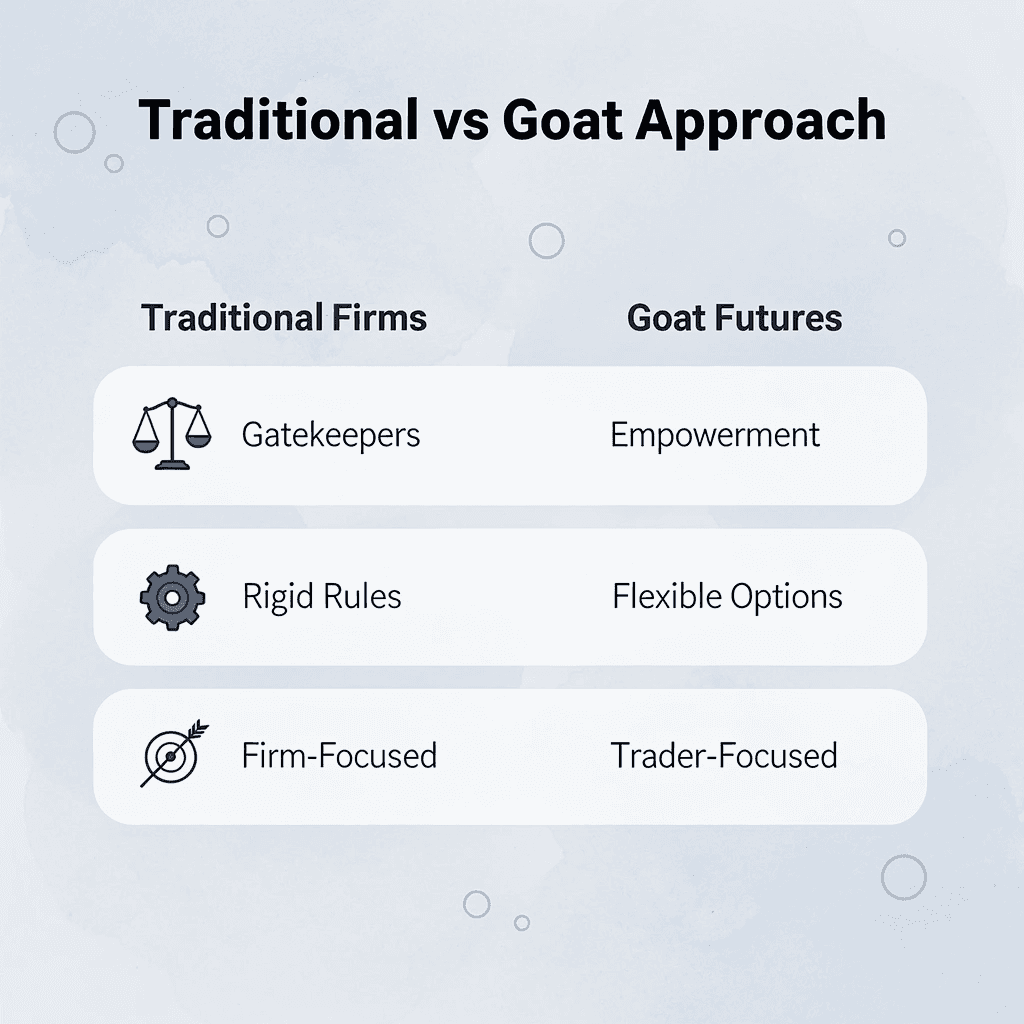
💡 Tip: When evaluating prop firms, look for platforms that offer multiple evaluation options and transparent requirements rather than one-size-fits-all approaches that favor the firm over the trader.
Instant Funded Program
The biggest frustration many traders face is time lost to evaluations that test patience more than skill. A trader with three years of consistent profitability still spends weeks proving they can follow arbitrary rules disconnected from real market conditions. Our Instant Funded Program eliminates that delay. Experienced traders can access funded opportunities immediately rather than repeating what they've already demonstrated in live markets. Reducing qualification time from weeks to minutes means capturing current market conditions rather than watching opportunities slip away during evaluation phases.
EOD Program
Risk management frameworks determine whether your trading strategy can operate naturally or requires constant adjustments to comply with firm rules. Intraday drawdown calculations often create unnecessary pressure that conflicts with position management. Our EOD Program uses end-of-day drawdown structures, calculating risk thresholds based on account balance at the close of each trading day rather than continuously throughout the session. This approach aligns with how performance is measured in real trading environments, allowing you to execute trades and manage positions without constantly monitoring moving drawdown thresholds that penalize temporary paper losses.
Sprint Program and Pro Program
Not every trader progresses the same way. Our Sprint Program and Pro Program offer different evaluation methods tailored to various account sizes and risk parameters. This matters because a funding model suited to building confidence may not fit your needs after six months of consistent profitability. Multiple pathways let you select an approach that fits your current circumstances rather than adapting your trading to a rigid framework.
Built Around Trader Outcomes
Goat Funded Futures reduces participation costs and increases profit retention through no activation fees, no mandatory buffer requirements, and up to 90% profit split. Traders earn a 100% profit share on the first $10,000, then keep up to 90% thereafter. With clear one-time fees and accounts up to $250,000, Goat Funded Futures makes costs and earning potential transparent—often as important to traders as the funding itself.
What matters most when choosing a funding structure?
The mistake most traders make when evaluating prop firms is focusing solely on whether a firm offers a challenge or avoids one. The more important question is whether the funding structure supports how you actually trade. Some traders want immediate access to capital, while others prioritize flexible risk frameworks or alternative pathways that accommodate their progression timeline.
Goat Funded Futures offers multiple funding structures through the Instant Funded, EOD, Sprint, and Pro Programs that accommodate different trading styles, experience levels, and goals. Traders succeed when the funding model adapts to their needs rather than forcing them to meet arbitrary requirements.
Why does accessibility matter for funding programs?
But having the right funding structure only matters if you can start using it.
Start Trading Futures Today with our Futures Prop Firm
Getting funded matters less than staying funded. You can access capital through instant funding or pass an evaluation in a weekend, but if the risk rules conflict with how you trade, you'll burn through accounts faster than you can replace them. The question isn't whether a firm has a challenge—it's whether its funding structure lets you execute your strategy without fighting the framework daily.

Start by identifying what's blocking you. If you've passed evaluations but struggle with intraday drawdown calculations that punish normal position fluctuations, an end-of-day model solves that friction. If you've proven consistency and need immediate capital access, instant funding removes the waiting period. If you're building discipline, an evaluation path with clear progression makes sense. The obstacle reveals the solution.
Most traders choose firms based on marketing materials rather than on what matches their actual trading behavior. A $200,000 instant funded account sounds impressive until position sizing restrictions don't accommodate your average trade size. A 90% profit split looks generous until payout delays stretch across weeks. Comparing specific program structures (drawdown calculations, scaling thresholds, payout timelines, and activation costs) matters more than promotional headlines.
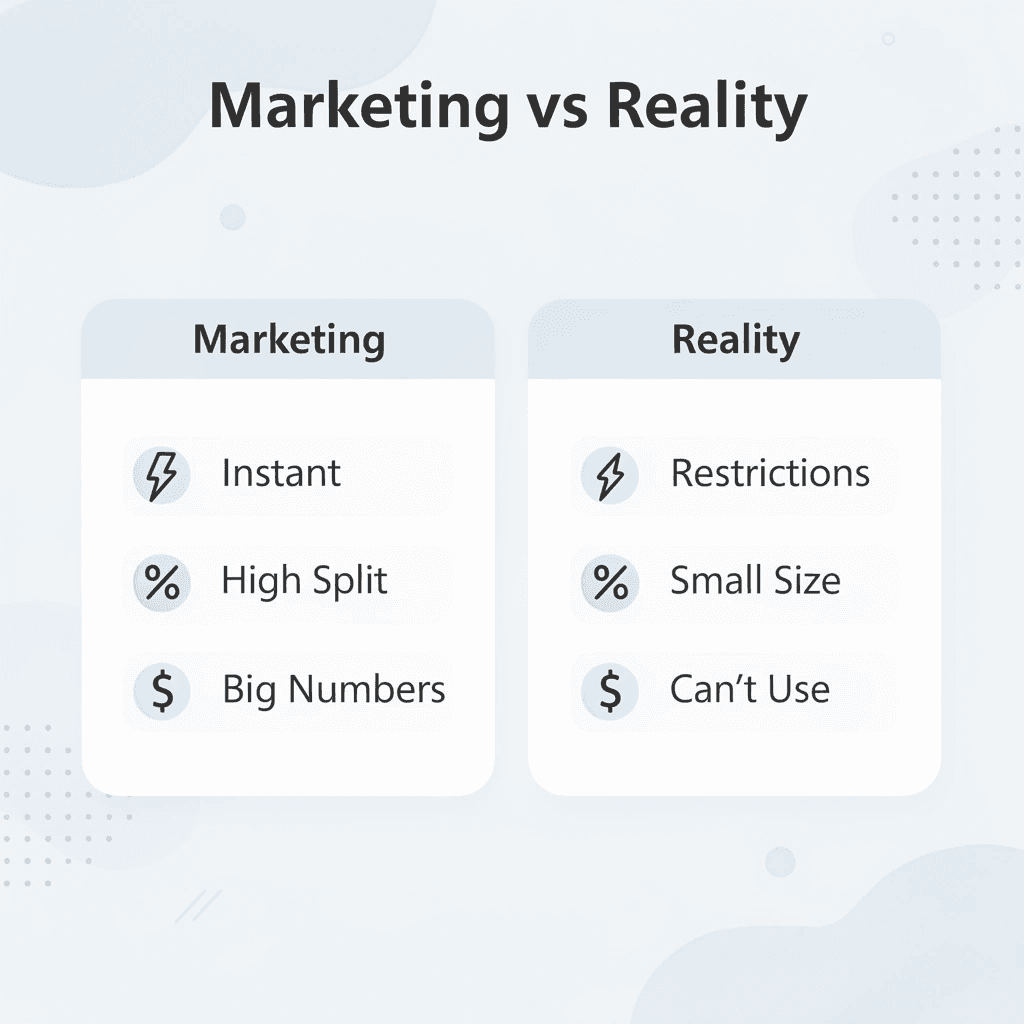
Goat Funded Futures operates on the premise that different traders need different paths. Our Instant Funded Program serves experienced traders requiring immediate market access. Our End-of-Day Program accommodates swing traders whose strategies involve holding positions through intraday volatility. Our Sprint Program offers faster evaluation cycles, while our Pro Program provides structured progression for building consistency. None is objectively better—they're designed for different trading realities.
The best time to get funded was when you first developed a profitable strategy. The second best time is today, provided you choose a structure that supports rather than restricts how you trade. If your strategy works but traditional evaluation requirements disqualify you for reasons unrelated to profitability, you're not failing as a trader—you're succeeding in the wrong framework. Finding the right one changes everything.

Related Reading