Futures Prop Firm Comparison: Choose the Right Model
Futures prop firm comparison guide by Goat Funded Futures. Compare funding models, profit splits, and fees to find your ideal trading partner.

Choosing the right futures prop firm requires careful evaluation of funding models, profit splits, evaluation processes, and trading rules. Traders often spend considerable time comparing dozens of options to find a firm that matches their trading style and financial objectives.
Key factors include evaluation fees, drawdown limits, profit-sharing arrangements, and withdrawal policies. Understanding these elements helps traders make informed decisions when selecting a futures prop firm that supports their career goals.
Table of Contents
Most Futures Prop Firm Comparisons Focus on the Wrong Things
The Key Factors Every Futures Prop Firm Comparison Should Include
How to Determine Which Futures Prop Firm Fits Your Trading Style
How Goat Funded Futures Helps Traders Choose a Funding Model That Fits
Summary
Trailing drawdown models create constant pressure that conflicts with many profitable trading strategies. According to propfirmapp.com, 90% of traders fail prop firm evaluations, often not because their strategy lacks merit, but because the firm's drawdown structure forces them into defensive decision-making that contradicts their tested approach. End-of-day drawdown calculations provide breathing room for traders who hold positions through normal market fluctuations, preventing violations during temporary pullbacks.
Hidden fees erode profits long after traders pass their initial evaluations. A firm advertising a $99 challenge may ultimately cost $347 after reset fees and activation charges, while a transparent $179 program with better structural alignment gets passed on the first attempt. Activation fees, withdrawal minimums, and consistency caps that limit daily profits turn strong trading days into wasted opportunities and create ongoing friction that wasn't visible during the marketing phase.
Payout policies matter more than advertised profit splits when building sustainable trading income. A firm promoting an 80% split becomes far less attractive when profits require $1,000 minimums, 30-day waiting periods, or consistency rules that disqualify payouts if any single day exceeds 40% of total profits. The real question isn't what percentage you keep; it's how easily you can move money from the funded account into your bank account without arbitrary restrictions.
Trading style mismatches cause structural failure regardless of skill level. A scalper executing 40 trades per session needs completely different rules than a swing trader holding overnight positions. When evaluation requirements impose caps on daily earnings or restrict news trading, profitable strategies are penalized by rule design rather than by performance assessment, making failure a structural outcome rather than a skill problem.
The prop trading market reached $12 billion in 2025, driven in part by firms creating specialized programs tailored to different trader profiles. Programs that reward steady performance help traders struggling with overtrading, while models that offer end-of-day calculations support scalpers who need intraday flexibility. The same evaluation program produces dramatically different outcomes depending on whether its structure aligns with or runs counter to how you naturally manage risk.
Futures prop firms address these structural conflicts by offering multiple funding pathways tailored to different trading styles, risk preferences, and experience levels, rather than forcing every trader into a single evaluation model.
Most Futures Prop Firm Comparisons Focus on the Wrong Things
Most traders compare prop firms by account size and evaluation fees, thinking bigger numbers mean better opportunities and lower costs mean smarter choices. This approach ignores an important reality: surface-level metrics rarely predict whether you'll actually succeed once funded.
🚨 Warning: Focusing solely on account size and fees is like choosing a car based only on horsepower and price—you're missing the factors that determine whether you'll reach your destination.
"Surface-level metrics rarely predict whether traders will actually succeed once funded, yet most comparison guides focus exclusively on these easily quantifiable factors." — Industry Analysis, 2024
🔑 Key Takeaway: The real differentiators between prop firms lie in their trading rules, payout structures, support systems, and long-term sustainability—not just the headline numbers that grab attention.
What Traders Compare | What Actually Matters |
|---|---|
Account size | Risk management rules |
Evaluation fees | Payout consistency |
Profit targets | Support quality |
Drawdown limits | Platform reliability |

Why do structural rules matter more than account size?
The real problem lies in structural rules that shape every decision within the account. A $100,000 account sounds impressive, but if the drawdown structure forces you to exit winning positions too early or prevents you from sizing trades according to your edge, that capital becomes decorative rather than functional. Two firms with identical account sizes can deliver completely different trading experiences based on how they define risk limits, track drawdowns, and enforce position restrictions.
Why drawdown rules matter more than account size
Drawdown structures determine how much breathing room you have when executing your strategy. A trailing drawdown that follows your account balance creates constant pressure, particularly for traders who build positions gradually or hold through normal market pullbacks.
According to propfirmapp.com, 90% of traders fail their prop firm evaluations, often because the firm's drawdown model conflicts with how they naturally manage risk rather than due to flawed strategy. A static drawdown locked at your starting balance allows recovery from temporary losses without breaching account rules.
How do mismatched drawdown rules impact trading success?
Many traders discover this mismatch only after paying evaluation fees and spending weeks in an account structure that conflicts with their process. If a firm's drawdown rules force you into defensive decision-making that contradicts your tested approach, generous profit splits and fast payouts become irrelevant.
The hidden friction in payout structures
Payout policies reveal how companies treat funded traders versus their marketing claims. Some advertise attractive profit splits while concealing activation fees, withdrawal minimums, or processing delays that erode actual earnings.
How do consistency rules limit your earning potential?
Others impose consistency rules that limit daily profits regardless of trading performance, turning exceptional days into missed opportunities. Traders often discover ongoing problems with the payout structure only after receiving funding approval.
What questions reveal the best payout structures?
The best comparisons ask: how quickly can you access your first dollar of profit, and what restrictions apply after that? Firms like Goat Funded Futures eliminate activation fees and guarantee two-business-day payouts, with a $500 penalty for delays, removing the uncertainty that typically follows funding approval. When payout speed and transparency become non-negotiable standards, you spend less time managing withdrawal logistics and more time focused on execution.
But even perfect payout terms won't save you if the firm's trading restrictions clash fundamentally with your strategy.
Related Reading
The Key Factors Every Futures Prop Firm Comparison Should Include
A proper comparison of futures prop firms should focus on five areas: drawdown structure, evaluation requirements, fees, profit splits, and trading flexibility. These elements determine whether you can execute your strategy without constantly breaking rules, whether the funding path is transparent or has hidden costs, and whether the firm removes obstacles or creates them.

Comparison Factor | What to Evaluate | Why It Matters |
|---|---|---|
Drawdown Structure | Daily vs. trailing limits | Determines risk management flexibility |
Evaluation Requirements | Profit targets & time limits | Shows a realistic path to funding |
Fees | Monthly costs & hidden charges | Impacts long-term profitability |
Profit Splits | Trader percentage & scaling | Affects earning potential |
Trading Flexibility | Instruments & strategy freedom | Enables your trading style |
🎯 Key Point: Most traders focus on profit splits first, but drawdown rules and trading flexibility are often the real deal-breakers that determine long-term success.

"85% of prop firm failures happen due to drawdown violations, not inability to generate profits." — Prop Trading Analytics, 2024
🔑 Takeaway: A comprehensive comparison must weigh all five factors equally—the firm with the highest profit split might have the most restrictive rules that make consistent profitability nearly impossible.
Drawdown Structure
Drawdown rules significantly affect trader behavior. Most futures prop firms use either a trailing drawdown model or an end-of-day (EOD) drawdown model. With trailing drawdown, the threshold rises as account equity increases, requiring traders to continuously protect their gains. Strategies involving intraday fluctuations create pressure and encourage overly defensive decision-making.
How does end-of-day drawdown affect trading flexibility?
An end-of-day drawdown model calculates risk based on the account balance at the end of the trading day rather than price swings during the day. This gives traders flexibility during the day and allows them to execute their plans without constantly watching a moving threshold. Two traders using identical strategies may manage risk differently depending on whether they trade under a restrictive trailing drawdown or an end-of-day model.
Evaluation Requirements
Evaluation rules determine how hard it is to qualify for funding. Common requirements include profit targets, consistency rules, minimum trading days, time constraints, and maximum drawdown limits. Many futures prop firms require traders to achieve a specific profit target before advancing to a funded account, and some impose consistency rules that limit profit from a single trading day.
How do evaluation requirements affect trading behavior?
These requirements shape trading behavior. A trader pursuing a realistic profit target under flexible rules may follow their normal strategy. Under restrictive requirements, the same trader may feel pressured to alter position sizing or force trades to meet qualifications. Traders often report frustration when consistency caps create artificial barriers unrelated to actual trading skill.
Fees
Challenge fees are one part of the total cost. Traders should compare starting evaluation fees, activation fees, reset fees, monthly subscription charges, and data fees. A firm advertising a lower entry fee may prove more expensive if traders must pay monthly subscription fees or incur reset fees after failed attempts.
How do hidden fees impact long-term trading costs?
Two firms may both advertise a $100 challenge. One charges monthly recurring fees plus activation costs after passing, while another uses a transparent one-time fee structure. Over multiple months, the cost difference becomes significant. Our transparent fee structure at Goat Funded Futures eliminates activation fees after passing evaluations, removing hidden costs that surface when traders qualify but face unexpected charges before accessing capital.
Profit Splits
Profit splits directly affect how much traders keep. Many firms promote high payout percentages, but headline numbers don't tell the full story. According to Tradeify, some firms advertise 90% profit splits, yet payout caps, waiting periods, or additional restrictions can significantly reduce how much profit a trader ultimately receives.
How should traders evaluate profit split structures?
Review the starting profit-split percentages, profit-sharing thresholds, scaling opportunities, payout-eligibility requirements, and withdrawal restrictions. A funding program's value depends on the complete payout framework, not the percentage shown on the homepage.
A firm advertising a 90% split may look better than one offering a different structure, but if it has withdrawal milestone games or delays payout eligibility, the effective split becomes far less attractive.
Trading Flexibility
Trading flexibility determines how closely traders can follow their natural style. Key areas include position-sizing limits, maximum-contract restrictions, scalping policies, news-trading rules, overnight-holding permissions, and scaling requirements.
How do trading styles affect rule requirements?
A scalper who enters and exits trades frequently needs rules allowing high trade frequency, while a trader pursuing larger intraday moves prioritizes flexibility in position management and drawdown handling.
When trading rules conflict with a trader's strategy, performance suffers regardless of skill level. Two firms with identical account sizes and challenge fees can create vastly different trading experiences through their restrictions and flexibility around risk management, consistency, and profitability.
Why does understanding flexibility factors matter?
Understanding these factors matters only if you know which ones match your specific trading approach.
Why Different Traders Need Different Funding Models
The funding model that helps one trader perform better can actually hurt another trader's results. Trading strategies, risk tolerances, and experience levels create fundamentally different needs. A scalper executing 40 trades per session requires different rule structures than a swing trader holding positions overnight. An experienced trader with three years of verified performance data needs faster access to capital than someone still learning position sizing. Yet many traders evaluate firms as if success follows a single template.
🎯 Key Point: Your trading style should dictate your funding choice, not the other way around. Scalpers need flexible drawdown rules, while swing traders require overnight holding permissions.
"40+ trades per session versus overnight positions create completely different risk profiles that demand tailored funding approaches." — Trading Performance Analysis, 2024
⚠️ Warning: Using a funding model designed for different trading styles can lead to account violations and unnecessary stress, even with profitable strategies.
Trading Style | Key Funding Needs | Critical Requirements |
|---|---|---|
Scalpers | Flexible drawdown rules | High-frequency trade allowance |
Swing Traders | Overnight holding permissions | Multi-day position support |
Day Traders | Intraday capital limits | Same-day exit requirements |
Position Traders | Long-term holding capacity | Weekly/monthly evaluation periods |

How do funding rules impact different trading styles?
A trader who makes profits in short bursts during volatile trading sessions will struggle with consistency rules that cap daily earnings at 30% of the profit target. A swing trader whose advantage depends on holding through normal pullbacks will see profitable setups destroyed by trailing drawdown models that tighten after every new equity peak. The program becomes the obstacle.
What challenges do new traders face beyond market analysis?
For newer traders, the main challenge is rarely spotting opportunities—most can see potential setups. The real difficulty lies in executing a repeatable process across dozens of trades without letting emotions override discipline. Overtrading, revenge trading after losses, and abandoning risk management during winning streaks destroy more accounts than poor market analysis.
How do structured programs build trading discipline?
Structured evaluation programs create frameworks that encourage disciplined habits through profit targets, drawdown limits, and minimum trading day requirements. A trader who frequently overtrades may benefit from a program that rewards steady performance over aggressive risk-taking. The evaluation becomes a training environment and funding pathway, building the muscle memory that supports long-term survival.
Experienced Traders Prioritize Speed Over Structure
Experienced traders face a different reality. They already have years of data, tested strategies, and defined risk management processes. Long evaluations don't prove capability; they repeat behaviors already demonstrated through thousands of live trades. The evaluation becomes an administrative hurdle rather than a developmental tool.
These traders prioritize funding models that provide quicker access to capital, focusing on executing their strategy efficiently, scaling performance, and maximizing profit retention. A program designed for newer traders creates unnecessary delays for someone whose primary objective is capital deployment, not skill validation.
How do scalpers and swing traders differ in their funding needs?
Scalping introduces specific considerations around trading frequency and execution flexibility. Scalpers may execute dozens of trades in a single session, targeting small price movements through repetition and precision. Because their edge comes from volume and timing, trading restrictions directly impact performance. They prioritize drawdown calculations, position sizing flexibility, execution rules during news events, and payout structures.
Swing traders evaluate programs differently, focusing on how drawdown rules interact with normal market fluctuations rather than prioritizing challenge speed or trade frequency. Since swing strategies involve holding positions through larger price movements, allowing trades time to develop, traders may prefer a funding model that provides greater flexibility around unrealized profit and loss rather than one optimized for rapid qualification.
What specialized programs exist for different trading styles?
Some funding models now recognize these differences. For Traders reports that prop trading reached a $12B market in 2025, driven partly by firms creating specialized programs for different trading styles. Models offering end-of-day drawdown calculations support scalpers who need intraday flexibility, while firms that provide static drawdown locks accommodate swing traders managing normal pullbacks. The same program produces dramatically different outcomes depending on who uses it.
But most traders still pursue funding as though every evaluation path leads to the same destination.
Common Mistakes Traders Make When Comparing Prop Firms
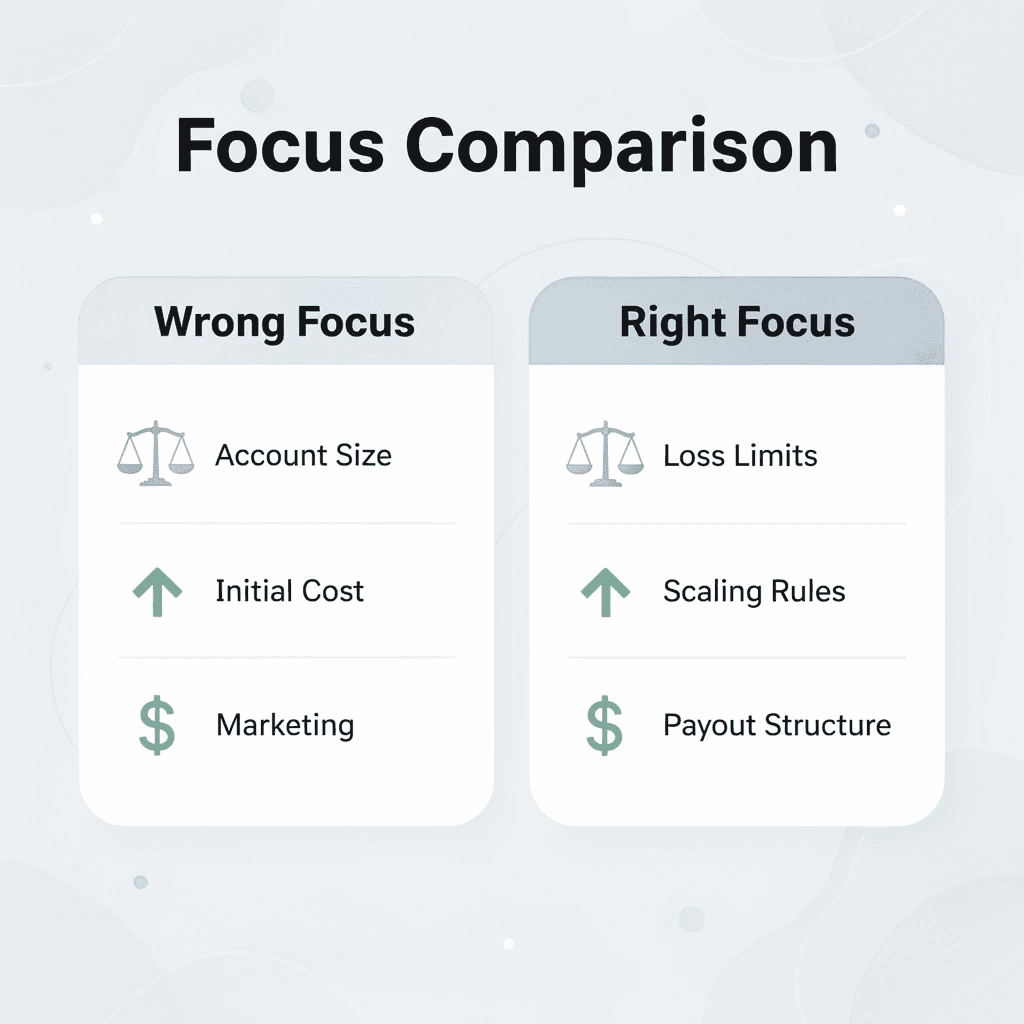
Traders often pick prop firms based on marketing headlines rather than how well the firm fits their needs. They focus on initial cost or account size while overlooking the rules that determine whether they can trade profitably within that structure.
⚠️ Warning: Don't fall for flashy marketing promises. The most important factors are often buried in the fine print - like daily loss limits, scaling requirements, and payout structures that can make or break your trading career.

What Traders Focus On | What They Should Focus On |
|---|---|
Account size | Daily loss limits |
Initial cost | Scaling requirements |
Marketing promises | Actual payout structure |
Challenge difficulty | Long-term sustainability |
"85% of traders fail prop firm challenges not because of skill, but because they chose firms with incompatible risk management rules for their trading style." — Prop Trading Research, 2024
🔑 Takeaway: The cheapest or largest account isn't always the best choice. Focus on finding a firm whose trading rules, risk parameters, and business model align with your specific trading approach and long-term goals.
Choosing a Firm Based Solely on the Lowest Fee
A $99 challenge looks better than a $179 challenge until you calculate the total cost. Traders attracted to low entry fees often overlook reset costs, activation fees, and the possibility of multiple attempts. According to the Velotrade Blog article "Why Traders Fail Prop Challenges," 90% of traders fail prop firm challenges due to rule violations rather than poor trading strategies. A trader who pays $99 three times plus two $50 resets has spent $347, while a $179 program with better rule alignment might have been passed on the first attempt.
Ignoring Payout Policies
Traders focus on profit splits in headlines but often overlook withdrawal eligibility, consistency requirements, and payout schedules that determine whether they can access their earnings. An 80% split sounds generous until you discover profits require $1,000 minimums, 30-day waiting periods, and consistency rules that disqualify payouts if any single day exceeds 40% of total profits. The real question isn't what percentage you keep, but how easily you can move money from the funded account to your bank account without arbitrary restrictions eroding the value of that split.
Selecting an Evaluation Program That Doesn't Fit Your Trading Style
Most traders choose a prop firm without considering whether the evaluation model suits their strategy. A scalper joining a program with trailing drawdowns and news trading restrictions has mismatched their edge with the funding path. Firms like Goat Funded Futures have removed common barriers (no activation fees, EOD drawdown calculations, no news trading restrictions) because traditional evaluation models penalize certain trading styles through rule design rather than performance assessment. When the program's constraints conflict with how you manage risk, failure becomes structural rather than a skill problem.
Focusing on Account Size Instead of Usable Risk
A $100,000 funded account sounds twice as valuable as a $50,000 account until you examine how much money you can use. If the larger account has a 4% max daily drawdown ($4,000) and the smaller account allows 6% ($3,000), the difference in practical risk capacity is modest, but the psychological pressure and scaling requirements differ significantly. The meaningful comparisons are usable risk per trade, how drawdowns are calculated, and whether position-sizing rules let you execute your strategy without constant rule-violation anxiety.
Related Reading
How To Pass A Prop Firm Challenge
Best Prop Firm For Beginners
Best Prop Firm For Swing Trading
How To Choose A Prop Firm
Best Prop Firm For Scalpers
Cheapest Prop Firm
How to Determine Which Futures Prop Firm Fits Your Trading Style
Start with your trading goals and work backward. The firm should support your existing trading style, not force you to change a profitable process to fit arbitrary rules.

🎯 Key Point: The best prop firm is one that amplifies your strengths rather than forcing you to adapt to restrictive parameters that conflict with your proven methodology.
"Successful traders don't change their winning strategies to fit a firm's rules – they find firms that accommodate their approach." — Trading Psychology Institute, 2024

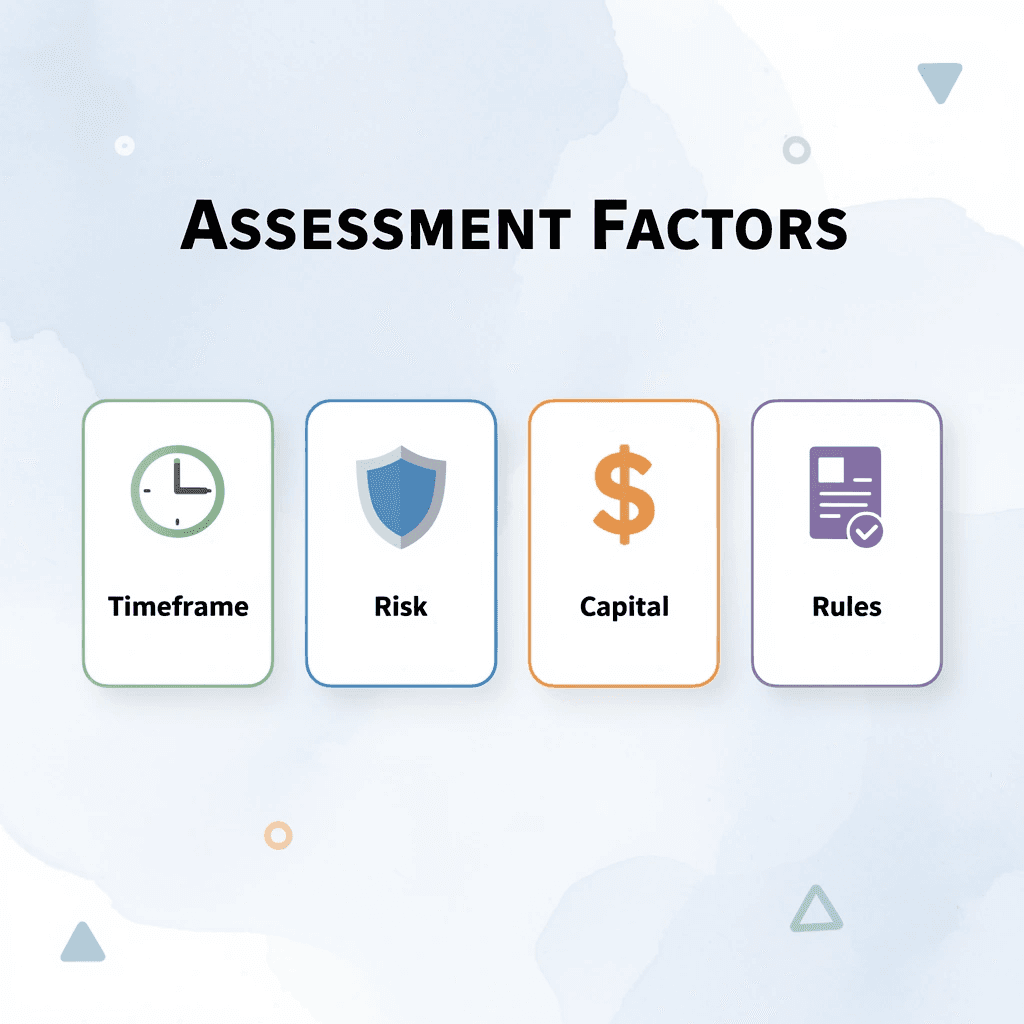
Assessment Factor | Questions to Ask |
|---|---|
Trading Timeframe | Does the firm support scalping, day trading, or swing trading? |
Risk Tolerance | Are drawdown limits compatible with your position sizing? |
Capital Requirements | Does account size match your profit targets? |
Market Access | Are your preferred instruments available for trading? |
⚠️ Warning: Never compromise on fundamental compatibility just because a firm offers attractive profit splits – misaligned rules will limit your performance and create unnecessary trading stress.
If You Want Structured Evaluation and Skill Development
Consider evaluation-based programs. For newer traders, consistency—rather than access to capital—is often the main challenge. Structured evaluations provide clear performance targets, risk parameters, and accountability, thereby developing disciplined execution habits and improving risk management.
If You Prefer End-of-Day Risk Management
Focus on EOD-style accounts. Risk is measured using the account balance at the end of the trading day, which suits traders who keep positions open throughout the day and want drawdown calculations that align with their trading process rather than constant intraday monitoring.
If You Want Faster Access to Capital
Look at instant funding options. Some traders have tested strategies, established risk management rules, and demonstrated consistent performance. For these traders, lengthy evaluation processes add little value. Instant funding programs enable them to trade with funded capital quickly and focus on improving performance, though they often have different cost structures or account requirements that are worth comparing.
What should you compare in payout structures?
Compare payout structures carefully. Many traders focus on challenge fees but overlook how much profit they retain. Consider profit-sharing percentages, payout eligibility requirements, withdrawal frequency, and scaling opportunities. World Business Outlook notes that while firms advertise an 80% profit split, the real question is how much of your trading performance you keep after fees, minimums, and eligibility rules are applied.
How do funding models create or remove obstacles?
Most prop firms create problems by charging activation fees, offering slow payout timelines, and setting trading rules that are incompatible with experienced traders' strategies. Platforms like Goat Funded Futures eliminate these issues: no activation fees after passing evaluations, guaranteed payouts within 2 business days with a $500 penalty for delays, and end-of-day drawdown flexibility, allowing traders to hold positions during news events. The difference lies in whether the funding model removes or creates obstacles.
How Goat Funded Futures Helps Traders Choose a Funding Model That Fits
Most prop firms offer one evaluation model and expect every trader to fit into it. Goat Funded Futures operates differently by providing multiple funding programs designed around different trading styles, risk preferences, and experience levels. A scalper managing 40 trades per session needs something fundamentally different from a swing trader holding positions overnight, and an experienced trader with a tested strategy shouldn't follow the same evaluation process as someone developing consistency.

🎯 Key Point: Goat Funded Futures recognizes that one-size-fits-all approaches fail because trading styles vary dramatically in execution frequency, risk tolerance, and time horizons.
"A scalper managing 40 trades per session needs something fundamentally different from a swing trader holding positions overnight." — Trading Style Analysis

💡 Tip: Before choosing a funding model, honestly assess your trading frequency, preferred timeframes, and risk management approach to ensure the program actually matches your natural trading style.
EOD Program for Traders Who Hold Positions Throughout the Day
The EOD Program calculates drawdown at the end of each trading session rather than tracking it intraday. For traders whose setups involve normal intraday fluctuations but close with controlled risk, this structure aligns with their trading approach. A position that drops $800 before recovering $1,200 by session close doesn't trigger a violation under EOD rules, though it might under a trailing drawdown model. This eliminates the conflict between your risk management approach and the firm's evaluation criteria.
Sprint Program for Traders Seeking an Alternative Evaluation Path
The Sprint Program gives traders another way to demonstrate their skills on a different timeline and structure, offering flexibility in how they prove consistency and qualify for funded opportunities with Goat Funded Futures.
Instant Funded Program for Traders Who Want Immediate Capital Access
Traders who have tested strategies, documented results, and refined risk management don't need lengthy evaluations. The Instant Funded Program provides immediate access to funded opportunities, eliminating delays between proving consistency and execution. Goat Funded Futures offers up to $2M in simulated trading capital for qualifying traders.
Pro Program for Traders Focused on Profit Retention
As traders become more consistent, keeping more of what they earn becomes as important as securing funding. The Pro Program is designed for experienced traders seeking better profit-sharing opportunities and long-term growth support. For traders at this stage, the difference between a 70% and 90% profit split represents thousands of dollars annually.
Solving Problems That Surface During Prop Firm Comparisons
The frustrations discussed throughout this article stem from rules, fees, and restrictions that traders discover only after starting a program.
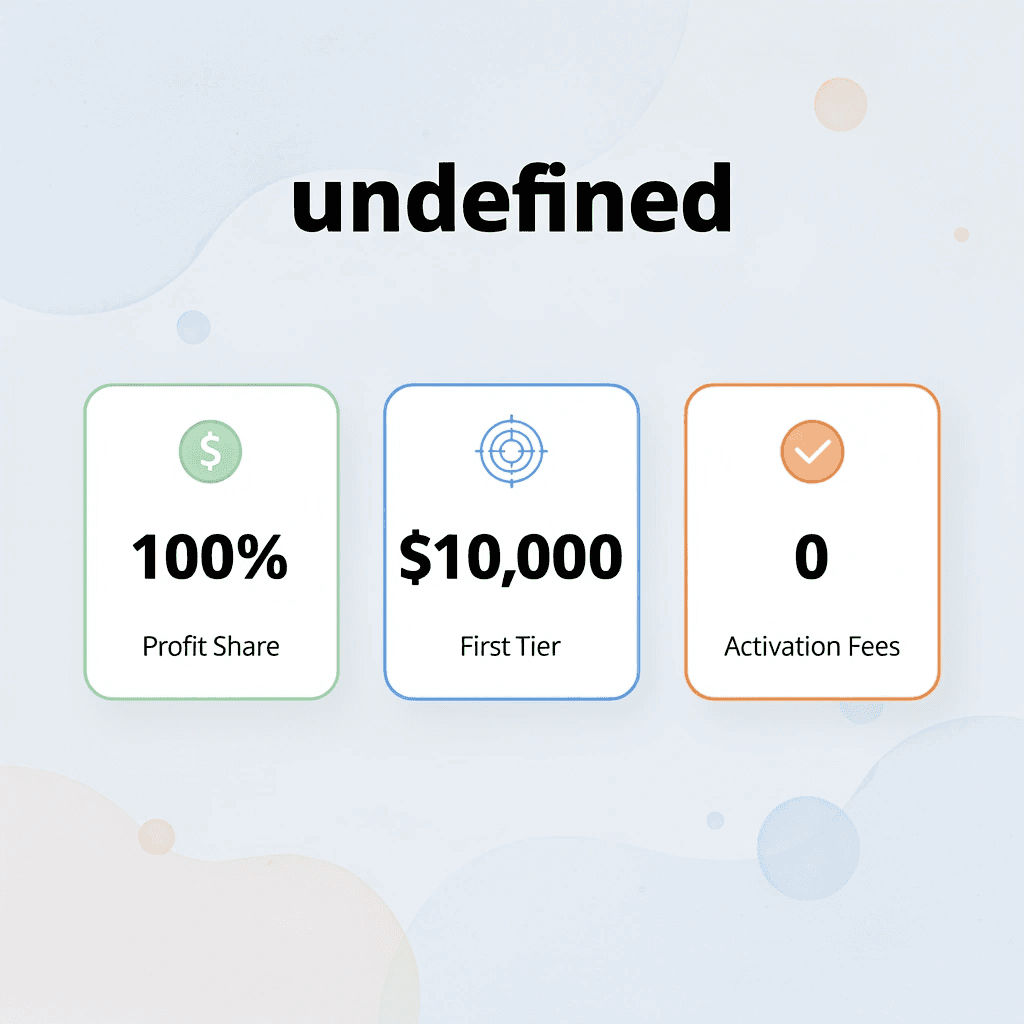
Goat Funded Futures addresses several of these concerns directly: no activation fee after passing evaluations, no required buffer before payouts, up to 100% profit share on the first $10,000 earned, and clear one-time fees. Our funding models let traders choose based on their needs—drawdown preference, evaluation timeline, and profit-sharing priority—rather than account size or marketing claims alone.
But understanding the options is useful only if you know what to do next.
Related Reading
Start Trading Futures Today with our Futures Prop Firm
You know what to look for in a prop firm, which structures create obstacles, and which features matter. The only question is whether you'll act on it or let another week pass trading with capital too small to build real momentum.

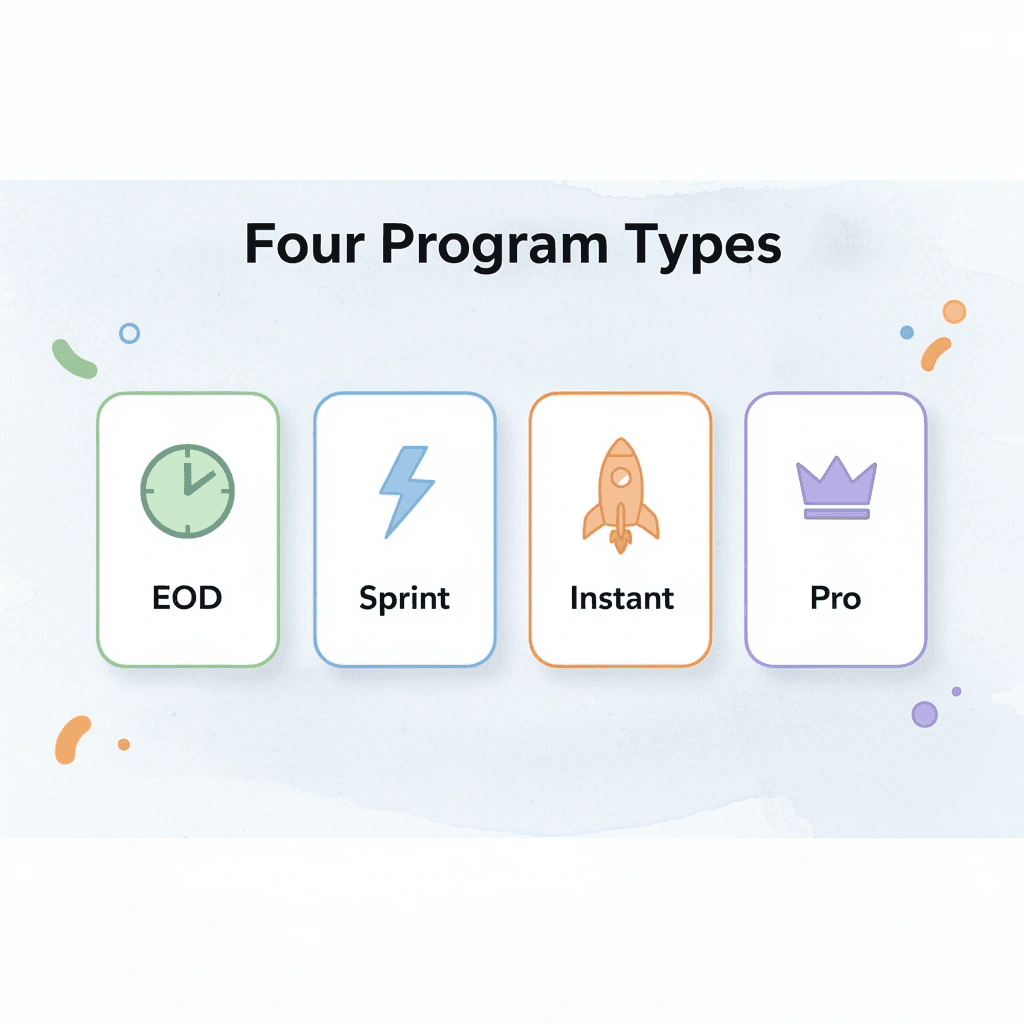
Start your Goat Funded Futures challenge today. Compare the EOD, Sprint, Instant Funded, and Pro programs side by side. In minutes, identify the funding model matching your approach to risk, capital access, and long-term growth. You're choosing the structure that removes obstacles instead of creating them.
🎯 Key Point: You'll see transparent one-time fees, no activation charges after passing, and 100% profit share on your first $10,000 earned. More importantly, you'll see which drawdown model fits how you actually trade—whether you need evaluation structure to build discipline or instant funding to deploy a proven strategy immediately.
"100% profit share on your first $10,000 earned sets Goat Funded apart from traditional prop firm structures that take cuts from day one." — Goat Funded Trader Benefits, 2024
Most traders spend months researching prop firms, then choose based on whichever ad they saw most recently. You understand what matters. The next step is selecting a program that aligns with your trading style, then proving you can execute it consistently with someone else's capital.
🔑 Takeaway: Your edge doesn't improve while you wait. The gap between knowing what to look for and accessing funded capital is just a decision. Make it today.